Editors Pick

Auto Added by WPeMatico

How to Build Portable, In-Database Feature Engineering Pipelines with Ibis Using Lazy Python APIs and DuckDB Execution

In this tutorial, we demonstrate how we use Ibis to build a portable, in-database feature engineering pipeline that looks and feels like Pandas but executes entirely inside the database. We show how we connect to DuckDB, register data safely inside the backend, and define complex transformations using window functions and aggregations without ever pulling raw […]

How to Build Portable, In-Database Feature Engineering Pipelines with Ibis Using Lazy Python APIs and DuckDB Execution Read More »

Stanford Researchers Build SleepFM Clinical: A Multimodal Sleep Foundation AI Model for 130+ Disease Prediction

A team of Stanford Medicine researchers have introduced SleepFM Clinical, a multimodal sleep foundation model that learns from clinical polysomnography and predicts long term disease risk from a single night of sleep. The research work is published in Nature Medicine and the team has released the clinical code as the open source sleepfm-clinical repository on

Stanford Researchers Build SleepFM Clinical: A Multimodal Sleep Foundation AI Model for 130+ Disease Prediction Read More »

A Coding Implementation to Build a Unified Apache Beam Pipeline Demonstrating Batch and Stream Processing with Event-Time Windowing Using DirectRunner

In this tutorial, we demonstrate how to build a unified Apache Beam pipeline that works seamlessly in both batch and stream-like modes using the DirectRunner. We generate synthetic, event-time–aware data and apply fixed windowing with triggers and allowed lateness to demonstrate how Apache Beam consistently handles both on-time and late events. By switching only the

A Coding Implementation to Build a Unified Apache Beam Pipeline Demonstrating Batch and Stream Processing with Event-Time Windowing Using DirectRunner Read More »

TII Abu-Dhabi Released Falcon H1R-7B: A New Reasoning Model Outperforming Others in Math and Coding with only 7B Params with 256k Context Window

Technology Innovation Institute (TII), Abu Dhabi, has released Falcon-H1R-7B, a 7B parameter reasoning specialized model that matches or exceeds many 14B to 47B reasoning models in math, code and general benchmarks, while staying compact and efficient. It builds on Falcon H1 7B Base and is available on Hugging Face under the Falcon-H1R collection. Falcon-H1R-7B is

TII Abu-Dhabi Released Falcon H1R-7B: A New Reasoning Model Outperforming Others in Math and Coding with only 7B Params with 256k Context Window Read More »

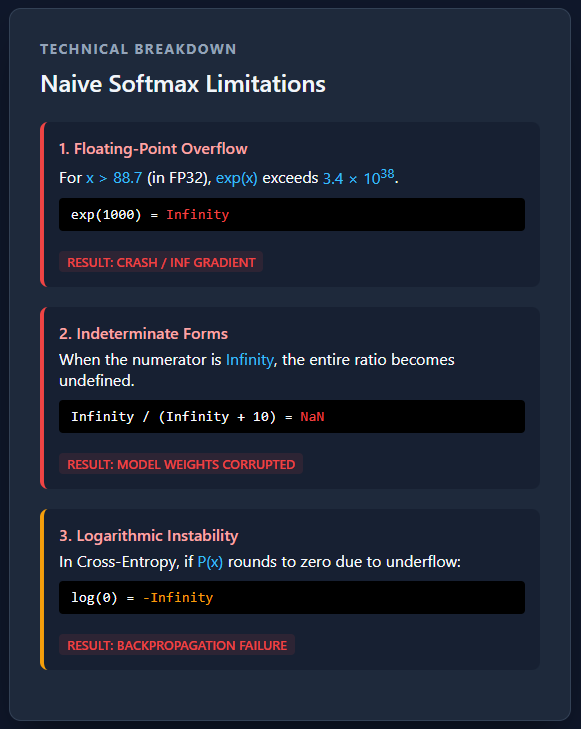
Implementing Softmax From Scratch: Avoiding the Numerical Stability Trap

In deep learning, classification models don’t just need to make predictions—they need to express confidence. That’s where the Softmax activation function comes in. Softmax takes the raw, unbounded scores produced by a neural network and transforms them into a well-defined probability distribution, making it possible to interpret each output as the likelihood of a specific

Implementing Softmax From Scratch: Avoiding the Numerical Stability Trap Read More »

NVIDIA AI Released Nemotron Speech ASR: A New Open Source Transcription Model Designed from the Ground Up for Low-Latency Use Cases like Voice Agents

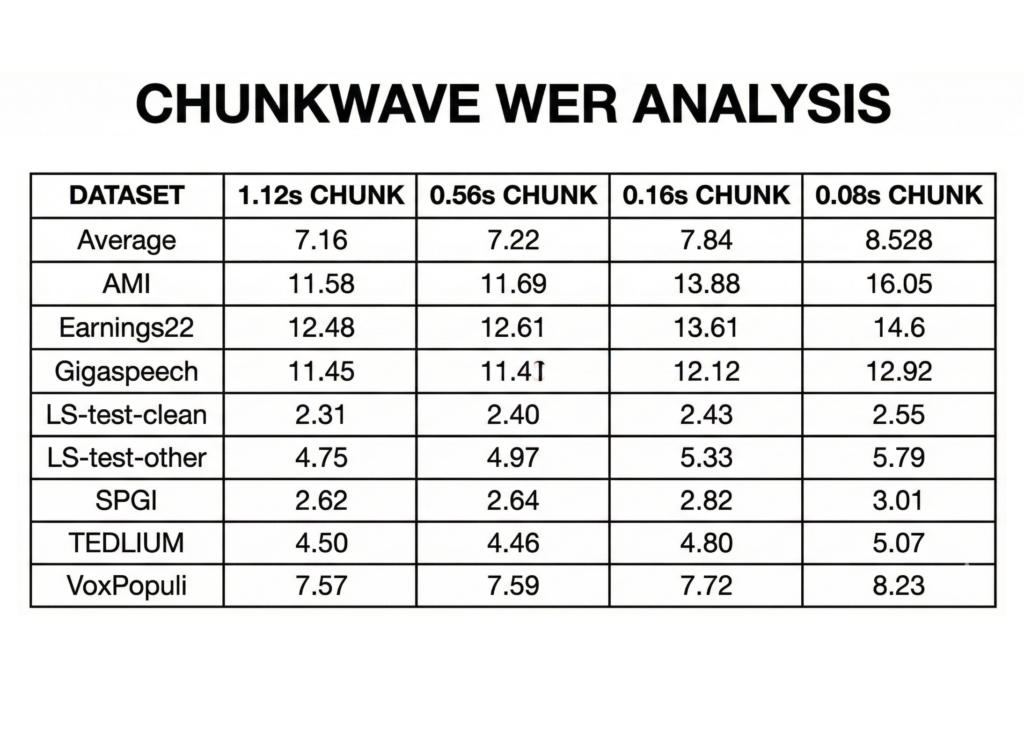
NVIDIA has just released its new streaming English transcription model (Nemotron Speech ASR) built specifically for low latency voice agents and live captioning. The checkpoint nvidia/nemotron-speech-streaming-en-0.6b on Hugging Face combines a cache aware FastConformer encoder with an RNNT decoder, and is tuned for both streaming and batch workloads on modern NVIDIA GPUs. Model design, architecture

NVIDIA AI Released Nemotron Speech ASR: A New Open Source Transcription Model Designed from the Ground Up for Low-Latency Use Cases like Voice Agents Read More »

How to Design an Agentic AI Architecture with LangGraph and OpenAI Using Adaptive Deliberation, Memory Graphs, and Reflexion Loops

In this tutorial, we build a genuinely advanced Agentic AI system using LangGraph and OpenAI models by going beyond simple planner, executor loops. We implement adaptive deliberation, where the agent dynamically decides between fast and deep reasoning; a Zettelkasten-style agentic memory graph that stores atomic knowledge and automatically links related experiences; and a governed tool-use

How to Design an Agentic AI Architecture with LangGraph and OpenAI Using Adaptive Deliberation, Memory Graphs, and Reflexion Loops Read More »

Liquid AI Releases LFM2.5: A Compact AI Model Family For Real On Device Agents

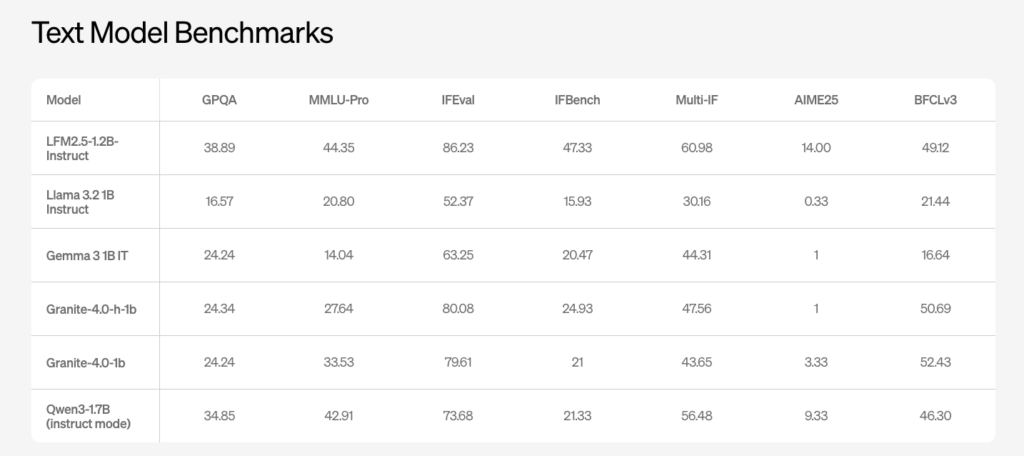
Liquid AI has introduced LFM2.5, a new generation of small foundation models built on the LFM2 architecture and focused at on device and edge deployments. The model family includes LFM2.5-1.2B-Base and LFM2.5-1.2B-Instruct and extends to Japanese, vision language, and audio language variants. It is released as open weights on Hugging Face and exposed through the

Liquid AI Releases LFM2.5: A Compact AI Model Family For Real On Device Agents Read More »

Marktechpost Releases ‘AI2025Dev’: A Structured Intelligence Layer for AI Models, Benchmarks, and Ecosystem Signals

Marktechpost has released AI2025Dev, its 2025 analytics platform (available to AI Devs and Researchers without any signup or login) designed to convert the year’s AI activity into a queryable dataset spanning model releases, openness, training scale, benchmark performance, and ecosystem participants. Marktechpost is a California based AI news platform covering machine learning, deep learning, and

Marktechpost Releases ‘AI2025Dev’: A Structured Intelligence Layer for AI Models, Benchmarks, and Ecosystem Signals Read More »

A Coding Guide to Design and Orchestrate Advanced ReAct-Based Multi-Agent Workflows with AgentScope and OpenAI

In this tutorial, we build an advanced multi-agent incident response system using AgentScope. We orchestrate multiple ReAct agents, each with a clearly defined role such as routing, triage, analysis, writing, and review, and connect them through structured routing and a shared message hub. By integrating OpenAI models, lightweight tool calling, and a simple internal runbook,

A Coding Guide to Design and Orchestrate Advanced ReAct-Based Multi-Agent Workflows with AgentScope and OpenAI Read More »