
Robotics

Auto Added by WPeMatico

Clearing up a robot’s fuzzy memory

In an emergency, a human might someday ask a robotic assistant to fetch a wall-mounted defibrillator located down the hall. But if the robot has incorrectly labeled the defibrillator as a fire extinguisher in its stored memory, it may not know where to find the life-saving device.This robotic assistant could benefit from a new memory
Clearing up a robot’s fuzzy memory Read More »

Meet Kyutai REKI: The 2.4B VLA Model Bringing Efficient Memory to Robot Manipulation

Kyutai, with Inria and École des Ponts, has released REKI, a 2.4B vision-language-action model (VLA) for robot manipulation. The REKI vision-language-action model is pretrained only on public data. It also carries a cheap memory of its recent past. On three out-of-distribution benchmarks, only models about twice its size beat it. All weights are live on

Meet Kyutai REKI: The 2.4B VLA Model Bringing Efficient Memory to Robot Manipulation Read More »

Building a Streaming Robotics Learning Pipeline Using NVIDIA Cosmos3-DROID

In this tutorial, we design an end-to-end streaming robotics learning pipeline around the NVIDIA Cosmos3-DROID dataset without downloading its 707 GB repository locally. We first introspect the LeRobotDataset v3.0 structure and construct a metadata graph from info.json, task metadata, episode tables, and dataset statistics, then use HTTP byte-range access with PyArrow to selectively read Parquet

Building a Streaming Robotics Learning Pipeline Using NVIDIA Cosmos3-DROID Read More »

Inside NVIDIA’s IsaacTeleop: From Hand and Controller Tracking to Robot Actions with the Graph-Based Retargeting Engine

In this tutorial, we work through the retargeting engine at the core of NVIDIA IsaacTeleop, the framework that turns XR hand tracking and motion-controller input into commands for simulated and real robots. Rather than plugging in a headset, we build every input ourselves in NumPy, so each step runs on a plain Colab CPU and

Inside NVIDIA’s IsaacTeleop: From Hand and Controller Tracking to Robot Actions with the Graph-Based Retargeting Engine Read More »

Computational tools for society’s most complex challenges

As far back as she can remember, Cathy Wu ’12, MNG ’13 wanted to find ways to solve problems to improve people’s lives. Her parents were Taiwanese immigrants, and her father had a long commute to his job, which took him away from the family. On a tight budget, the rest of the family often

Computational tools for society’s most complex challenges Read More »

NVIDIA Researchers Introduce Physis-Lang: Self-Evolving Physical Language That Lifts Cosmos 3 Past Veo 3.1 on Physics Benchmarks

Video world models can render convincing clips that still break physics. Butter spreads like paint. Balls pass through walls. A team from NVIDIA, MIT and the University of Oxford argues the fix can come from language itself, not from extra visual, latent or numerical signals. Their framework, Physis-Lang, treats physical language as a shared, optimizable

NVIDIA Researchers Introduce Physis-Lang: Self-Evolving Physical Language That Lifts Cosmos 3 Past Veo 3.1 on Physics Benchmarks Read More »

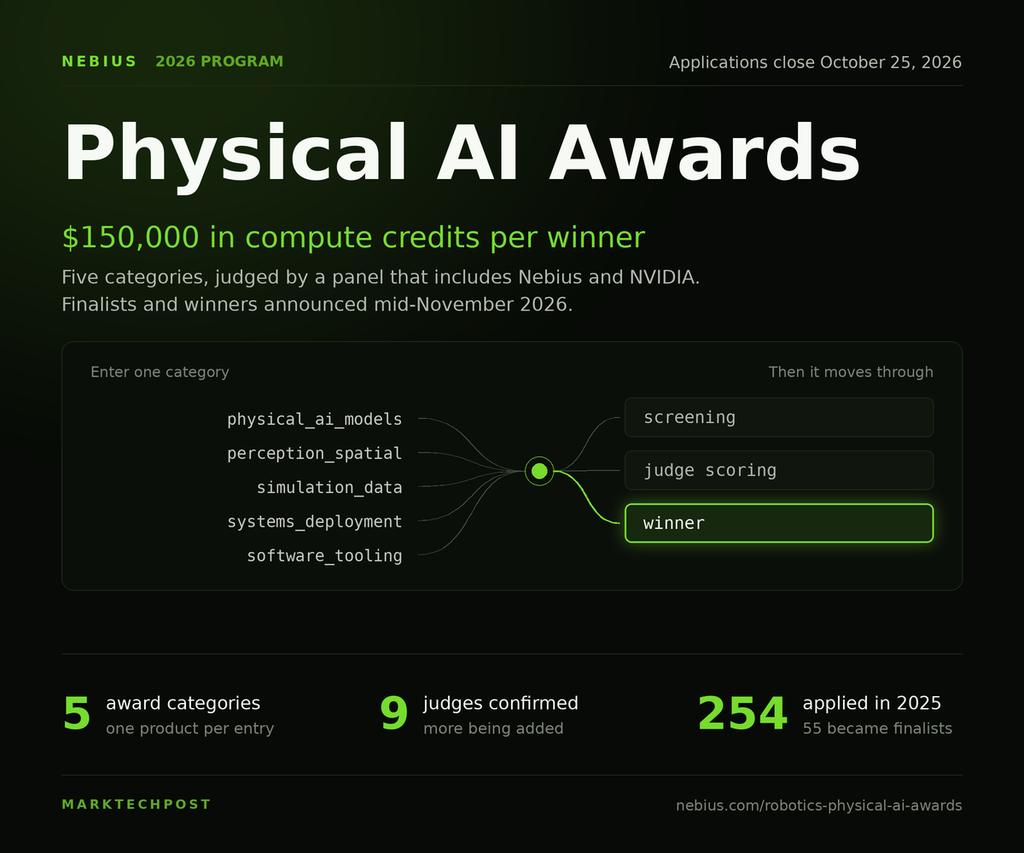
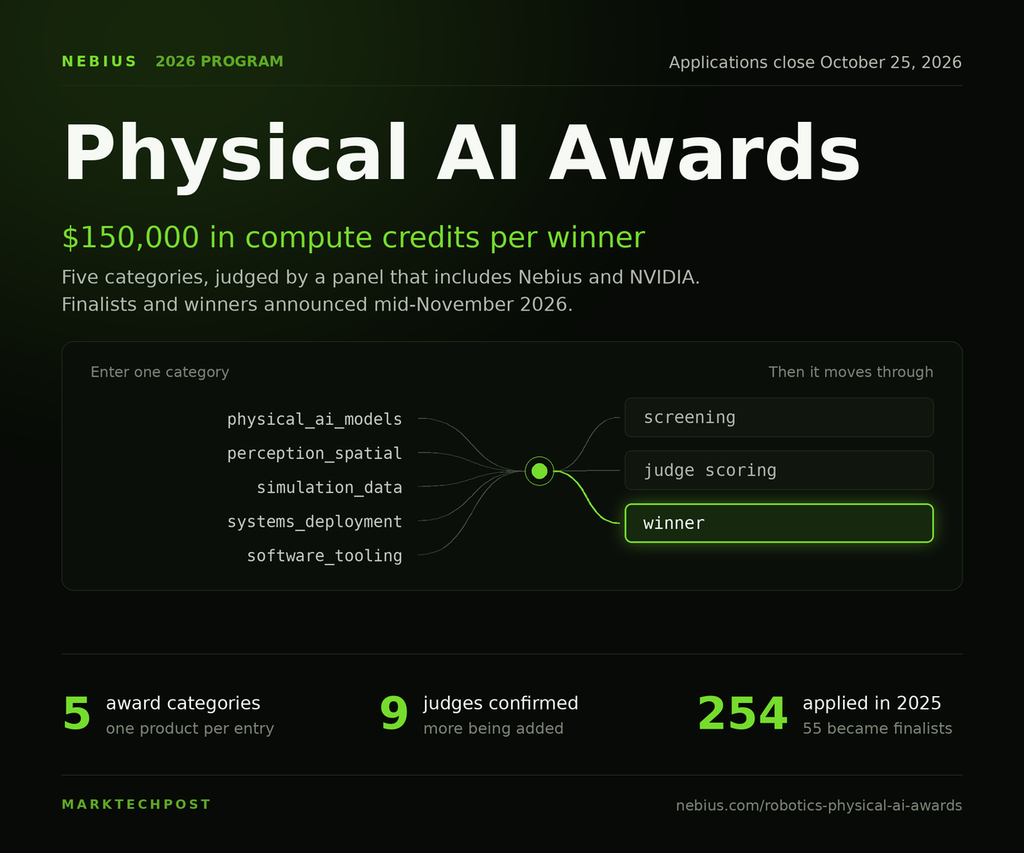
Nebius Opens 2026 Physical AI Awards: Five $150K Compute Credit Prizes

Once a physical AI product is in the field, the compute problem changes shape. Fleet data starts arriving faster than a team can label it, every retraining cycle has to be validated before it ships to hardware, and the sim-to-real loop stops being a research exercise and becomes a release process. That is the stage

Nebius Opens 2026 Physical AI Awards: Five $150K Compute Credit Prizes Read More »

Nebius Opens 2026 Physical AI Awards: Five $150K Compute Prizes, Nine Judges, and an October 25 Deadline

Once a physical AI product is in the field, the compute problem changes shape. Fleet data starts arriving faster than a team can label it, every retraining cycle has to be validated before it ships to hardware, and the sim-to-real loop stops being a research exercise and becomes a release process. That is the stage

Nebius Opens 2026 Physical AI Awards: Five $150K Compute Prizes, Nine Judges, and an October 25 Deadline Read More »

Black Forest Labs Releases FLUX 3 Action: A 7B Open-Weights World Action Model That Tops RoboLab-120

Black Forest Labs (BFL), the lab behind the FLUX image models, has released FLUX 3 Action. It is a 7B open-weights World Action Model (WAM) for robot control. The model reads camera frames, robot state and a text instruction. It then predicts future video frames and the next chunk of actions together. On the RoboLab-120

Black Forest Labs Releases FLUX 3 Action: A 7B Open-Weights World Action Model That Tops RoboLab-120 Read More »

Banner for AI & Big Data Expo by TechEx events.

Toyota’s $6.4bn robotics estimate puts physical AI in focus

Toyota Motor estimates that expanding automation across its factories, group companies, and major suppliers could require around 400,000 robots and annual spending of about 1 trillion yen ($6.4 billion) from 2028. The potential investment was discussed with investors earlier in September, according to Reuters. Toyota has not said whether the full investment will proceed or

Toyota’s $6.4bn robotics estimate puts physical AI in focus Read More »
