Data Engineering & MLOps

Auto Added by WPeMatico

Banner for the AI & Big Data Expo event series.

ChatGPT pioneer launches Jev model for programmatic logic

TypeSafe, founded by a ChatGPT co-inventor, has left stealth and is launching its Jev model to automate programmatic decisions with parallel sampling architecture. Software systems requiring automated deterministic logic can now bypass conversational language models following TypeSafe AI’s release of Jev, a specialised System One Model designed to execute structured probabilistic decisions directly inside production […]

ChatGPT pioneer launches Jev model for programmatic logic Read More »

Accuracy score results for the post-trained NVIDIA Nemotron 3.5 Lightning AI model.

Palantir Foundry and cuOpt drive NVIDIA supply chain allocation

NVIDIA is using Palantir Foundry and cuOpt to automate its hardware supply chain allocation decisions across global manufacturing sites. The company measures operational delivery from wafer-out to first token. This window splits into time-to-rack (the transit from fab output to an assembled data centre system) and time-to-token (which covers power, cooling, networking, and day-one software

Palantir Foundry and cuOpt drive NVIDIA supply chain allocation Read More »

Banner for the AI & Big Data Expo event series.

Samsung taps Mistral AI models for semiconductor manufacturing

Samsung has partnered with Mistral AI to deploy on-premises models across its semiconductor manufacturing and engineering operations. The agreement was announced during the bilateral state summit held in Paris between South Korea and France. Samsung will integrate Mistral’s software suite – including its flagship Mistral Large model – into internal semiconductor facilities to build customised

Samsung taps Mistral AI models for semiconductor manufacturing Read More »

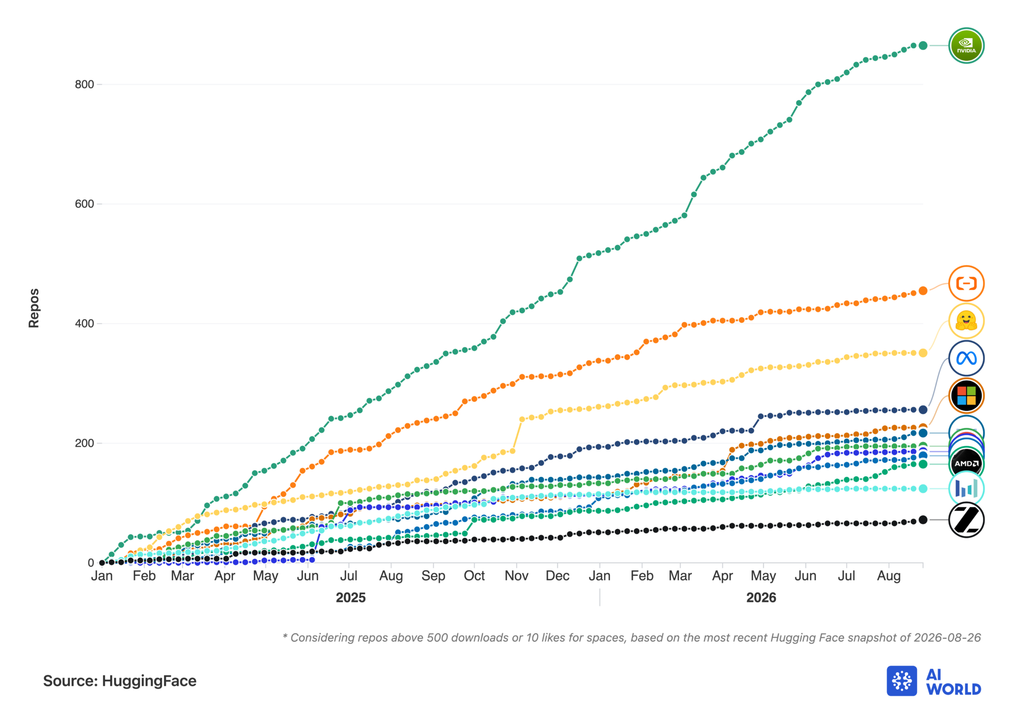
Chart showing NVIDIA contributions to Hugging Face compared to rivals.

NVIDIA to acquire Hugging Face for $12.93B

NVIDIA has agreed to acquire Hugging Face for $12.93 billion to scale the open-source model repository’s platform and infrastructure. The transaction targets platform growth and infrastructure investment, aiming to expand AI access for enterprise developers, software engineers, and research institutions globally. Built over the past decade by Clem Delangue, Julien Chaumond, Thomas Wolf, and their

NVIDIA to acquire Hugging Face for $12.93B Read More »

Banner for the AI & Big Data Expo event series.

Motional and MIT AI explains self-driving car decisions

Motional and MIT researchers have built a system that lets self-driving cars explain their decisions in real-time, tackling the black-box problem in autonomous vehicle AI. The work, published in Nature, comes from a team at Motional that includes CEO Laura Major, working alongside researchers from MIT’s Computer Science and Artificial Intelligence Laboratory. Their proposed method,

Motional and MIT AI explains self-driving car decisions Read More »

Banner for the AI & Big Data Expo event series.

MIT AI forecasts extreme weather without historical data

MIT engineers have built an AI tool that forecasts extreme weather without training on historical disaster data. Kai Chang, a mechanical engineering graduate student, and Professor Themis Sapsis developed the tool. It produces maps of events that have not appeared in a region’s historical record but remain statistically-possible. Each map also carries estimates of the

MIT AI forecasts extreme weather without historical data Read More »

Banner for the AI & Big Data Expo event series.

OpenAI president urges enterprises to hasten AI security defences

OpenAI president and co-founder Greg Brockman warns that enterprise security teams face a compressed timeline to adopt AI defences. Brockman has published an account of what the company calls the “OpenAI-Hugging Face” incident, using it to argue that organisations need to uplevel their security practices with what he terms unprecedented speed. He writes that he

OpenAI president urges enterprises to hasten AI security defences Read More »

Banner for the AI & Big Data Expo event series.

Okta targets AI agent token costs with MCP scoping

Okta says identity-scoped Model Context Protocol (MCP) tool lists can reduce AI agent token costs. Each model call made by an AI agent can include schemas, names, descriptions and parameters for every tool exposed by a MCP server. Okta calls the resulting prompt overhead the “tool tax”: tokens consumed as a model considers tools, including

Okta targets AI agent token costs with MCP scoping Read More »

Banner for the AI & Big Data Expo event series.

PRISM2 model uses clinical dialogue to interpret pathology slides

Built by Paige and Microsoft, PRISM2 reads whole-slide images through a perceiver-based encoder trained jointly on tissue tiles and clinical dialogue drawn from pathology reports. The model aggregates thousands of tile embeddings per slide into one representation, then generates text that answers diagnostic questions rather than simply classifying pixels.  Training data spans 2.3 million whole-slide

PRISM2 model uses clinical dialogue to interpret pathology slides Read More »

Banner for the AI & Big Data Expo event series.

Red Hat, NVIDIA, IBM back project turning AI policy into code

Red Hat has launched asago, an open-source community project that aims to turn AI governance policy into production-ready deployment code. The project describes itself as an automated, auditable workflow that connects the “fragmented steps, tools, and requirements” of engineering and compliance teams. With regulation such as the EU AI Act now taking effect, Red Hat

Red Hat, NVIDIA, IBM back project turning AI policy into code Read More »