OCR

Auto Added by WPeMatico

A Coding Guide to Build Advanced Document Intelligence Pipelines with Google LangExtract, OpenAI Models, Structured Extraction, and Interactive Visualization

In this tutorial, we explore how to use Google’s LangExtract library to transform unstructured text into structured, machine-readable information. We begin by installing the required dependencies and securely configuring our OpenAI API key to leverage powerful language models for extraction tasks. Also, we will build a reusable extraction pipeline that enables us to process a […]

A Coding Guide to Build Advanced Document Intelligence Pipelines with Google LangExtract, OpenAI Models, Structured Extraction, and Interactive Visualization Read More »

TII Releases Falcon Perception: A 0.6B-Parameter Early-Fusion Transformer for Open-Vocabulary Grounding and Segmentation from Natural Language Prompts

In the current landscape of computer vision, the standard operating procedure involves a modular ‘Lego-brick’ approach: a pre-trained vision encoder for feature extraction paired with a separate decoder for task prediction. While effective, this architectural separation complicates scaling and bottlenecks the interaction between language and vision. The Technology Innovation Institute (TII) research team is challenging

TII Releases Falcon Perception: A 0.6B-Parameter Early-Fusion Transformer for Open-Vocabulary Grounding and Segmentation from Natural Language Prompts Read More »

IBM Releases Granite 4.0 3B Vision: A New Vision Language Model for Enterprise Grade Document Data Extraction

IBM has announced the release of Granite 4.0 3B Vision, a vision-language model (VLM) engineered specifically for enterprise-grade document data extraction. Departing from the monolithic approach of larger multimodal models, the 4.0 Vision release is architected as a specialized adapter designed to bring high-fidelity visual reasoning to the Granite 4.0 Micro language backbone. This release

IBM Releases Granite 4.0 3B Vision: A New Vision Language Model for Enterprise Grade Document Data Extraction Read More »

Alibaba Qwen Team Releases Qwen3.5 Omni: A Native Multimodal Model for Text, Audio, Video, and Realtime Interaction

The landscape of multimodal large language models (MLLMs) has shifted from experimental ‘wrappers’—where separate vision or audio encoders are stitched onto a text-based backbone—to native, end-to-end ‘omnimodal’ architectures. Alibaba Qwen team latest release, Qwen3.5-Omni, represents a significant milestone in this evolution. Designed as a direct competitor to flagship models like Gemini 3.1 Pro, the Qwen3.5-Omni

Alibaba Qwen Team Releases Qwen3.5 Omni: A Native Multimodal Model for Text, Audio, Video, and Realtime Interaction Read More »

LlamaIndex Releases LiteParse: A CLI and TypeScript-Native Library for Spatial PDF Parsing in AI Agent Workflows

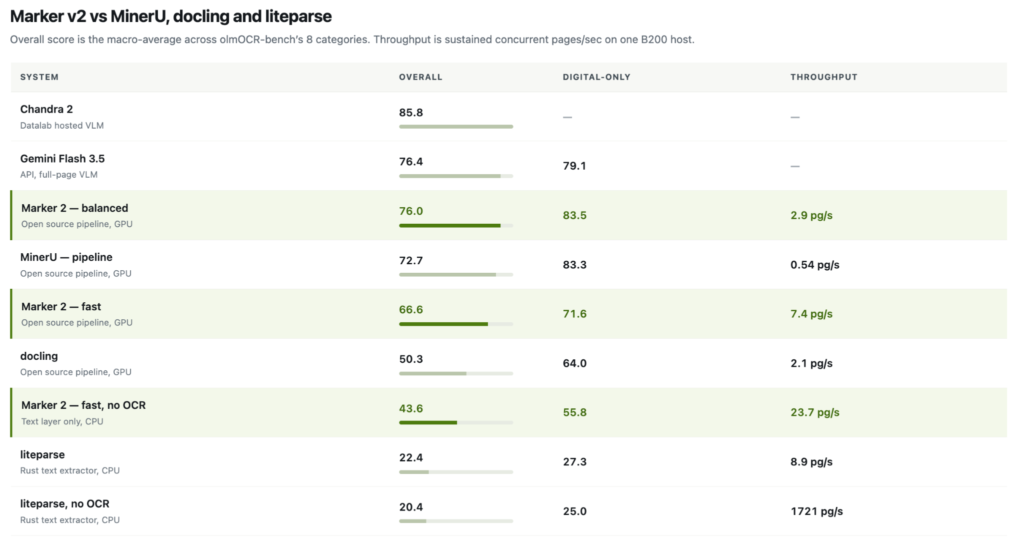
In the current landscape of Retrieval-Augmented Generation (RAG), the primary bottleneck for developers is no longer the large language model (LLM) itself, but the data ingestion pipeline. For software developers, converting complex PDFs into a format that an LLM can reason over remains a high-latency, often expensive task. LlamaIndex has recently introduced LiteParse, an open-source,

LlamaIndex Releases LiteParse: A CLI and TypeScript-Native Library for Spatial PDF Parsing in AI Agent Workflows Read More »

Baidu Qianfan Team Releases Qianfan-OCR: A 4B-Parameter Unified Document Intelligence Model

The Baidu Qianfan Team introduced Qianfan-OCR, a 4B-parameter end-to-end model designed to unify document parsing, layout analysis, and document understanding within a single vision-language architecture. Unlike traditional multi-stage OCR pipelines that chain separate modules for layout detection and text recognition, Qianfan-OCR performs direct image-to-Markdown conversion and supports prompt-driven tasks like table extraction and document question

Baidu Qianfan Team Releases Qianfan-OCR: A 4B-Parameter Unified Document Intelligence Model Read More »

New “vibe coded” AI translation tool splits the video game preservation community

Since Andrej Karpathy coined the term “vibe coding” just over a year ago, we’ve seen a rapid increase in both the capabilities and popularity of using AI models to throw together quick programming projects with less human time and effort than ever before. One such vibe-coded project, Gaming Alexandria Researcher, launched over the weekend as

New “vibe coded” AI translation tool splits the video game preservation community Read More »

Zhipu AI Introduces GLM-OCR: A 0.9B Multimodal OCR Model for Document Parsing and Key Information Extraction (KIE)

Why Document OCR Still Remains a Hard Engineering Problem? What does it take to make OCR useful for real documents instead of clean demo images? And can a compact multimodal model handle parsing, tables, formulas, and structured extraction without turning inference into a resource bonfire? That is the problem targeted by GLM-OCR, introduced by researchers

Zhipu AI Introduces GLM-OCR: A 0.9B Multimodal OCR Model for Document Parsing and Key Information Extraction (KIE) Read More »

FireRedTeam Releases FireRed-OCR-2B Utilizing GRPO to Solve Structural Hallucinations in Tables and LaTeX for Software Developers

Document digitization has long been a multi-stage problem: first detect the layout, then extract the text, and finally try to reconstruct the structure. For Large Vision-Language Models (LVLMs), this often leads to ‘structural hallucinations’—disordered rows, invented formulas, or unclosed syntax. The FireRedTeam has released FireRed-OCR-2B, a flagship model designed to treat document parsing as a

FireRedTeam Releases FireRed-OCR-2B Utilizing GRPO to Solve Structural Hallucinations in Tables and LaTeX for Software Developers Read More »

What Is Liveness Detection and Biometric Spoofing?

If you rely on biometrics for onboarding or authentication, liveness detection (also called presentation attack detection, PAD) is critical to stop biometric spoofing—from printed photos and screen replays to 3D masks and deepfakes. Done right, liveness detection proves there’s a live human at the sensor before any recognition or matching occurs.  Quick Answer: How Liveness

What Is Liveness Detection and Biometric Spoofing? Read More »