
Quality Engineering

Auto Added by WPeMatico

Code Abundance, Operational Scarcity: Why AI-Generated Software Is Creating a New CIO Bottleneck

TL;DR AI coding tools are reducing the effort required to produce software, but they are not removing the work required to make software safe, supportable, observable, and valuable. The constraint is moving downstream into architecture review, test design, security analysis, release governance, documentation, production operations, and cost control. CIOs should not treat lines of code, […]

Code Abundance, Operational Scarcity: Why AI-Generated Software Is Creating a New CIO Bottleneck Read More »

From Traditional QA to AI Assurance and Governance

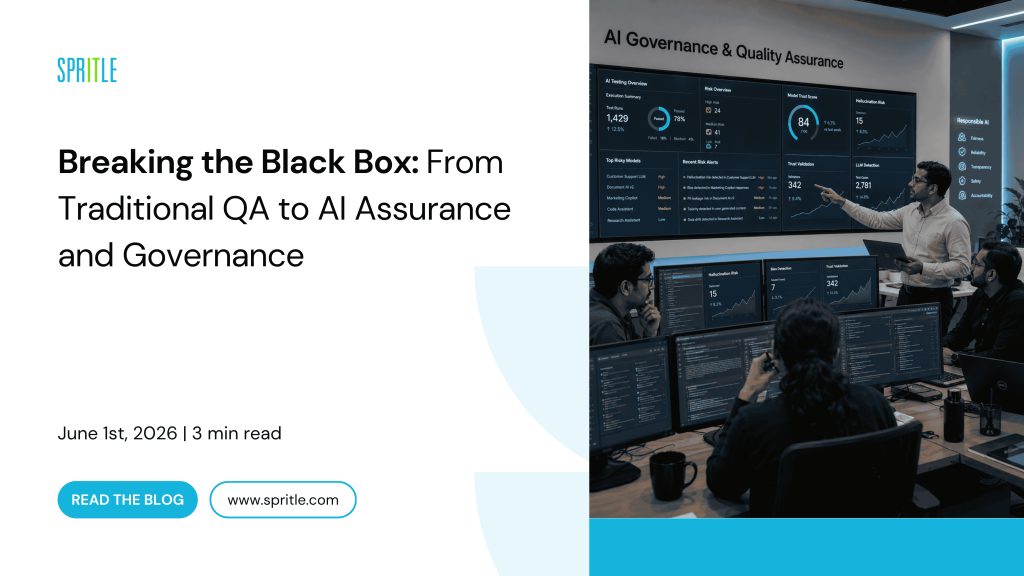
Breaking the Black Box: From Traditional QA to AI Assurance and Governance

I recently had the opportunity to review IMDA’s Starter Kit for Testing LLM-Based Applications for Safety and Reliability. As someone who has spent over 14 years in Quality Assurance, I was curious to see how established testing principles are being adapted to address the unique challenges introduced by Large Language Models (LLMs). What I expected

Breaking the Black Box: From Traditional QA to AI Assurance and Governance Read More »

Breaking the Black Box: From Traditional QA to AI Assurance and Governance

Testing for Trust: What IMDA’s LLM Testing Starter Kit Teaches Us At Spritle About AI Assurance

Breaking the Black Box: From Traditional QA to AI Assurance and Governance I recently had the opportunity to review IMDA’s Starter Kit for Testing LLM-Based Applications for Safety and Reliability. As someone who has spent over 14 years in Quality Assurance, I was curious to see how established testing principles are being adapted to address

Testing for Trust: What IMDA’s LLM Testing Starter Kit Teaches Us At Spritle About AI Assurance Read More »

From Physical AI to AI-Augmented QA:  The Next Evolution of Testing

Many of you may already be familiar with Physical AI — the evolution of artificial intelligence from purely digital intelligence to systems that understand and interact with the real world. Physical AI enables machines to: Understand physical environments Adapt to real-world conditions Make autonomous decisions Execute actions in dynamic systems This shift — from information

From Physical AI to AI-Augmented QA:  The Next Evolution of Testing Read More »