Harness

Auto Added by WPeMatico

Nace AI Open-Sources Drex 1.5: A 9B Decision Model That Scores Options, Not Text

Nace.AI has open-sourced Drex 1.5, a 9B decision model for agents and backend workflows. The Drex 1.5 decision model does not write text. It reads a state and typed questions, then returns a probability for every option. Nace reports 58.08 on the public Decision Index 0.3.1, the top score under 10B parameters. Weights are on

Nace AI Open-Sources Drex 1.5: A 9B Decision Model That Scores Options, Not Text Read More »
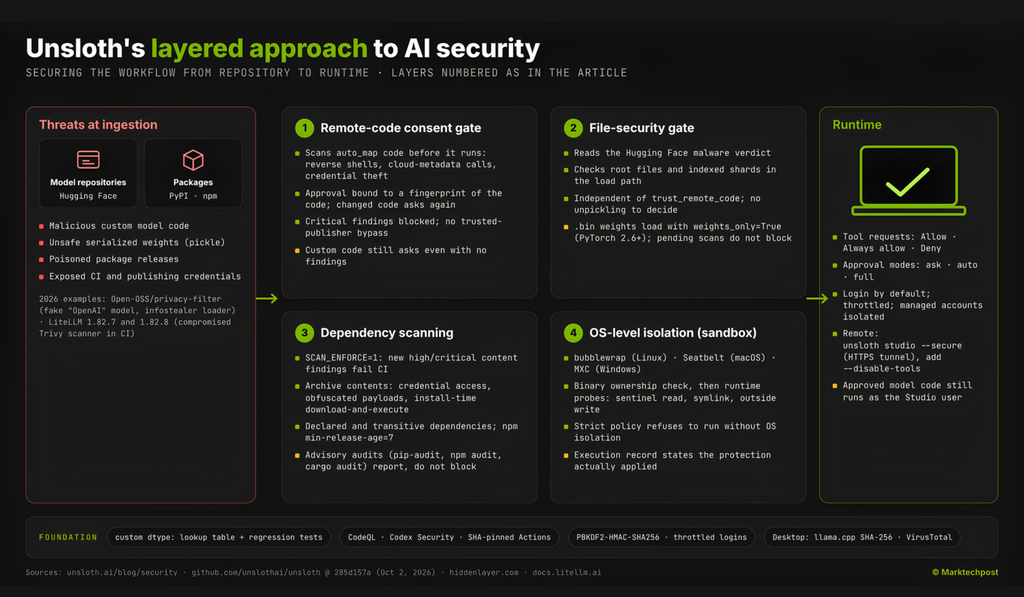
What Happens When a Trusted Model Repo Changes? Unsloth Studio Re-Checks Before It Runs

Beta Lessons Learned After over 500 million downloads, years of requests from the open-source community, and being a top product on Hugging Face, Unsloth launched their beta desktop App, Unsloth Studio. Unsloth which makes it faster, easier, and more affordable to fine-tune and run AI models, including locally on your own hardware. The app centralizes

What Happens When a Trusted Model Repo Changes? Unsloth Studio Re-Checks Before It Runs Read More »

Anthropic Releases Claude Haiku 5.5: A Small Model With 1M Context Priced at $0.10 per Million Input Tokens

Anthropic has released Claude Haiku 5.5, its cheapest and fastest small model to date. It targets high-volume work like summaries, compaction, classification and subagent tasks. It keeps a 1M token context window and up to 128K output tokens. Pricing starts at $0.10 per million input tokens and $0.50 per million output tokens. That is 90%

Anthropic Releases Claude Haiku 5.5: A Small Model With 1M Context Priced at $0.10 per Million Input Tokens Read More »

Reflection AI Introduces Beam: A 501B Open-Weight MoE Model With 23B Active Parameters for Coding and Agentic Workloads

Reflection AI has introduced Beam, its first open-weight model. Beam is a sparse Mixture-of-Experts (MoE) model with 501B total parameters and 23B active per token, built for coding, reasoning and agentic workloads. As per the Reflection AI team, Beam directly competes with larger open models like GLM 5.2 while using 3 to 4x less inference

Reflection AI Introduces Beam: A 501B Open-Weight MoE Model With 23B Active Parameters for Coding and Agentic Workloads Read More »

GPT-6 Astra vs GPT-6.1 Sol vs Gemini 4 Argon vs Claude Fable 5.1: Which Frontier Model Fits Which Job

Anthropic, OpenAI and Google DeepMind shipped 4 frontier-class models within 30 days. Claude Fable 5.1 arrived on September 1. GPT-6 Astra followed on September 3. GPT-6.1 Sol and Gemini 4 Argon landed in the last days of September. We covered each launch on its own. This piece puts them side by side. The benchmark scores

GPT-6 Astra vs GPT-6.1 Sol vs Gemini 4 Argon vs Claude Fable 5.1: Which Frontier Model Fits Which Job Read More »

Cloudflare Releases Clef and Clef-flash: Open-Weight Decision Models That Return Typed Probabilities Instead of Text

Cloudflare has released Clef and Clef-flash, the first models trained by its Workers AI team. They are decision models, not chatbots. Each reads an input state and a schema of typed questions. It returns a probability for every allowed answer, with no free-form text. Both are open-weight under Apache 2.0 and compatible with TypeSafe AI’s

Cloudflare Releases Clef and Clef-flash: Open-Weight Decision Models That Return Typed Probabilities Instead of Text Read More »

Google DeepMind Unveils Gemini 4 Argon with 1M Output Tokens for Coding, Knowledge Work and Cyber Defense

Google DeepMind has just announced Gemini 4 Argon, its new frontier model and the first model of the Gemini 4 generation. It targets long-horizon software engineering, enterprise knowledge work in legal and finance, and cybersecurity defense. The biggest technical change is output length. Argon can generate up to 1M tokens in a single response, up

Google DeepMind Unveils Gemini 4 Argon with 1M Output Tokens for Coding, Knowledge Work and Cyber Defense Read More »

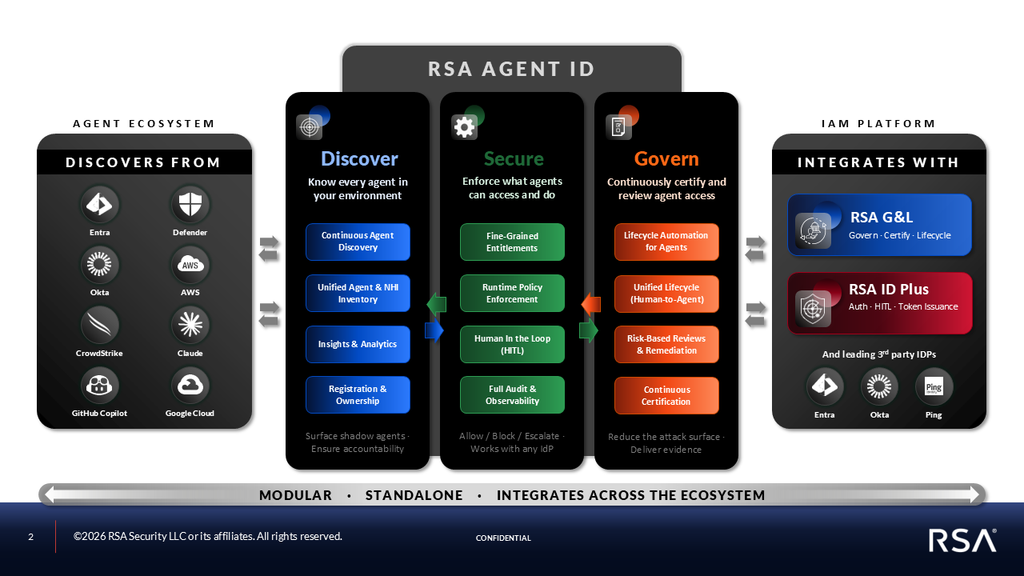
One Bad Prompt Took Down a Company’s Salesforce: RSA’s Jim Taylor on Agent ID and Taming the 4,000 Shadow AI Agents Hiding in Your Enterprise

AI agents are moving into production faster than security teams can track them. They hold credentials, carry entitlements, and act on systems of record, yet most enterprises cannot say which agents are running, who owns them, or whether anyone can stop them. Gartner expects a typical Global Fortune 500 enterprise to run roughly 150,000 AI

One Bad Prompt Took Down a Company’s Salesforce: RSA’s Jim Taylor on Agent ID and Taming the 4,000 Shadow AI Agents Hiding in Your Enterprise Read More »

Google Research Open-Sources RRSI: AI Agents That Improve Their Own Harness Without Overfitting

Google Cloud AI Research, with UNC-Chapel Hill, Stanford and Washington University in St. Louis, has released RRSI (Regularized Recursive Self-Improvement). It lets an LLM agent rewrite its own harness: prompts, tools, memory, control flow and sub-agents. Model weights never change. RRSI constrains the improvement loop itself, so gains hold on benchmarks the agent never optimized

Google Research Open-Sources RRSI: AI Agents That Improve Their Own Harness Without Overfitting Read More »

NVIDIA Launches Open Agent Safety Platform: OpenShell Sandboxes Agents on Vera CPUs While Sentry on BlueField-4 Quarantines Them in Milliseconds

NVIDIA has launched the NVIDIA Open Agent Safety Platform, an open software platform and reference system design for AI agent security. It pairs the OpenShell secure runtime with NVIDIA Sentry, an out-of-band watchdog on BlueField-4 DPUs. The core idea is simple. Safety controls should not live inside the agent they are meant to control. Today,

NVIDIA Launches Open Agent Safety Platform: OpenShell Sandboxes Agents on Vera CPUs While Sentry on BlueField-4 Quarantines Them in Milliseconds Read More »