
Small Language Model

Auto Added by WPeMatico

▶

NVIDIA Releases Nemotron 3.5 Bolt E4B 4GB: An Open Small Language Model for Local Voice Agents, Game Characters and Robots

NVIDIA has just released Nemotron 3.5 Bolt E4B 4GB, an open small language model for fast conversational agents. It targets voice assistants, game NPCs and robot interfaces running locally on RTX, Jetson and Spark hardware. The model is post-trained from Google’s Gemma 4 E4B using reinforcement learning only. For developers, this is agent behavior in
NVIDIA Releases Nemotron 3.5 Bolt E4B 4GB: An Open Small Language Model for Local Voice Agents, Game Characters and Robots Read More »

TII Releases Falcon-ASR: 1.6B Arabic Speech Model Hits 20.92% WER

The Technology Innovation Institute (TII) in Abu Dhabi has released Falcon-ASR, a 1.6B parameter Arabic speech recognition model. It focuses on the Emirati dialect and also transcribes English, French, Spanish and Portuguese. In TII’s evaluation, Falcon-ASR posts a 20.92% average word error rate (WER) across 6 Arabic test sets. That beats the best published entry

TII Releases Falcon-ASR: 1.6B Arabic Speech Model Hits 20.92% WER Read More »

Nace AI Open-Sources Drex 1.5: A 9B Decision Model That Scores Options, Not Text

Nace.AI has open-sourced Drex 1.5, a 9B decision model for agents and backend workflows. The Drex 1.5 decision model does not write text. It reads a state and typed questions, then returns a probability for every option. Nace reports 58.08 on the public Decision Index 0.3.1, the top score under 10B parameters. Weights are on

Nace AI Open-Sources Drex 1.5: A 9B Decision Model That Scores Options, Not Text Read More »

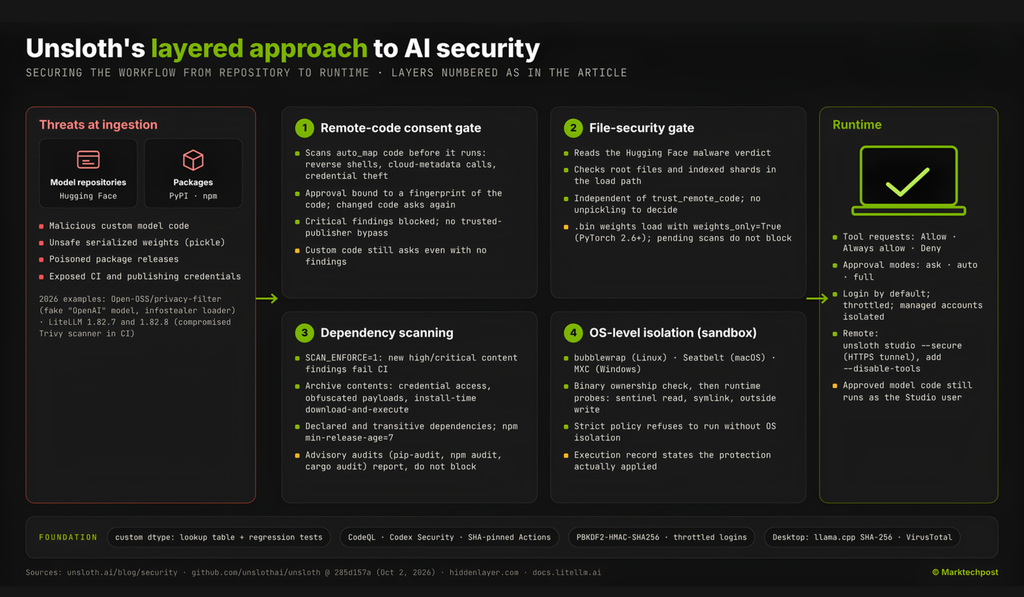
What Happens When a Trusted Model Repo Changes? Unsloth Studio Re-Checks Before It Runs

Beta Lessons Learned After over 500 million downloads, years of requests from the open-source community, and being a top product on Hugging Face, Unsloth launched their beta desktop App, Unsloth Studio. Unsloth which makes it faster, easier, and more affordable to fine-tune and run AI models, including locally on your own hardware. The app centralizes

What Happens When a Trusted Model Repo Changes? Unsloth Studio Re-Checks Before It Runs Read More »

The Story of Qwen: Alibaba’s AI Models From 7B to 2.4T

In April 2023, Alibaba Cloud demoed a chatbot whose name roughly means ‘truth from a thousand questions.’ Three and a half years later, its descendant ships open weights with 2.4 trillion parameters. This is the story of how Qwen got there, release by release. window.addEventListener(‘message’,function(e){if(e.data&&e.data.mtpQwenTl&&e.data.h){var f=document.getElementById(‘mtp-qwen-tl-frame’);if(f&&e.source===f.contentWindow){f.style.height=e.data.h+’px’;}}}); Chapter 1 — 2023: a thousand questions Alibaba moved

The Story of Qwen: Alibaba’s AI Models From 7B to 2.4T Read More »

Create a Reasoning-Focused LLM: A Practical Guide to Streaming, Curating, and Fine-Tuning the SupraLabs Reasoning Corpus

In this tutorial, we build an end-to-end workflow for working with the SupraLabs reasoning corpus. We stream a representative subset directly from the Hugging Face Hub, inspect its source distribution, token-length patterns, task composition, and reasoning-to-answer ratios, and then apply a series of quality filters to remove unsuitable training examples. We transform the retained samples

Create a Reasoning-Focused LLM: A Practical Guide to Streaming, Curating, and Fine-Tuning the SupraLabs Reasoning Corpus Read More »

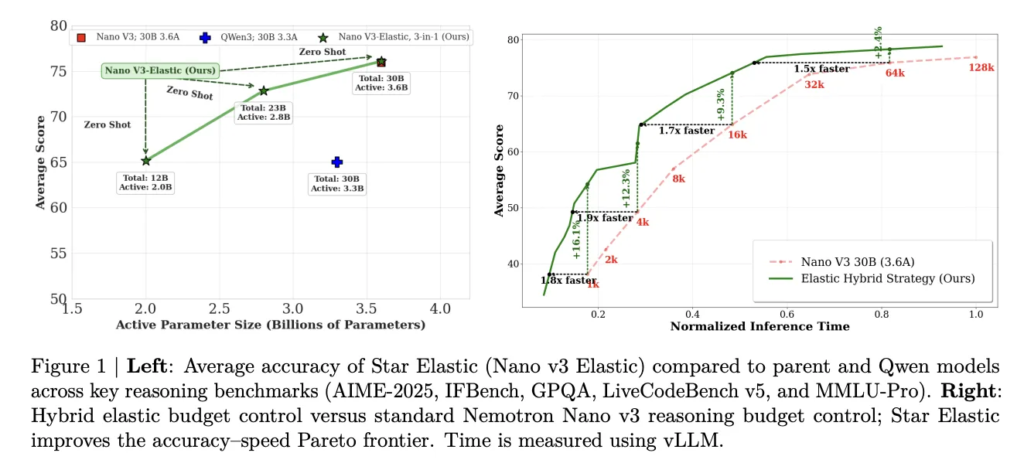
NVIDIA AI Releases Star Elastic: One Checkpoint that Contains 30B, 23B, and 12B Reasoning Models with Zero-Shot Slicing

Training a family of large language models (LLMs) has always come with a painful multiplier: every model variant in the family—whether 8B, 30B, or 70B—typically requires its own full training run, its own storage, and its own deployment stack. For a dev team running inference at scale, this means multiplying compute costs by the number

NVIDIA AI Releases Star Elastic: One Checkpoint that Contains 30B, 23B, and 12B Reasoning Models with Zero-Shot Slicing Read More »

Defeating the ‘Token Tax’: How Google Gemma 4, NVIDIA, and OpenClaw are Revolutionizing Local Agentic AI: From RTX Desktops to DGX Spark

Run Google’s latest omni-capable open models faster on NVIDIA RTX AI PCs, from NVIDIA Jetson Orin Nano, GeForce RTX desktops to the new DGX Spark, to build personalized, always-on AI assistants like OpenClaw without paying a massive “token tax” for every action. The landscape of modern AI is shifting rapidly. We are moving away from

Defeating the ‘Token Tax’: How Google Gemma 4, NVIDIA, and OpenClaw are Revolutionizing Local Agentic AI: From RTX Desktops to DGX Spark Read More »

Mistral AI Releases Mistral Small 4: A 119B-Parameter MoE Model that Unifies Instruct, Reasoning, and Multimodal Workloads

Mistral AI has released Mistral Small 4, a new model in the Mistral Small family designed to consolidate several previously separate capabilities into a single deployment target. Mistral team describes Small 4 as its first model to combine the roles associated with Mistral Small for instruction following, Magistral for reasoning, Pixtral for multimodal understanding, and

Mistral AI Releases Mistral Small 4: A 119B-Parameter MoE Model that Unifies Instruct, Reasoning, and Multimodal Workloads Read More »

Microsoft Releases Phi-4-Reasoning-Vision-15B: A Compact Multimodal Model for Math, Science, and GUI Understanding

Microsoft has released Phi-4-reasoning-vision-15B, a 15 billion parameter open-weight multimodal reasoning model designed for image and text tasks that require both perception and selective reasoning. It is a compact model built to balance reasoning quality, compute efficiency, and training-data requirements, with particular strength in scientific and mathematical reasoning and understanding user interfaces. https://arxiv.org/pdf/2603.03975 What the

Microsoft Releases Phi-4-Reasoning-Vision-15B: A Compact Multimodal Model for Math, Science, and GUI Understanding Read More »