Editors Pick

Auto Added by WPeMatico

How to Build a Stateless, Secure, and Asynchronous MCP-Style Protocol for Scalable Agent Workflows

In this tutorial, we build a clean, advanced demonstration of modern MCP design by focusing on three core ideas: stateless communication, strict SDK-level validation, and asynchronous, long-running operations. We implement a minimal MCP-like protocol using structured envelopes, signed requests, and Pydantic-validated tools to show how agents and services can interact safely without relying on persistent […]

How to Build a Stateless, Secure, and Asynchronous MCP-Style Protocol for Scalable Agent Workflows Read More »

Google AI Releases MedGemma-1.5: The Latest Update to their Open Medical AI Models for Developers

Google Research has expanded its Health AI Developer Foundations program (HAI-DEF) with the release of MedGemma-1.5. The model is released as open starting points for developers who want to build medical imaging, text and speech systems and then adapt them to local workflows and regulations. https://research.google/blog/next-generation-medical-image-interpretation-with-medgemma-15-and-medical-speech-to-text-with-medasr/ MedGemma 1.5, small multimodal model for real clinical data

Google AI Releases MedGemma-1.5: The Latest Update to their Open Medical AI Models for Developers Read More »

Anthropic Releases Cowork As Claude’s Local File System Agent For Everyday Work

Anthropic has released Cowork, a new feature that runs agentic workflows on local files for non coding tasks currently available in research preview inside the Claude macOS desktop app. What Cowork Does At The File System Level Cowork currently runs as a dedicated mode in the Claude desktop app. When you start a Cowork session,

Anthropic Releases Cowork As Claude’s Local File System Agent For Everyday Work Read More »

Understanding the Layers of AI Observability in the Age of LLMs

Artificial intelligence (AI) observability refers to the ability to understand, monitor, and evaluate AI systems by tracking their unique metrics—such as token usage, response quality, latency, and model drift. Unlike traditional software, large language models (LLMs) and other generative AI applications are probabilistic in nature. They do not follow fixed, transparent execution paths, which makes

Understanding the Layers of AI Observability in the Age of LLMs Read More »

How to Build a Multi-Turn Crescendo Red-Teaming Pipeline to Evaluate and Stress-Test LLM Safety Using Garak

In this tutorial, we build an advanced, multi-turn crescendo-style red-teaming harness using Garak to evaluate how large language models behave under gradual conversational pressure. We implement a custom iterative probe and a lightweight detector to simulate realistic escalation patterns in which benign prompts slowly pivot toward sensitive requests, and we assess whether the model maintains

How to Build a Multi-Turn Crescendo Red-Teaming Pipeline to Evaluate and Stress-Test LLM Safety Using Garak Read More »

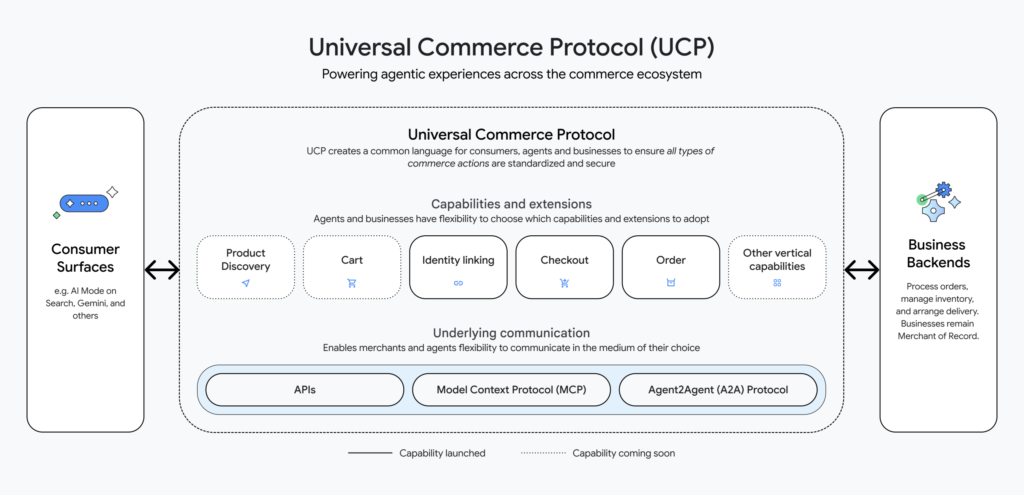
Google AI Releases Universal Commerce Protocol (UCP): An Open-Source Standard Designed to Power the Next Generation of Agentic Commerce

Can AI shopping agents move beyond sending product links and actually complete trusted purchases end to end inside a chat? Universal Commerce Protocol, or UCP, is Google’s new open standard for agentic commerce. It gives AI agents and merchant systems a shared language so that a shopping query can move from product discovery to an

Google AI Releases Universal Commerce Protocol (UCP): An Open-Source Standard Designed to Power the Next Generation of Agentic Commerce Read More »

How This Agentic Memory Research Unifies Long Term and Short Term Memory for LLM Agents

How do you design an LLM agent that decides for itself what to store in long term memory, what to keep in short term context and what to discard, without hand tuned heuristics or extra controllers? Can a single policy learn to manage both memory types through the same action space as text generation? Researchers

How This Agentic Memory Research Unifies Long Term and Short Term Memory for LLM Agents Read More »

A Coding Guide to Demonstrate Targeted Data Poisoning Attacks in Deep Learning by Label Flipping on CIFAR-10 with PyTorch

In this tutorial, we demonstrate a realistic data poisoning attack by manipulating labels in the CIFAR-10 dataset and observing its impact on model behavior. We construct a clean and a poisoned training pipeline side by side, using a ResNet-style convolutional network to ensure stable, comparable learning dynamics. By selectively flipping a fraction of samples from

A Coding Guide to Demonstrate Targeted Data Poisoning Attacks in Deep Learning by Label Flipping on CIFAR-10 with PyTorch Read More »

Meet SETA: Open Source Training Reinforcement Learning Environments for Terminal Agents with 400 Tasks and CAMEL Toolkit

What does an end to end stack for terminal agents look like when you combine structured toolkits, synthetic RL environments, and benchmark aligned evaluation? A team of researchers from CAMEL AI, Eigent AI and other collaborators have released SETA, a toolkit and environment stack that focuses on reinforcement learning for terminal agents. The project targets

Meet SETA: Open Source Training Reinforcement Learning Environments for Terminal Agents with 400 Tasks and CAMEL Toolkit Read More »

Meta and Harvard Researchers Introduce the Confucius Code Agent (CCA): A Software Engineering Agent that can Operate at Large-Scale Codebases

How far can a mid sized language model go if the real innovation moves from the backbone into the agent scaffold and tool stack? Meta and Harvard researchers have released the Confucius Code Agent, an open sourced AI software engineer built on the Confucius SDK that is designed for industrial scale software repositories and long

Meta and Harvard Researchers Introduce the Confucius Code Agent (CCA): A Software Engineering Agent that can Operate at Large-Scale Codebases Read More »