
Uncategorized

Google Research Introduces GlucoFM: A 0.72M-Parameter Dual-Stream Foundation Model for Continuous Glucose Monitoring

Google Research and UNSW Sydney have released GlucoFM, a self-supervised foundation model for continuous glucose monitoring. Its core move is a split. Existing CGM models — CGMformer, GluFormer, CGM-JEPA — encode a glucose trace as one entangled sequence. GlucoFM decomposes it into a slow physiological “state” stream and a transient “event” stream, keeps the observation […]
Google Research Introduces GlucoFM: A 0.72M-Parameter Dual-Stream Foundation Model for Continuous Glucose Monitoring Read More »

Alibaba’s Qwen Team Releases Qwen3.8-Flash-Next: A 125B Multimodal MoE With 6B Active Parameters Previewing the Qwen4 Architecture

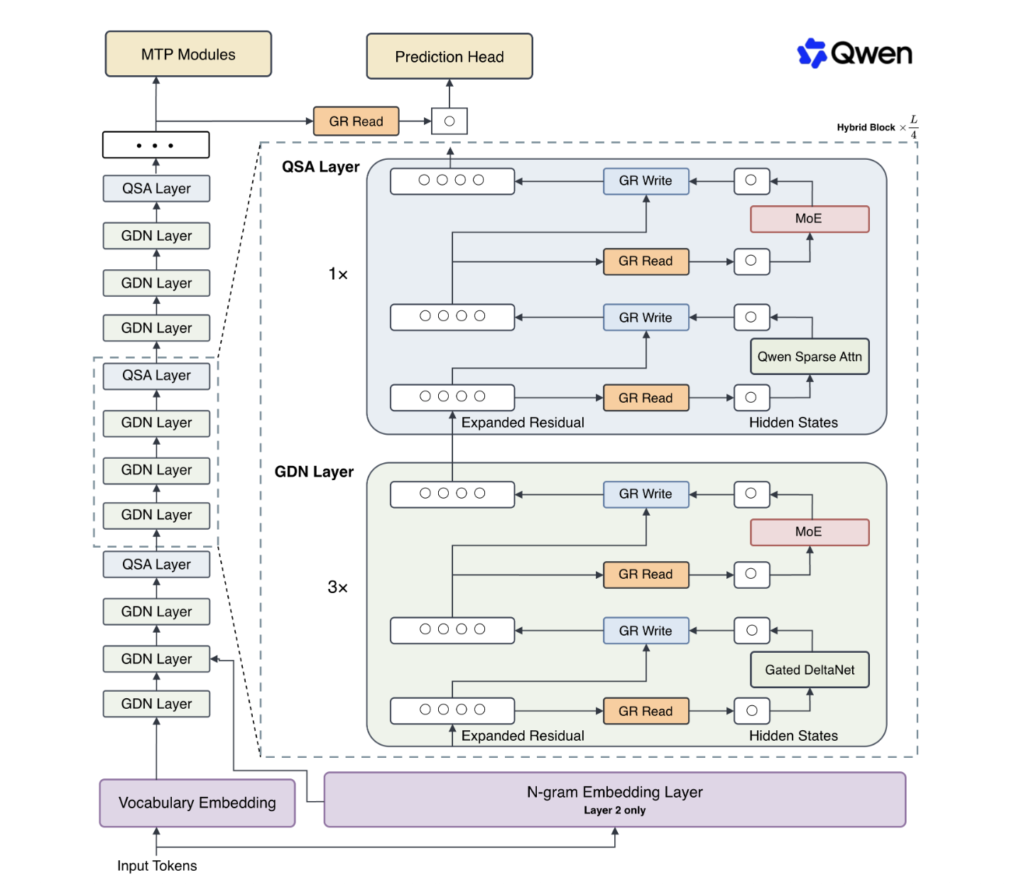
Alibaba’s Qwen team has released Qwen3.8-Flash-Next, an open-weight multimodal Mixture-of-Experts model built for cost per token. The checkpoint pairs a 125B backbone with a 51B N-gram embedding table and a 4B multi-token prediction module. Only 6B parameters activate per token. The team positions it as an early preview of the architecture that will underpin Qwen4,

Alibaba’s Qwen Team Releases Qwen3.8-Flash-Next: A 125B Multimodal MoE With 6B Active Parameters Previewing the Qwen4 Architecture Read More »

What Would Have to Be True for Agentic Coding to Replace Junior Engineers

I read every major model release. Most of them ship a coding number. The number goes up. The conclusion everyone draws is that junior engineers are finished. I think that conclusion is being reached the wrong way. People are reasoning from a benchmark score to a labor market outcome, skipping every step in between. So

What Would Have to Be True for Agentic Coding to Replace Junior Engineers Read More »

IBM Releases Granite 4.2: Bringing Native Reasoning and Agentic RL to Open Enterprise Models

IBM has released Granite 4.2, a family of open reasoning language models in 3B, 8B, and 30B parameter sizes. Unlike earlier Granite releases, which were instruction-following assistants, Granite 4.2 is built around explicit reasoning. Every model can emit a chain of thought before answering, and every model exposes a thinking / non-thinking switch plus a

IBM Releases Granite 4.2: Bringing Native Reasoning and Agentic RL to Open Enterprise Models Read More »

Liquid AI Open-Sources Pipette: A Reproducible Benchmarking Suite That Measures On-Device Models, Quantization, Runtime and Hardware Together

Model cards report quality under server-class, full-precision conditions. Those numbers rarely predict how the same model behaves on a phone. This week, Liquid AI released Pipette. It is an open-source platform for benchmarking foundation models on edge devices, built in partnership with Artificial Analysis as an independent methodology validator. Pipette treats on-device behavior as a

Liquid AI Open-Sources Pipette: A Reproducible Benchmarking Suite That Measures On-Device Models, Quantization, Runtime and Hardware Together Read More »

MIT tech powered the Artemis II livestreams

During the original US missions to the moon in the 1960s and ’70s, astronauts relied on radio-­frequency systems to communicate, sending grainy, low-quality images and videos to Earth. But on the Artemis II Orion mission in April, spacecraft transmitted crystal-clear footage at speeds on par with those of home internet connections.  The livestreams so many

MIT tech powered the Artemis II livestreams Read More »

Taking your temperature from the inside

Oral and forehead thermometers may not accurately capture a person’s core body temperature, and the few ingestible temperature sensors on the market are so big they are hard to swallow and risk obstructing the GI tract. But MIT engineers created one that can send continuous temperature updates at a size of just six by four

Taking your temperature from the inside Read More »

Amping up T cells to target cancer

Vaccines that turn the body’s immune system against tumors have shown promise in clinical trials, and a handful have been FDA approved for certain cancers. In many patients, however, these vaccines don’t stimulate enough of a response, and the approach some researchers have taken to strengthening it—delivering the vaccine along with immune-stimulating molecules called cytokines—can

Amping up T cells to target cancer Read More »