Software engineering

Auto Added by WPeMatico

Banner for the AI & Big Data Expo event series.

OpenAI report links coding agents to faster science software builds

OpenAI has released a new field report tracking eight scientific computing projects where coding agents cut runtimes. The report documents projects that used Codex on its own in five cases and a combination of Codex and Anthropic’s Claude Code in three others. Worth flagging upfront: this is a vendor publishing a survey of its own […]

OpenAI report links coding agents to faster science software builds Read More »
Liquid AI Releases LFM2.5-Encoder-230M and LFM2.5-Encoder-350M: Bidirectional Encoders That Stay Fast at 8K Context on CPU

Liquid AI has released two open-weight bidirectional encoders, LFM2.5-Encoder-230M and LFM2.5-Encoder-350M. Both are masked language models built on the LFM2 hybrid backbone. Both carry an 8,192-token context. Encoders sit underneath classifiers, intent routers, safety filters, and PII detectors. Those jobs run continuously, usually without a GPU, and increasingly on longer inputs. BERT established the class.

Liquid AI Releases LFM2.5-Encoder-230M and LFM2.5-Encoder-350M: Bidirectional Encoders That Stay Fast at 8K Context on CPU Read More »

✔

Building Non-Interactive Agentic Coding Workflows with Moonshot AI’s Kimi CLI, JSONL Streaming, Testing, and Session Memory

In this tutorial, we configure and operate Kimi CLI as a fully non-interactive AI coding agent. We install the CLI through uv with an isolated Python 3.13 environment, configure Moonshot API authentication through a TOML-based provider and model definition, and build a reusable Python wrapper for executing non-interactive CLI commands. We then apply Kimi to

Building Non-Interactive Agentic Coding Workflows with Moonshot AI’s Kimi CLI, JSONL Streaming, Testing, and Session Memory Read More »

Fireworks AI Releases Fireworks Nexus: A Drop-In Routing and Cost-Control Layer That Moves Routine Coding Work to Open-Weight Models

Fireworks AI has released Fireworks Nexus, an AI management and routing platform aimed at engineering organizations. It connects the coding tools developers already use to a managed layer of open-weight models. The problem it targets is well documented. Forbes reported that Uber exhausted its entire 2026 AI budget in four months. Claude Code had reached

Fireworks AI Releases Fireworks Nexus: A Drop-In Routing and Cost-Control Layer That Moves Routine Coding Work to Open-Weight Models Read More »

Microsoft AI Releases MAI-Cyber-1-Flash: A 5B-Active-Parameter Cyber Model That Pushes MDASH to 95.95% on CyberGym

Microsoft AI has released MAI-Cyber-1-Flash, its first model built specifically for cyber defense. The model does not ship as a standalone endpoint. It runs inside MDASH, Microsoft’s multi-model agentic scanning harness. MAI-Cyber-1-Flash MAI-Cyber-1-Flash is a transformer with self-attention and sparse Mixture-of-Experts layers. It carries 137B total parameters with 5B active, and a 256k context length.

Microsoft AI Releases MAI-Cyber-1-Flash: A 5B-Active-Parameter Cyber Model That Pushes MDASH to 95.95% on CyberGym Read More »

Kimi AI and kvcache-ai Open Sources ‘AgentENV’: A Distributed System that Powers Agentic Reinforcement Learning (RL) Training for Kimi K3

Moonshot AI’s Kimi team and kvcache-ai have open-sourced AgentENV (AENV), a distributed platform for running agent environments at scale. AgentENV powers agentic reinforcement learning (RL) training for Kimi K3, Moonshot’s 2.8-trillion-parameter Mixture-of-Experts model. The code ships under an MIT license. Why Environment Infra Holds Back Agentic RL Agentic RL does not just sample text. It

Kimi AI and kvcache-ai Open Sources ‘AgentENV’: A Distributed System that Powers Agentic Reinforcement Learning (RL) Training for Kimi K3 Read More »

Perplexity Releases pplx, a Single-Binary CLI That Puts Its Search API in the Terminal for Coding Agents

Perplexity has released pplx, an official command line client for its Search API. The tool returns grounded search results and extracted page text, all as JSON. According to its docs, it targets humans and coding agents equally. It is not a chat client. There is no conversational mode, no model selection and no synthesized answer.

Perplexity Releases pplx, a Single-Binary CLI That Puts Its Search API in the Terminal for Coding Agents Read More »

KwaiKAT Team Releases KAT-Coder-V2.5: An Agentic Coding Model Trained on 100,000+ Verifiable Repository Environments

The KwaiKAT Team at Kuaishou has introduced the KAT-Coder-V2.5. It is a coding model trained to operate inside real, executable repositories rather than emit single-turn code. The served model is available through StreamLake. An open-weight variant, KAT-Coder-V2.5-Dev, was released separately on Hugging Face under Apache-2.0. AutoBuilder: environments that actually run the intended tests The research

KwaiKAT Team Releases KAT-Coder-V2.5: An Agentic Coding Model Trained on 100,000+ Verifiable Repository Environments Read More »

Sakana AI Releases Fugu-Cyber: An Orchestration Model Reporting 86.9% on CyberGym and 72.1% on CTI-REALM

Sakana AI has released Fugu-Cyber (model ID is fugu-cyber-v1.0), a cybersecurity-specialized addition to its Fugu orchestration family. It is not just a new frontier model. It is a third endpoint on the Fugu orchestrator, tuned for security reasoning. Sakana launched that orchestrator a month earlier. Sakana reports a success rate of 86.9% on CyberGym and

Sakana AI Releases Fugu-Cyber: An Orchestration Model Reporting 86.9% on CyberGym and 72.1% on CTI-REALM Read More »

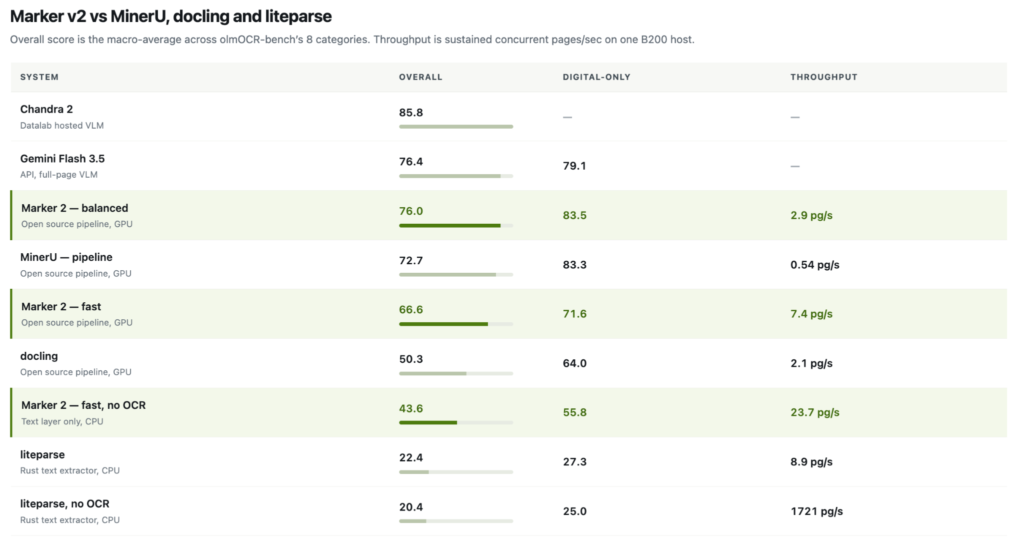
Datalab Marker v2 vs MinerU, Docling, and Liteparse: Benchmark Breakdown

Datalab has released Marker 2, a full rewrite of its open source document conversion pipeline. Marker converts PDF, image, PPTX, DOCX, XLSX, HTML, and EPUB files into markdown, JSON, HTML, or chunks. The Datalab team rebuilt it around three components shipped over the preceding months: Surya OCR 2, a 20M-param fast layout model, and a

Datalab Marker v2 vs MinerU, Docling, and Liteparse: Benchmark Breakdown Read More »