Open Source

Auto Added by WPeMatico

Kimi AI and kvcache-ai Open Sources ‘AgentENV’: A Distributed System that Powers Agentic Reinforcement Learning (RL) Training for Kimi K3

Moonshot AI’s Kimi team and kvcache-ai have open-sourced AgentENV (AENV), a distributed platform for running agent environments at scale. AgentENV powers agentic reinforcement learning (RL) training for Kimi K3, Moonshot’s 2.8-trillion-parameter Mixture-of-Experts model. The code ships under an MIT license. Why Environment Infra Holds Back Agentic RL Agentic RL does not just sample text. It […]

Kimi AI and kvcache-ai Open Sources ‘AgentENV’: A Distributed System that Powers Agentic Reinforcement Learning (RL) Training for Kimi K3 Read More »

Perplexity Releases pplx, a Single-Binary CLI That Puts Its Search API in the Terminal for Coding Agents

Perplexity has released pplx, an official command line client for its Search API. The tool returns grounded search results and extracted page text, all as JSON. According to its docs, it targets humans and coding agents equally. It is not a chat client. There is no conversational mode, no model selection and no synthesized answer.

Perplexity Releases pplx, a Single-Binary CLI That Puts Its Search API in the Terminal for Coding Agents Read More »

Datalab Marker v2 vs MinerU, Docling, and Liteparse: Benchmark Breakdown

Datalab has released Marker 2, a full rewrite of its open source document conversion pipeline. Marker converts PDF, image, PPTX, DOCX, XLSX, HTML, and EPUB files into markdown, JSON, HTML, or chunks. The Datalab team rebuilt it around three components shipped over the preceding months: Surya OCR 2, a 20M-param fast layout model, and a

Datalab Marker v2 vs MinerU, Docling, and Liteparse: Benchmark Breakdown Read More »

Datalab’s Marker 2 vs MinerU, Docling and LiteParse: 76.0 on olmOCR-bench at 5× MinerU’s Throughput

Datalab has released Marker 2, a full rewrite of its open source document conversion pipeline. Marker converts PDF, image, PPTX, DOCX, XLSX, HTML, and EPUB files into markdown, JSON, HTML, or chunks. The Datalab team rebuilt it around three components shipped over the preceding months: Surya OCR 2, a 20M-param fast layout model, and a

Datalab’s Marker 2 vs MinerU, Docling and LiteParse: 76.0 on olmOCR-bench at 5× MinerU’s Throughput Read More »

Banner for the AI & Big Data Expo event series.

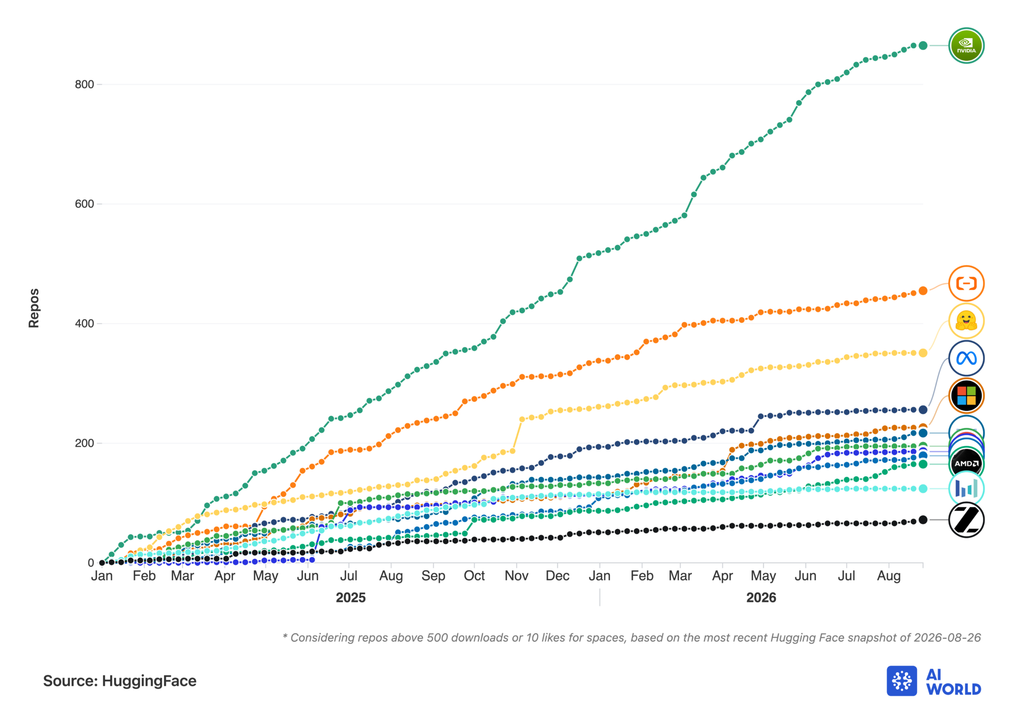
Meta, Microsoft, Nvidia, IBM, and others back open-weight AI

Two dozen companies and organisations signed an open letter urging US policymakers to protect open-weight AI models. The letter, published today (PDF), carries signatures from a list that spans direct commercial rivals and organisations with little obvious overlap in business model: Meta, Microsoft, Nvidia, IBM, Dell Technologies, CrowdStrike, Palantir, ServiceNow, Hugging Face, Perplexity, Mistral, Andreessen

Meta, Microsoft, Nvidia, IBM, and others back open-weight AI Read More »

↔

Andrew Ng Just Released OpenWorker: An Open-Source, Local-First Desktop AI Coworker That Returns Finished Deliverables Instead of Chat

Andrew Ng has announced OpenWorker, an open-source desktop agent that produces finished work rather than conversation. OpenWorker asks the user for an outcome, not a prompt: a polished document, a Slack reply containing the actual numbers, an updated calendar, a triaged inbox. It then breaks that outcome into steps, works across local files and connected

Andrew Ng Just Released OpenWorker: An Open-Source, Local-First Desktop AI Coworker That Returns Finished Deliverables Instead of Chat Read More »

Banner for the AI & Big Data Expo event series.

Nvidia bets physical AI can solve healthcare robotics’ data problem

Nvidia’s new Medical Physics Simulation framework treats healthcare robots as physical AI systems that need embodied experience to learn, not just code. Physical AI is the term Nvidia and much of the robotics industry now use to describe machines that have to learn how the world behaves through contact, force, and consequence, rather than through

Nvidia bets physical AI can solve healthcare robotics’ data problem Read More »

Meet Gigatoken: A Rust BPE Tokenizer that Encodes Text at 24.53 GB/s, up to 989x Faster than HuggingFace Tokenizers

Tokenization is the one part of the language modeling stack that almost nobody profiles. Gigatoken, released by Marcel Rød (a PhD student from Stanford)  under an MIT license, argues that this was a mistake. The library encodes text at gigabytes per second on a single machine, against baselines that are already multithreaded Rust. The GPT-2

Meet Gigatoken: A Rust BPE Tokenizer that Encodes Text at 24.53 GB/s, up to 989x Faster than HuggingFace Tokenizers Read More »

Cisco Foundation AI Releases Antares: 350M and 1B Open-Weight Models That Localize Known Vulnerabilities Inside Real Codebases

Cisco Foundation AI has released Antares, a family of security small language models (SLMs) built for one narrow security task. The task is vulnerability localization. Given a vulnerability description and a repository, find the files containing the flaw. Two models are open-weight and available now on Hugging Face, Antares-350M and Antares-1B. Both are Apache 2.0.

Cisco Foundation AI Releases Antares: 350M and 1B Open-Weight Models That Localize Known Vulnerabilities Inside Real Codebases Read More »

Poolside Releases Laguna S 2.1, an Open-Weight Agentic Coding Model Punching Above Its Weight Class on SWE-Bench Multilingual

Poolside has released Laguna S 2.1, a 118B-parameter open-weight model built for agentic coding. It is a Mixture-of-Experts (MoE) model with 8B activated parameters per token. It supports a context window of up to 1M tokens in both thinking and no-thinking modes. The weights are on Hugging Face under an OpenMDW-1.1 license, and the model

Poolside Releases Laguna S 2.1, an Open-Weight Agentic Coding Model Punching Above Its Weight Class on SWE-Bench Multilingual Read More »