Machine Learning

Auto Added by WPeMatico

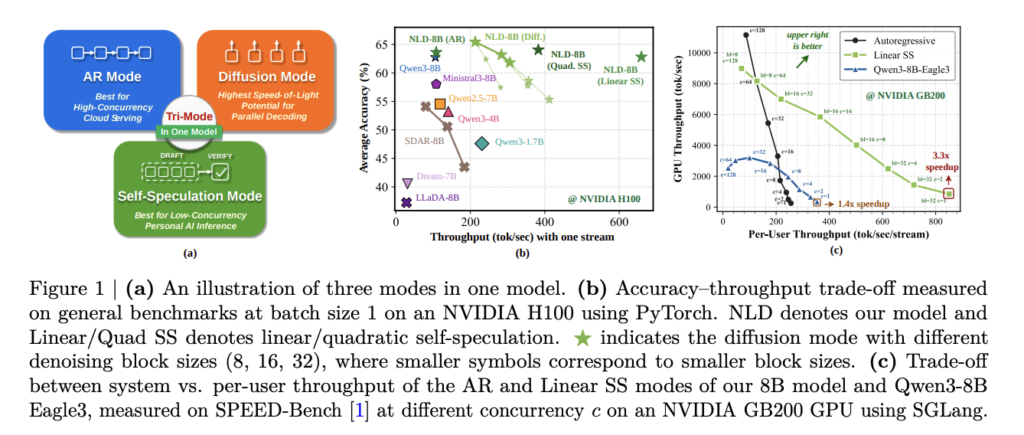
NVIDIA AI Releases Nemotron-Labs-Diffusion: A Tri-Mode Language Model with 6× Tokens Per Forward Over Qwen3-8B

NVIDIA researchers have released Nemotron-Labs-Diffusion, a language model family that unifies three decoding modes in one architecture. The model supports autoregressive (AR) decoding, diffusion-based parallel decoding, and self-speculation decoding. It is available in 3B, 8B, and 14B parameter sizes. The family includes base, instruct, and vision-language variants. Sequential Decoding Limits Throughput Standard autoregressive (AR) language
NVIDIA AI Releases Nemotron-Labs-Diffusion: A Tri-Mode Language Model with 6× Tokens Per Forward Over Qwen3-8B Read More »

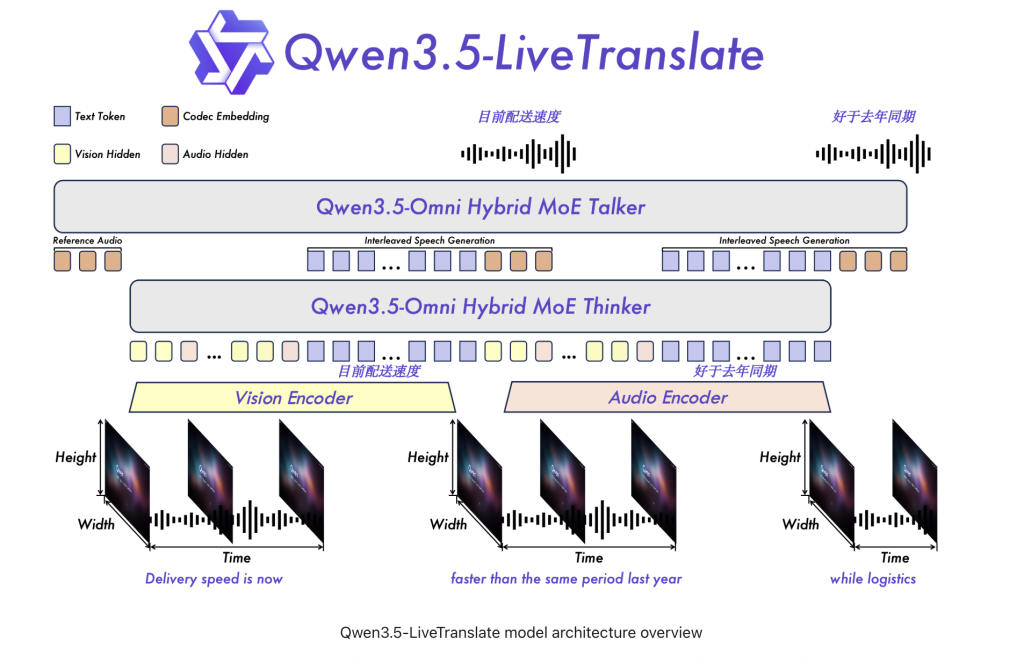
Alibaba Qwen Team Introduces Qwen3.5-LiveTranslate-Flash: Real-Time Multimodal Interpretation Across 60 Languages at 2.8-Second Latency

Simultaneous interpretation is one of the harder problems in applied AI. You’re asking a model to translate speech before the speaker has finished a sentence. Every extra second of delay breaks the illusion of real-time communication. Alibaba’s Qwen team has been chipping away at this with each release. Their latest model, Qwen3.5-LiveTranslate-Flash, brings that latency

Alibaba Qwen Team Introduces Qwen3.5-LiveTranslate-Flash: Real-Time Multimodal Interpretation Across 60 Languages at 2.8-Second Latency Read More »

Building AI models that understand chemical principles

Among all of the possible chemical compounds, it’s estimated that between 1020 and 1060 may hold potential as small-molecule drugs.Evaluating each of those compounds experimentally would be far too time-consuming for chemists. So, in recent years, researchers have begun using artificial intelligence to help identify compounds that could make good drug candidates. One of those researchers is MIT

Building AI models that understand chemical principles Read More »

Justin Solomon appointed associate dean of engineering education

Justin Solomon, associate professor in the MIT Department of Electrical Engineering and Computer Science (EECS), has been appointed associate dean of engineering education in the MIT School of Engineering, effective July 1.In this new role, Solomon will focus on advancing innovation in engineering education across the school. He will help shape new pedagogical approaches in

Justin Solomon appointed associate dean of engineering education Read More »

Meet MemPrivacy: An Edge-Cloud Framework that Uses Local Reversible Pseudonymization to Protect User Data Without Breaking Memory Utility

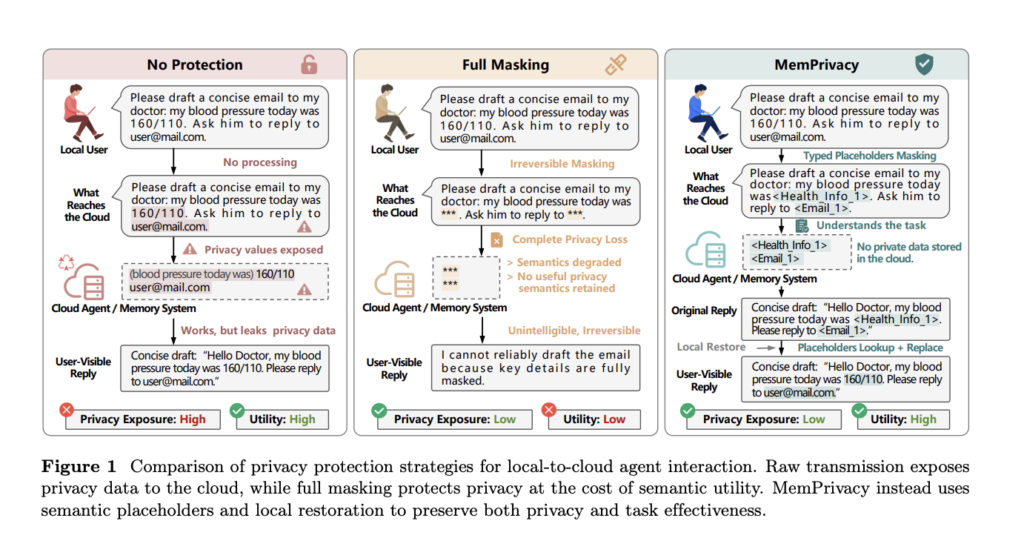
As LLM-powered agents move from research to production, one design tension is becoming harder to ignore: the more useful cloud-hosted memory becomes, the more private user data it exposes. Researchers from MemTensor (Shanghai), HONOR Device and Tongji University have introduced MemPrivacy, a framework that attempts to resolve this tension without sacrificing the utility that makes

Meet MemPrivacy: An Edge-Cloud Framework that Uses Local Reversible Pseudonymization to Protect User Data Without Breaking Memory Utility Read More »

Stochastic Gradient Descent (SGD’s) Frequency Bias and How Adam Fixes It 

Modern language models are trained on data with extremely uneven token distributions. A small number of words appear in almost every sentence, while many rare but meaningful tokens occur only occasionally. This creates a hidden optimization challenge: parameters associated with common tokens receive constant gradient updates, while parameters tied to rare tokens may go hundreds

Stochastic Gradient Descent (SGD’s) Frequency Bias and How Adam Fixes It  Read More »

NVIDIA Introduces a 4-Bit Pretraining Methodology Using NVFP4, Validated on a 12B Hybrid Mamba-Transformer at 10T Token Horizon

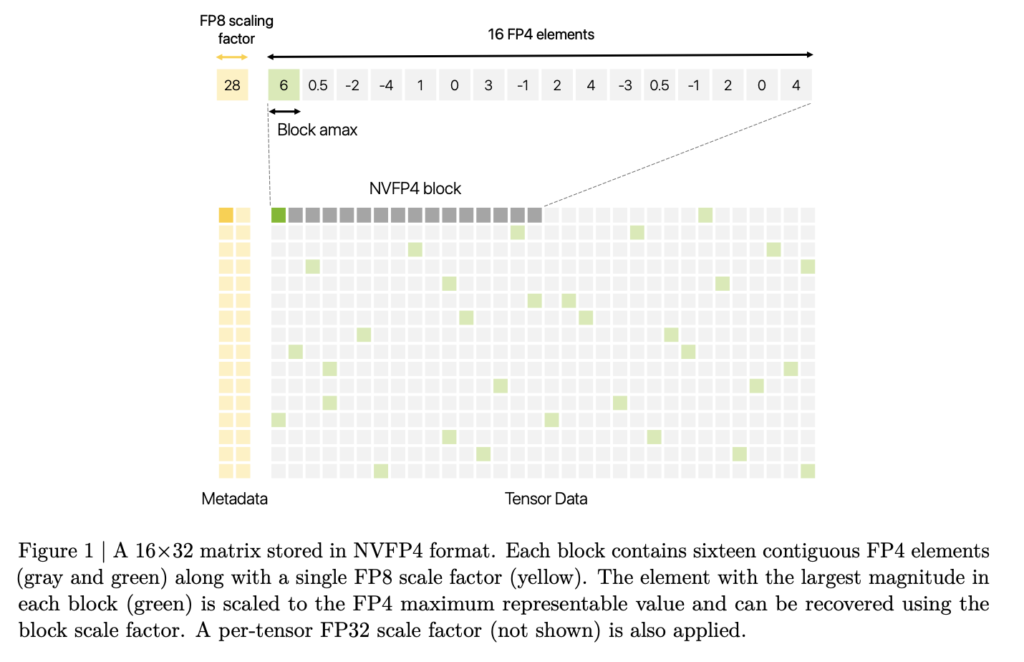
Pretraining frontier-scale LLMs in FP8 is now standard practice, but moving to 4-bit floating point has remained an open research problem because narrower formats compress dynamic range and amplify quantization error at long token horizons. A new research from NVIDIA describes a pretraining methodology built around NVFP4, a 4-bit microscaling format supported natively by Blackwell

NVIDIA Introduces a 4-Bit Pretraining Methodology Using NVFP4, Validated on a 12B Hybrid Mamba-Transformer at 10T Token Horizon Read More »

A Coding Implementation to Compress and Benchmark Instruction-Tuned LLMs with FP8, GPTQ, and SmoothQuant Quantization using llmcompressor

In this tutorial, we explore how to apply post-training quantization to an instruction-tuned language model using llmcompressor. We start with an FP16 baseline and then compare multiple compression strategies, including FP8 dynamic quantization, GPTQ W4A16, and SmoothQuant with GPTQ W8A8. Along the way, we benchmark each model variant for disk size, generation latency, throughput, perplexity,

A Coding Implementation to Compress and Benchmark Instruction-Tuned LLMs with FP8, GPTQ, and SmoothQuant Quantization using llmcompressor Read More »

↔

A Coding Guide Implementing SHAP Explainability Workflows with Explainer Comparisons, Maskers, Interactions, Drift, and Black-Box Models

In this tutorial, we implement SHAP workflows as a practical framework for interpreting machine learning models beyond basic feature-importance plots. We start by training tree-based models and then compare different SHAP explainers, including Tree, Exact, Permutation, and Kernel methods, to understand how accuracy and runtime change across model-aware and model-agnostic approaches. We also examine how

A Coding Guide Implementing SHAP Explainability Workflows with Explainer Comparisons, Maskers, Interactions, Drift, and Black-Box Models Read More »

Nous Research Proposes Lighthouse Attention: A Training-Only Selection-Based Hierarchical Attention That Delivers 1.4–1.7× Pretraining Speedup at Long Context

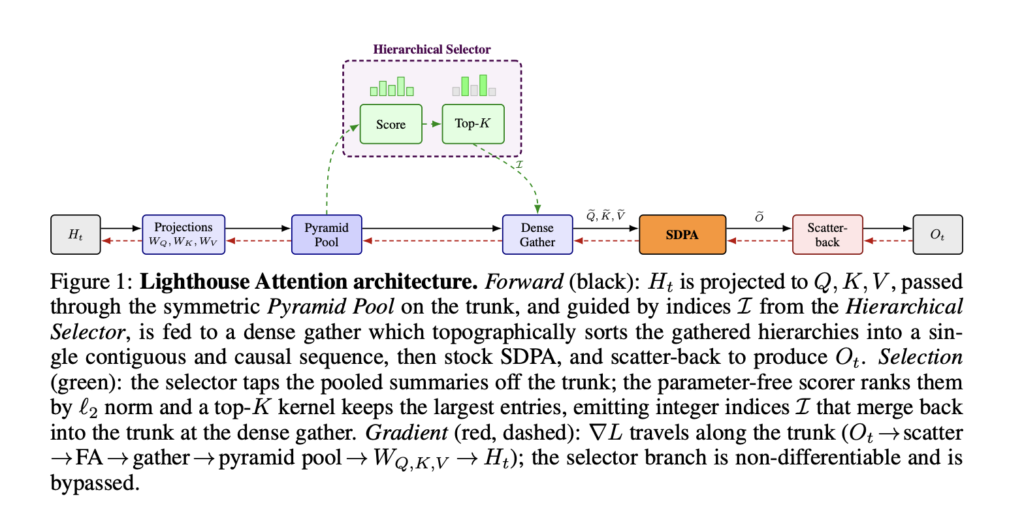
Training large language models on long sequences has a well-known problem: attention is expensive. The scaled dot-product attention (SDPA) at the core of every transformer scales quadratically Θ(N²) in both compute and memory with sequence length N. FlashAttention addressed this through IO-aware tiling that avoids materializing the full N×N attention matrix in high-bandwidth memory, reducing

Nous Research Proposes Lighthouse Attention: A Training-Only Selection-Based Hierarchical Attention That Delivers 1.4–1.7× Pretraining Speedup at Long Context Read More »