Large Language Model

Auto Added by WPeMatico

Cisco Foundation AI Releases Antares: 350M and 1B Open-Weight Models That Localize Known Vulnerabilities Inside Real Codebases

Cisco Foundation AI has released Antares, a family of security small language models (SLMs) built for one narrow security task. The task is vulnerability localization. Given a vulnerability description and a repository, find the files containing the flaw. Two models are open-weight and available now on Hugging Face, Antares-350M and Antares-1B. Both are Apache 2.0. […]

Cisco Foundation AI Releases Antares: 350M and 1B Open-Weight Models That Localize Known Vulnerabilities Inside Real Codebases Read More »

Poolside releases Laguna S 2.1, a 118B open-weight coding model that matches rivals many times its size

Poolside has released Laguna S 2.1, a 118B-parameter open-weight model built for agentic coding. It is a Mixture-of-Experts (MoE) model with 8B activated parameters per token. It supports a context window of up to 1M tokens in both thinking and no-thinking modes. The weights are on Hugging Face under an OpenMDW-1.1 license, and the model

Poolside releases Laguna S 2.1, a 118B open-weight coding model that matches rivals many times its size Read More »

Poolside Releases Laguna S 2.1, an Open-Weight Agentic Coding Model Punching Above Its Weight Class on SWE-Bench Multilingual

Poolside has released Laguna S 2.1, a 118B-parameter open-weight model built for agentic coding. It is a Mixture-of-Experts (MoE) model with 8B activated parameters per token. It supports a context window of up to 1M tokens in both thinking and no-thinking modes. The weights are on Hugging Face under an OpenMDW-1.1 license, and the model

Poolside Releases Laguna S 2.1, an Open-Weight Agentic Coding Model Punching Above Its Weight Class on SWE-Bench Multilingual Read More »

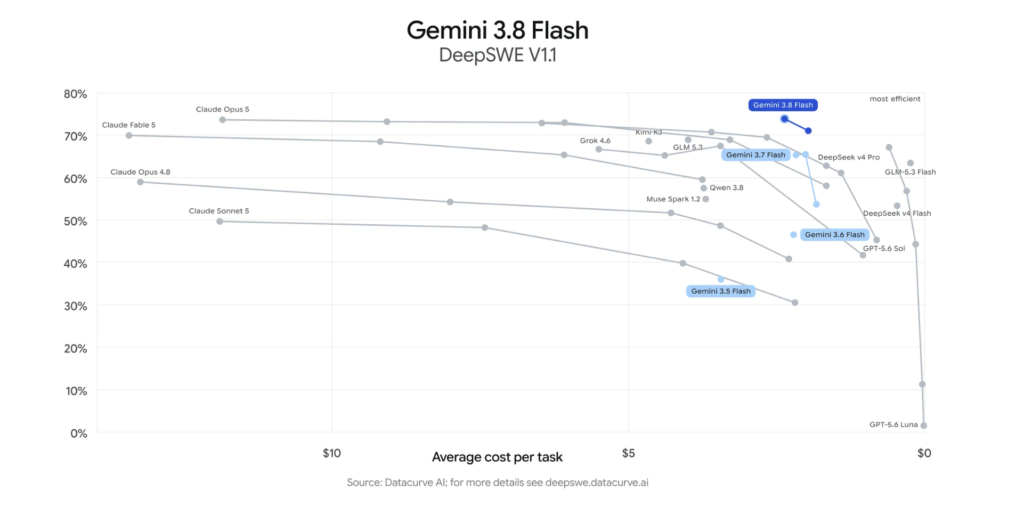
Google Releases Gemini 3.6 Flash, 3.5 Flash-Lite, and 3.5 Flash Cyber: A Cheaper, More Token-Efficient Flash Tier Built for Agentic Workloads

Developers building production agents need higher token efficiency, lower latency, and more reliable performance. Today, Google has released three new Gemini models. The lineup is Gemini 3.6 Flash, Gemini 3.5 Flash-Lite, and Gemini 3.5 Flash Cyber. All three sit in the Flash tier, which Google tunes for speed, cost, and high-volume agentic work rather than

Google Releases Gemini 3.6 Flash, 3.5 Flash-Lite, and 3.5 Flash Cyber: A Cheaper, More Token-Efficient Flash Tier Built for Agentic Workloads Read More »

NVIDIA Releases Cosmos 3 Edge: A 4B-Parameter Open World Model That Reasons and Generates Robot Actions On-Device

NVIDIA has released Cosmos 3 Edge, a 4-billion-parameter open world model built to run on-device. It helps robots and vision AI agents understand surroundings, reason in real time, and generate robot actions locally. The Cosmos 3 family included Cosmos 3 Nano (16B) and Cosmos 3 Super (64B) shipped on May 31, 2026 at GTC Taipei.

NVIDIA Releases Cosmos 3 Edge: A 4B-Parameter Open World Model That Reasons and Generates Robot Actions On-Device Read More »

Someone Fine-Tuned OpenBMB’s MiniCPM5-1B on Claude Fable 5 Traces to Ship a 657MB Local Thinking Model

A community developer, GnLOLot, has published a 1B model that runs fully on local hardware. The model is MiniCPM5-1B-Claude-Opus-Fable5-Thinking, with GGUF builds for llama.cpp-compatible runtimes. It needs no API key and makes no cloud calls. The Proposed Model The model is built on openbmb/MiniCPM5-1B. That base is a real, documented release from OpenBMB. It is

Someone Fine-Tuned OpenBMB’s MiniCPM5-1B on Claude Fable 5 Traces to Ship a 657MB Local Thinking Model Read More »

Best Local LLMs You Can Run on a Single 24GB GPU in 2026: Qwen, Gemma, Mistral, DeepSeek Compared

A single 24GB card is the practical floor for serious local inference. It is enough for genuinely capable models, and small enough to sit on one GPU. An RTX 3090 or RTX 4090 both land in this tier. The card you own matters less than the models you pick for it. The old hobbyist move

Best Local LLMs You Can Run on a Single 24GB GPU in 2026: Qwen, Gemma, Mistral, DeepSeek Compared Read More »

Alibaba Previews Qwen3.8-Max, a 2.4 Trillion-Parameter Multimodal Model, Days After Moonshot’s Kimi K3 Open-Weight Launch

On July 19, Alibaba’s Qwen team previewed Qwen3.8-Max-Preview, the next flagship in the Qwen family. The research team describes it as a 2.4 trillion-parameter model, ‘second only to Fable 5’ among the systems it benchmarked. The preview is live now. The benchmark table, model card, and license are not. The July 19th 2026 announcement landed

Alibaba Previews Qwen3.8-Max, a 2.4 Trillion-Parameter Multimodal Model, Days After Moonshot’s Kimi K3 Open-Weight Launch Read More »

Kimi K3 vs DeepSeek V4 Pro vs GLM-5.2: Open Trillion-Scale MoE Models Compared on Benchmarks, License, and Serving Cost

Three Chinese labs now hold the top of the open-weight leaderboard. Moonshot AI’s Kimi K3, DeepSeek V4 Pro, and Zhipu AI’s GLM-5.2 are all sparse Mixture-of-Experts (MoE) models with million-token context windows. Each targets long-horizon coding and agent workloads. This article compares them on three axes an AI team actually decides on: measured capability, license

Kimi K3 vs DeepSeek V4 Pro vs GLM-5.2: Open Trillion-Scale MoE Models Compared on Benchmarks, License, and Serving Cost Read More »

Sakana AI’s Error Diffusion Trains Dale-Compliant Dual-Stream Networks, Reaching 96.7% MNIST and 61.7% CIFAR-10 Without Backpropagation

Backpropagation dominates deep learning, yet it uses a mechanism the brain likely cannot. Specifically, the backward pass needs exact transposes of forward weight matrices. This is the weight transport problem. Sakana AI’s new paper, Diffusing Blame, confronts this constraint directly. The research team trains networks that obey Dale’s principle while avoiding weight transport entirely. What

Sakana AI’s Error Diffusion Trains Dale-Compliant Dual-Stream Networks, Reaching 96.7% MNIST and 61.7% CIFAR-10 Without Backpropagation Read More »