For Devs

Auto Added by WPeMatico

Vercel Introduces ‘Is Agentic’, a Free Agent-Readiness Scoring Tool That Audits Public Websites Using Ora’s 100+ Checks

Vercel has released Is Agentic, a public tool that scores how readily AI agents can discover, access, understand, and use a website. Scans are run and scored by Ora, an agent-experience research company from era labs. Vercel operates the interface, report pages, storage, and the grouping that produces the displayed score. Is it deployable? Yes
Vercel Introduces ‘Is Agentic’, a Free Agent-Readiness Scoring Tool That Audits Public Websites Using Ora’s 100+ Checks Read More »

The Developer’s Guide to NeMo Guardrails for Enterprise AI Safety

In this tutorial, we build an in-depth NeMo Guardrails pipeline that demonstrates how layered guardrails can control an LLM-based financial assistant across the full request lifecycle. We combine deterministic PII detection and redaction, LLM-based input and output self-checks, retrieval filtering, account-number masking, topical restrictions, and policy-based tool gating. We also implement stateful multi-turn interactions, detailed

The Developer’s Guide to NeMo Guardrails for Enterprise AI Safety Read More »

NVIDIA Releases TensorRT Model Connect in Public Preview: Hugging Face Checkpoint to Native C++ Inference in Two Commands

NVIDIA has released TensorRT Model Connect (TRTMC) in public preview, an open-source project that takes a supported Hugging Face or local checkpoint to end-to-end TensorRT inference in two commands. There is no intermediate ONNX export step. The build produces a versioned .bundle artifact that runs through native C++ task APIs, so inference can execute in

NVIDIA Releases TensorRT Model Connect in Public Preview: Hugging Face Checkpoint to Native C++ Inference in Two Commands Read More »

Meet SAM (Sovereign Agent Mesh): A Zero-Config, Zero-Trust P2P Network for AI Agents

google/sam is not Segment Anything. SAM here means Sovereign Agent Mesh, an Apache-2.0 networking project for autonomous AI agents. The problem it targets is concrete. Agents now run across cloud servers, on-prem datacenters, laptops, Raspberry Pis and Android devices. Letting them share tools usually means exposing internal scripts, LLM endpoints or private APIs to the

Meet SAM (Sovereign Agent Mesh): A Zero-Config, Zero-Trust P2P Network for AI Agents Read More »

Z.ai Ships GLM-5.3 Without Retraining the Base Model: Better at Complex Coding and Long-Horizon Tasks

Z.ai just released GLM-5.3. GLM-5.3 runs on the same 743B base model as GLM-5.2. Every reported gain comes from scaled post-training: more task environments, more environment types, longer training. The results land in two places. Coding jumps most on the longest-horizon benchmarks, with Terminal-Bench 3.0 moving from 4.6 to 28.3. Cybersecurity moved further than Z.ai

Z.ai Ships GLM-5.3 Without Retraining the Base Model: Better at Complex Coding and Long-Horizon Tasks Read More »

Prime Intellect Releases Prime Agent: An Open-Source RLM Harness Where Sub-Agents Are Function Calls Inside Persistent IPython Kernel

Prime Intellect has open-sourced Prime Agent, a self-improving coding harness designed around two abstractions, the Recursive Language Model (RLM) and Continual Harness. Fixed tool schemas and context compaction force a model to work around its own scaffolding. Prime Agent replaces both with a persistent Python REPL and a rewritable harness. With Opus 5, it reports

Prime Intellect Releases Prime Agent: An Open-Source RLM Harness Where Sub-Agents Are Function Calls Inside Persistent IPython Kernel Read More »

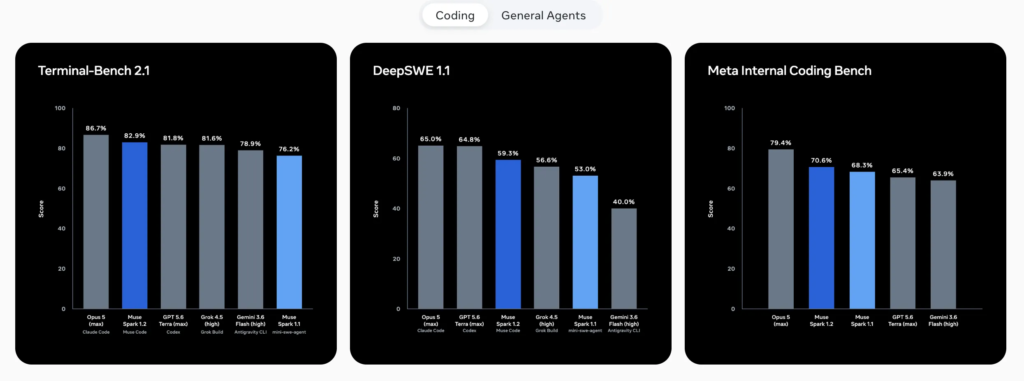
Meta AI Releases Muse Code (Beta): A Terminal Coding Agent Powered by the New Muse Spark 1.2 Model

Meta AI has released Muse Code (in beta), a terminal coding agent in beta, powered by its new Muse Spark 1.2 model. Meta positions the pair as its next step toward the frontier, with larger models on the way. Muse Code targets complex software engineering across large repositories: it plans changes, writes code, and validates

Meta AI Releases Muse Code (Beta): A Terminal Coding Agent Powered by the New Muse Spark 1.2 Model Read More »

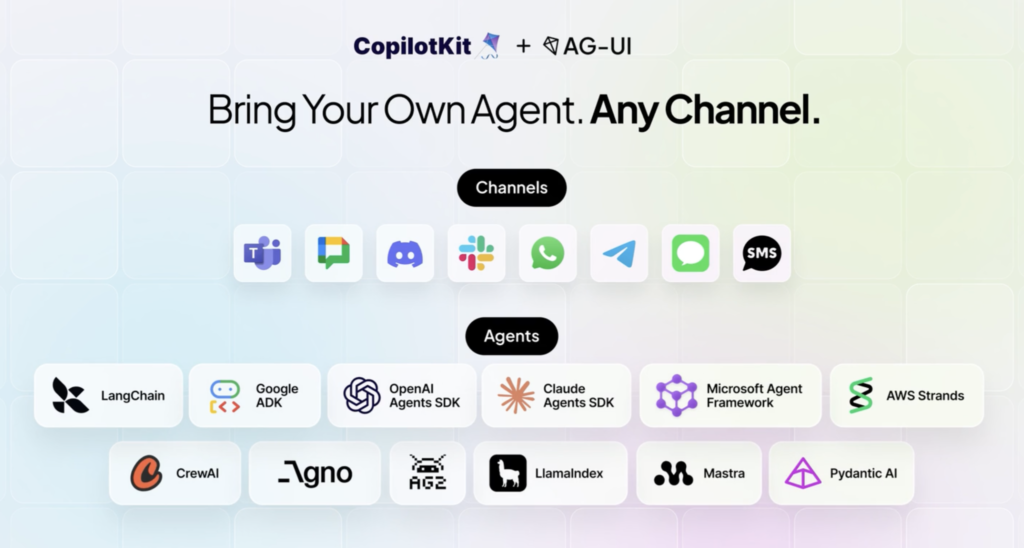
CopilotKit Open Sources Channels SDK: An MIT Licensed Library That Runs Any AG-UI Agent Inside Slack And Microsoft Teams

CopilotKit has just released the Channels SDK. It is an open source library that puts an existing agent inside a messaging platform. The core assumption is focused and verifiable. You already have an agent. It already has a model, tools and business logic. Channels gives it a place to work with people, without a rewrite

CopilotKit Open Sources Channels SDK: An MIT Licensed Library That Runs Any AG-UI Agent Inside Slack And Microsoft Teams Read More »

Meet Alibaba’s Page Agent: A JavaScript In-Page GUI Agent That Controls Web Interfaces With Natural Language Through the DOM

Most browser automation runs from the outside. Playwright, Puppeteer, Selenium, and browser-use all drive a browser from an external process. They read the page through screenshots or the Chrome DevTools Protocol. Alibaba’s Page Agent takes the opposite path. The agent lives inside the webpage as plain JavaScript. It reads the live DOM as text and

Meet Alibaba’s Page Agent: A JavaScript In-Page GUI Agent That Controls Web Interfaces With Natural Language Through the DOM Read More »

Perplexity Launches Brain, a Self-Improving Memory System That Builds a Context Graph of an Agent’s Work and Learns Overnight

Most AI memory remembers the user. It stores your preferences, your tastes, and your role. Perplexity is taking a different path. Today, Perplexity launched Brain, a self-improving memory system for its agent product, Computer. Brain does not focus on remembering you. It remembers what the agent did. That reframes what memory in AI is for.

Perplexity Launches Brain, a Self-Improving Memory System That Builds a Context Graph of an Agent’s Work and Learns Overnight Read More »