For Devs

Auto Added by WPeMatico

OpenAI Launches the Agents API in Public Beta, Putting the Codex Harness Behind One API Call

OpenAI has released the Agents API in public beta. It gives developers the same harness and infrastructure that run Codex. OpenAI hosts and maintains the harness. Developers run the agent’s compute in an OpenAI-managed sandbox, their own infrastructure, or a partner sandbox. Is it deployable? Yes. It is live for all developers in public beta.

OpenAI Launches the Agents API in Public Beta, Putting the Codex Harness Behind One API Call Read More »

Google Open-Sources Mantis: A Modular Skills Toolkit That Lets Coding Agents Find, Reproduce and Patch Vulnerabilities

Google has open-sourced Mantis, a stack-agnostic toolkit of security review skills that lets an AI coding agent run the whole vulnerability lifecycle. It finds a suspected flaw, strips the false positives, reproduces the bug inside a sandbox, writes a minimal patch, re-attacks that patch, and scores the residual risk. Mantis is not a scanner you

Google Open-Sources Mantis: A Modular Skills Toolkit That Lets Coding Agents Find, Reproduce and Patch Vulnerabilities Read More »

NVIDIA Announces CUDA Rust with cuda-oxide (SIMT) and cutile-rs (Tile) for Compile-Time-Safe GPU Kernels

NVIDIA has announced CUDA Rust, a push to make Rust a first-class language for writing GPU kernels. Rust code could already launch CUDA kernels, but the kernel body usually had to be written elsewhere. CUDA Rust closes that gap with two NVlabs open-source projects: cuda-oxide for the SIMT model and cutile-rs for the newer Tile

NVIDIA Announces CUDA Rust with cuda-oxide (SIMT) and cutile-rs (Tile) for Compile-Time-Safe GPU Kernels Read More »

▶

Perplexity Details Its GPU Embedding Stack: How Ivy, Tulip and ROSE Serve pplx-embed

Retrieval quality in an AI search product is bounded by two things: how good the embedding model is, and how cheaply you can run it across an index. This week, Perplexity Engineering team published Fast Embeddings on GPUs, an under-the-hood account of the second — the serving infrastructure behind pplx-embed and the ranking models used

Perplexity Details Its GPU Embedding Stack: How Ivy, Tulip and ROSE Serve pplx-embed Read More »

GitHub Introduces Project HydraFusion: Runtime Multi-Model Orchestration That Builds a Workflow Per Coding Task in Copilot CLI

GitHub has released Project HydraFusion, a research preview that stops treating model choice as a one-time setting. Instead of routing your prompt to a single model, HydraFusion builds an execution plan per request. It can draft with one model, have a second model critique the draft, or escalate to a stronger model when a quality

GitHub Introduces Project HydraFusion: Runtime Multi-Model Orchestration That Builds a Workflow Per Coding Task in Copilot CLI Read More »

Meta AI Released Muse Spark 1.3: An Agentic Coding Model That Uses ~20% Fewer Tool Calls and ~25% Fewer Tokens Than Muse Spark 1.2

This week, Meta Superintelligence Labs released Muse Spark 1.3. It is the fourth Muse Spark release in five months, and the target is long-horizon agentic and coding work rather than single-turn generation. The framing in Meta’s post is usability: sustaining a long thread, collaborating with the user, and knowing when it is stuck. Is it

Meta AI Released Muse Spark 1.3: An Agentic Coding Model That Uses ~20% Fewer Tool Calls and ~25% Fewer Tokens Than Muse Spark 1.2 Read More »

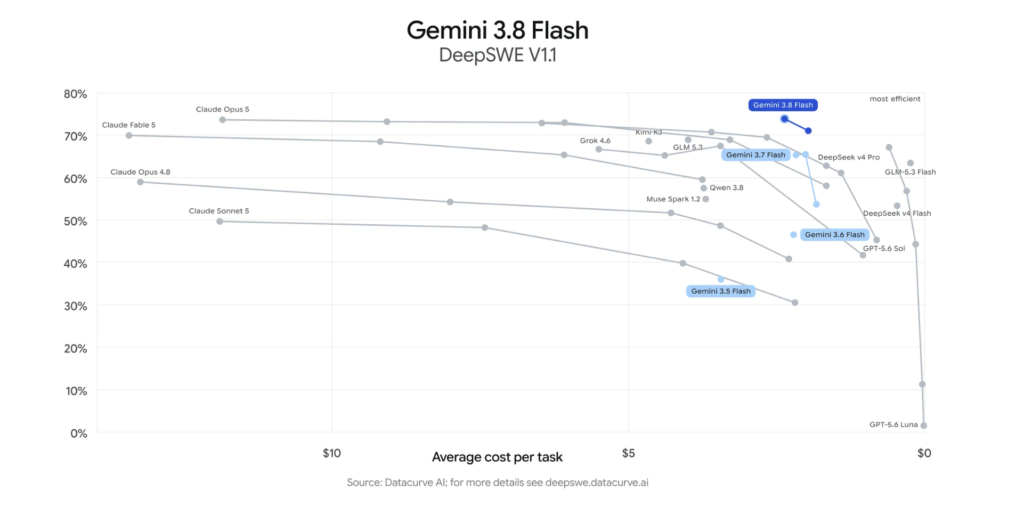
Google DeepMind Releases Gemini 3.8 Flash and Gemini 3.8 Flash Cyber: One Core Model, Two Access Envelopes

Google just announced Gemini 3.8 Flash and Gemini 3.8 Flash Cyber, three weeks after Gemini 3.7 Flash and marking the third Flash release in six weeks. Both variants run on the same foundational intelligence, refined through long-running agentic loops that recursively evaluate the underlying models. What separates them is not architecture, it is the safety

Google DeepMind Releases Gemini 3.8 Flash and Gemini 3.8 Flash Cyber: One Core Model, Two Access Envelopes Read More »

Anthropic Introduces Enterprise Frontier Safeguards (EFS): Zero-Data-Retention Privacy Plus Cross-Session Misuse Detection

Enterprise AI buyers have been stuck between two things they both need. Regulated teams need a zero data retention (ZDR) guarantee, so no prompt or agent transcript sits on a vendor’s servers. Security teams need misuse detection, which historically required the vendor to hold that same data long enough to correlate it. This week, Anthropic

Anthropic Introduces Enterprise Frontier Safeguards (EFS): Zero-Data-Retention Privacy Plus Cross-Session Misuse Detection Read More »

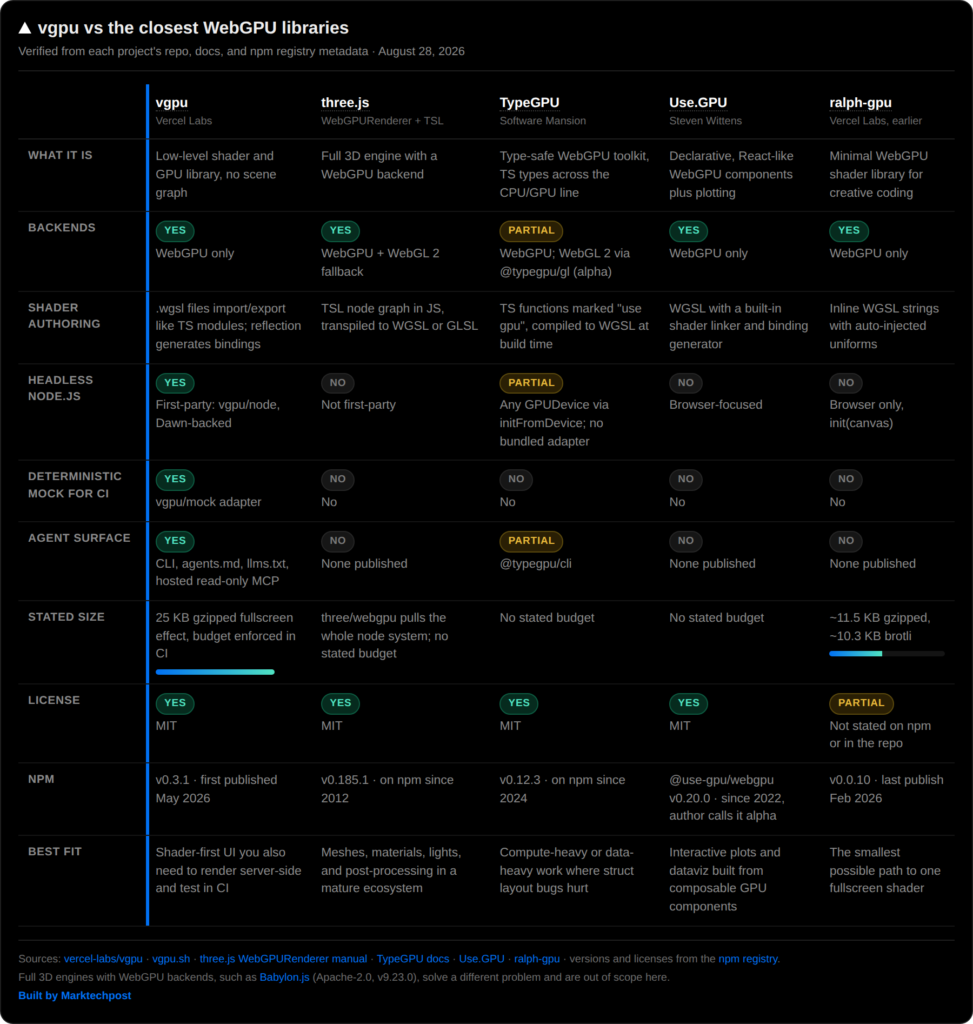
Vercel AI Open-Sources vgpu: A TypeScript WebGPU Library for AI Agent Shaders

Shaders are still the hardest thing to ship on a normal web team. WebGPU gives you the hardware, then hands you adapters, bind group layouts, and pipeline descriptors before a single pixel moves. Vercel spent that cost internally building the shaders on vercel.com, and has now open-sourced the result. vgpu is a TypeScript library that

Vercel AI Open-Sources vgpu: A TypeScript WebGPU Library for AI Agent Shaders Read More »

What Would Have to Be True for Agentic Coding to Replace Junior Engineers

I read every major model release. Most of them ship a coding number. The number goes up. The conclusion everyone draws is that junior engineers are finished. I think that conclusion is being reached the wrong way. People are reasoning from a benchmark score to a labor market outcome, skipping every step in between. So

What Would Have to Be True for Agentic Coding to Replace Junior Engineers Read More »