
Editors Pick

Auto Added by WPeMatico

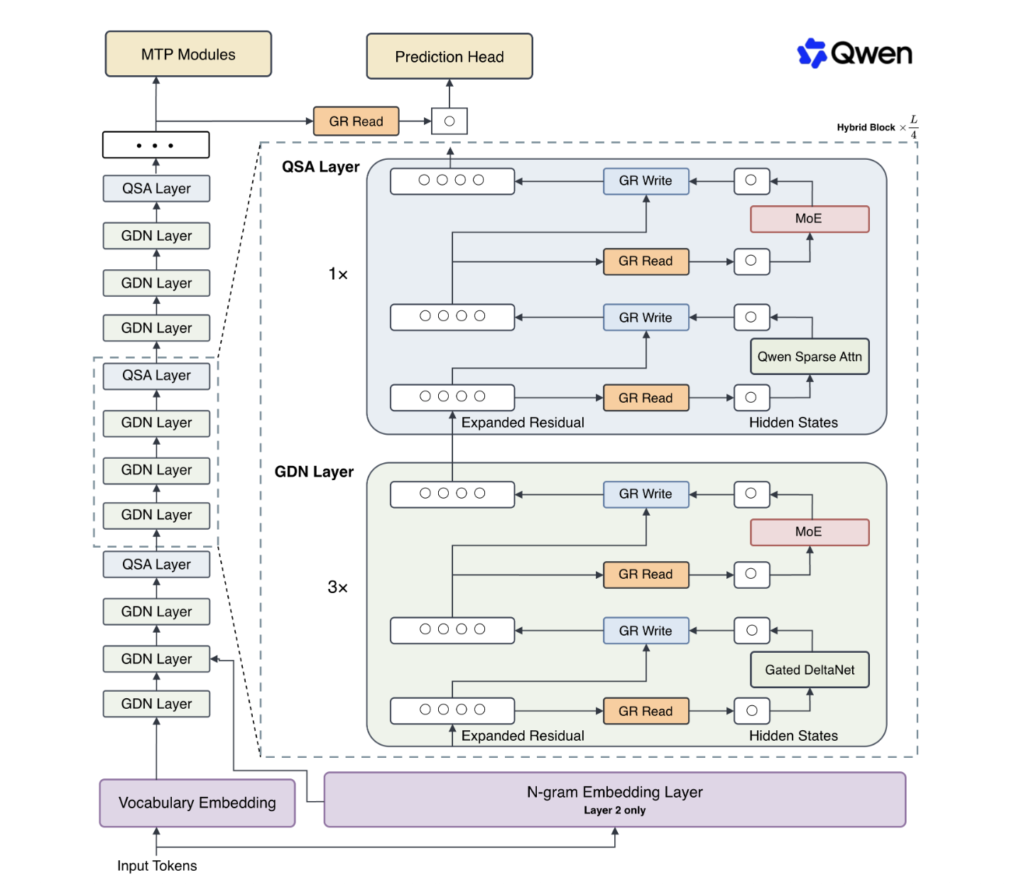
Alibaba’s Qwen Team Releases Qwen3.8-Flash-Next: A 125B Multimodal MoE With 6B Active Parameters Previewing the Qwen4 Architecture

Alibaba’s Qwen team has released Qwen3.8-Flash-Next, an open-weight multimodal Mixture-of-Experts model built for cost per token. The checkpoint pairs a 125B backbone with a 51B N-gram embedding table and a 4B multi-token prediction module. Only 6B parameters activate per token. The team positions it as an early preview of the architecture that will underpin Qwen4, […]

Alibaba’s Qwen Team Releases Qwen3.8-Flash-Next: A 125B Multimodal MoE With 6B Active Parameters Previewing the Qwen4 Architecture Read More »

What Would Have to Be True for Agentic Coding to Replace Junior Engineers

I read every major model release. Most of them ship a coding number. The number goes up. The conclusion everyone draws is that junior engineers are finished. I think that conclusion is being reached the wrong way. People are reasoning from a benchmark score to a labor market outcome, skipping every step in between. So

What Would Have to Be True for Agentic Coding to Replace Junior Engineers Read More »

IBM Releases Granite 4.2: Bringing Native Reasoning and Agentic RL to Open Enterprise Models

IBM has released Granite 4.2, a family of open reasoning language models in 3B, 8B, and 30B parameter sizes. Unlike earlier Granite releases, which were instruction-following assistants, Granite 4.2 is built around explicit reasoning. Every model can emit a chain of thought before answering, and every model exposes a thinking / non-thinking switch plus a

IBM Releases Granite 4.2: Bringing Native Reasoning and Agentic RL to Open Enterprise Models Read More »

Liquid AI Open-Sources Pipette: A Reproducible Benchmarking Suite That Measures On-Device Models, Quantization, Runtime and Hardware Together

Model cards report quality under server-class, full-precision conditions. Those numbers rarely predict how the same model behaves on a phone. This week, Liquid AI released Pipette. It is an open-source platform for benchmarking foundation models on edge devices, built in partnership with Artificial Analysis as an independent methodology validator. Pipette treats on-device behavior as a

Liquid AI Open-Sources Pipette: A Reproducible Benchmarking Suite That Measures On-Device Models, Quantization, Runtime and Hardware Together Read More »

Perplexity Ships Portable Computer on NVIDIA DGX Spark: Local Harness, OS-Enforced Sandbox, and Zero Per-Token Cost for Local Steps

Perplexity has released Portable Computer, a local-first build of its agentic Computer platform that runs the agent harness, orchestrator, planner, tool router and post-trained models directly on NVIDIA DGX Spark. The local model, inference engine, tool sandbox and app connectors ship as one packaged system, every task begins on the device, and work handled by

Perplexity Ships Portable Computer on NVIDIA DGX Spark: Local Harness, OS-Enforced Sandbox, and Zero Per-Token Cost for Local Steps Read More »

Meta AI Introduces MetaRoCE: A Clean-Sheet RDMA Transport Built for AI-Scale Ethernet

Training and serving frontier models is now a networking problem as much as a compute problem. Collective operations like all-reduce and all-to-all synchronize thousands of accelerators during training, and the slowest transfer sets the pace for the entire job. Even small amounts of network friction directly strand significant compute capacity. This week, Meta introduced MetaRoCE.

Meta AI Introduces MetaRoCE: A Clean-Sheet RDMA Transport Built for AI-Scale Ethernet Read More »

Fastino Releases GLiNER2.5: A Boundary-Prediction Architecture That Removes Span Enumeration From Information Extraction

Information extraction teams face a recurring choice. Small encoder models are cheap but rigid, and large language models are flexible but expensive per document. Fastino released GLiNER2.5 to narrow that gap. The release replaces span enumeration with boundary prediction: the model scores where an entity starts and ends instead of scoring every candidate span against

Fastino Releases GLiNER2.5: A Boundary-Prediction Architecture That Removes Span Enumeration From Information Extraction Read More »

Generalist AI Releases GEN-1.5: A Robot Foundation Model That Learns New Tasks From One 3–12 Second Demo

Generalist AI has released GEN-1.5, a robot foundation model that learns a new physical task from a single demonstration. Drop 3–12 seconds of sensorimotor data into its 30-second context window, and the robot performs the task. No gradient updates, no fine-tuning, no task-specific programming. Across 10 diverse manipulation tasks, this one-shot in-context prompting averaged 59%

Generalist AI Releases GEN-1.5: A Robot Foundation Model That Learns New Tasks From One 3–12 Second Demo Read More »

Google Research Introduces ME-POIs: A Mobility-Informed Framework that Adds “How a Place Is Used” to Text-Based POI Embeddings

A team from Google Research and USC has released Mobility-Embedded POIs (ME-POIs), a framework that folds aggregate human movement into text-based place embeddings. The premise is that language models describe what a place is, but not how it is used. Two coffee shops can share a category, an address block, and a text vector, while

Google Research Introduces ME-POIs: A Mobility-Informed Framework that Adds “How a Place Is Used” to Text-Based POI Embeddings Read More »

Best GPU Neoclouds 2026: CoreWeave, Nebius, Lambda, Crusoe, and Groq Ranked by Published Pricing and Contracted Power

The ‘neocloud’ label now covers five companies with very different business models. CoreWeave and Nebius are public companies that publish quarterly results and file reports with the SEC (CoreWeave on Form 10-Q, Nebius as a foreign private issuer on Form 6-K). Lambda and Crusoe are private and heading toward IPOs. Groq has run GroqCloud on

Best GPU Neoclouds 2026: CoreWeave, Nebius, Lambda, Crusoe, and Groq Ranked by Published Pricing and Contracted Power Read More »