
Editors Pick

Auto Added by WPeMatico

Building Custom Batched Ensemble Weather Forecasting with NVIDIA Earth2Studio

In this tutorial, we build an ensemble weather forecasting workflow with NVIDIA Earth2Studio. We install the required Earth2Studio components while preserving Colab’s existing CUDA-enabled PyTorch environment, load the FCN prognostic model, and retrieve atmospheric initial conditions from GFS. We then implement a custom wind-power diagnostic that converts 10-meter wind components into turbine capacity factors, along […]

Building Custom Batched Ensemble Weather Forecasting with NVIDIA Earth2Studio Read More »
Google AI Releases Gemini Omni 1.1 Flash: 40-Second Scene Extension, First/Last Frame Control, and 4K Upscaling

Google has released Gemini Omni 1.1 Flash (gemini-omni-1.1-flash), a production update to its native multimodal video generation and editing model. The release moves Omni from a capable generator to a directable one: scene extension now reads up to 10 seconds of prior context instead of a single final frame, first and last frames can be

Google AI Releases Gemini Omni 1.1 Flash: 40-Second Scene Extension, First/Last Frame Control, and 4K Upscaling Read More »

Hugging Face Unveils Microduck: A $399 Open-Source 25 cm Biped You Train with Reinforcement Learning

Most robotics launches ask you to trust a demo video. Pollen Robotics, the Bordeaux robotics team at Hugging Face, is instead shipping the training loop. This week it opened pre-orders for Microduck, a 25 cm bipedal robot in which every movement — walking, sitting, kicking, roller-skating, standing back up after a fall — is a

Hugging Face Unveils Microduck: A $399 Open-Source 25 cm Biped You Train with Reinforcement Learning Read More »

GLM-5.3-Flash vs Qwen3.8-Flash-Next: Two Chinese AI Labs Independently Converge on the Same Model Architecture

Two frontier open-weight models shipped within a day of each other this week. Z.ai released GLM-5.3-Flash, a 320B-parameter multimodal MoE model with 18B active parameters. Alibaba’s Qwen team released Qwen3.8-Flash-Next, a 125B model with 6B active parameters that previews the Qwen4 architecture. The two teams designed these systems independently. Yet their configs read like near-copies

GLM-5.3-Flash vs Qwen3.8-Flash-Next: Two Chinese AI Labs Independently Converge on the Same Model Architecture Read More »

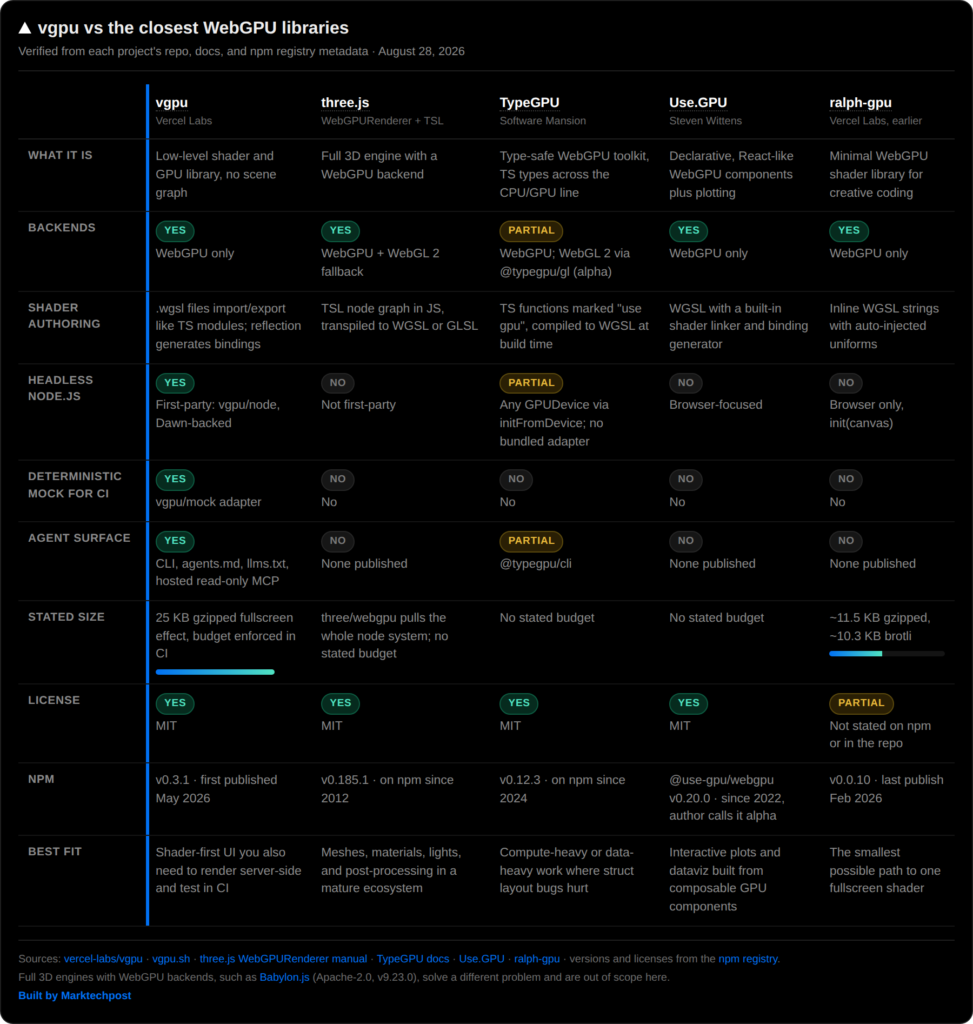
Vercel AI Open-Sources vgpu: A TypeScript WebGPU Library for AI Agent Shaders

Shaders are still the hardest thing to ship on a normal web team. WebGPU gives you the hardware, then hands you adapters, bind group layouts, and pipeline descriptors before a single pixel moves. Vercel spent that cost internally building the shaders on vercel.com, and has now open-sourced the result. vgpu is a TypeScript library that

Vercel AI Open-Sources vgpu: A TypeScript WebGPU Library for AI Agent Shaders Read More »

Google AI Releases Gemini 3.5 Transcribe: A Speech-to-Text Model Reporting 2.6% Average WER Across 85+ Languages

Google has released Gemini 3.5 Transcribe, a speech-to-text model for real-time voice interfaces and recorded audio. It ships as two endpoints, not one. gemini-3.5-transcribe handles pre-recorded files through the Interactions API. gemini-3.5-transcribe-live handles bidirectional streaming through the Live API. Google reports average word error rates of 4.0% streaming and 2.6% non-streaming, as measured by Artificial

Google AI Releases Gemini 3.5 Transcribe: A Speech-to-Text Model Reporting 2.6% Average WER Across 85+ Languages Read More »

Cohere Releases Parse 5 (parse-v5.0): A 2.3B Vision Language Model That Turns Enterprise Documents Into Markdown

Cohere has released Parse (parse-v5.0), a document parsing model aimed at high-volume enterprise ingestion. It is a 2.3B-parameter vision language model with an 8,192-token context window and a ~4.6GB footprint, built on Cohere Labs’ North-Micro-Vision-Instruct architecture. Parse takes a PDF, PPT or JPEG page as a base64-encoded data URI and returns Markdown containing text in

Cohere Releases Parse 5 (parse-v5.0): A 2.3B Vision Language Model That Turns Enterprise Documents Into Markdown Read More »

Best Agent Sandboxes in 2026: Cold Start, Per-Second Pricing, and Network Policy Across E2B, Daytona, Modal, Cloudflare, and Vercel

Every agent that writes code needs somewhere to run it. That “somewhere” is now a product category with at least a dozen vendors, four incompatible billing models, and marketing pages that quote cold starts measured under conditions nobody publishes. This comparison fixes the units. It covers the five platforms most teams shortlist — E2B, Daytona,

Best Agent Sandboxes in 2026: Cold Start, Per-Second Pricing, and Network Policy Across E2B, Daytona, Modal, Cloudflare, and Vercel Read More »

From In-Silico to Wet-Lab: Evaluating AI Protein Design Performance

In this tutorial, we use Anthropic’s claude-protein-binder-design dataset, which contains 1,440 AI-designed miniprotein binders tested against 16 targets. Because the release includes both computational predictions and real wet-lab results from two independent labs, we can go beyond simply studying the designs. We evaluate how well structure predictors identify successful binders, whether combining predictions improves performance,

From In-Silico to Wet-Lab: Evaluating AI Protein Design Performance Read More »

Google Research Introduces GlucoFM: A 0.72M-Parameter Dual-Stream Foundation Model for Continuous Glucose Monitoring

Google Research and UNSW Sydney have released GlucoFM, a self-supervised foundation model for continuous glucose monitoring. Its core move is a split. Existing CGM models — CGMformer, GluFormer, CGM-JEPA — encode a glucose trace as one entangled sequence. GlucoFM decomposes it into a slow physiological “state” stream and a transient “event” stream, keeps the observation

Google Research Introduces GlucoFM: A 0.72M-Parameter Dual-Stream Foundation Model for Continuous Glucose Monitoring Read More »