AI Paper Summary

Auto Added by WPeMatico

NVIDIA Researchers Introduce KVTC Transform Coding Pipeline to Compress Key-Value Caches by 20x for Efficient LLM Serving

Serving Large Language Models (LLMs) at scale is a massive engineering challenge because of Key-Value (KV) cache management. As models grow in size and reasoning capability, the KV cache footprint increases and becomes a major bottleneck for throughput and latency. For modern Transformers, this cache can occupy multiple gigabytes. NVIDIA researchers have introduced KVTC (KV […]

NVIDIA Researchers Introduce KVTC Transform Coding Pipeline to Compress Key-Value Caches by 20x for Efficient LLM Serving Read More »

Microsoft AI Proposes OrbitalBrain: Enabling Distributed Machine Learning in Space with Inter-Satellite Links and Constellation-Aware Resource Optimization Strategies

Earth observation (EO) constellations capture huge volumes of high-resolution imagery every day, but most of it never reaches the ground in time for model training. Downlink bandwidth is the main bottleneck. Images can sit on orbit for days while ground models train on partial and delayed data. Microsoft Researchers introduced ‘OrbitalBrain’ framework as a different

Microsoft AI Proposes OrbitalBrain: Enabling Distributed Machine Learning in Space with Inter-Satellite Links and Constellation-Aware Resource Optimization Strategies Read More »

Google AI Introduces PaperBanana: An Agentic Framework that Automates Publication Ready Methodology Diagrams and Statistical Plots

Generating publication-ready illustrations is a labor-intensive bottleneck in the research workflow. While AI scientists can now handle literature reviews and code, they struggle to visually communicate complex discoveries. A research team from Google and Peking University introduce new framework called ‘PaperBanana‘ which is changing that by using a multi-agent system to automate high-quality academic diagrams

Google AI Introduces PaperBanana: An Agentic Framework that Automates Publication Ready Methodology Diagrams and Statistical Plots Read More »

NVIDIA AI releases C-RADIOv4 vision backbone unifying SigLIP2, DINOv3, SAM3 for classification, dense prediction, segmentation workloads at scale

How do you combine SigLIP2, DINOv3, and SAM3 into a single vision backbone without sacrificing dense or segmentation performance? NVIDIA’s C-RADIOv4 is a new agglomerative vision backbone that distills three strong teacher models, SigLIP2-g-384, DINOv3-7B, and SAM3, into a single student encoder. It extends the AM-RADIO and RADIOv2.5 line, keeping similar computational cost while improving

NVIDIA AI releases C-RADIOv4 vision backbone unifying SigLIP2, DINOv3, SAM3 for classification, dense prediction, segmentation workloads at scale Read More »

NVIDIA AI Release VibeTensor: An AI Generated Deep Learning Runtime Built End to End by Coding Agents Programmatically

NVIDIA has released VIBETENSOR, an open-source research system software stack for deep learning. VIBETENSOR is generated by LLM-powered coding agents under high-level human guidance. The system asks a concrete question: can coding agents generate a coherent deep learning runtime that spans Python and JavaScript APIs down to C++ runtime components and CUDA memory management and

NVIDIA AI Release VibeTensor: An AI Generated Deep Learning Runtime Built End to End by Coding Agents Programmatically Read More »

Qwen Team Releases Qwen3-Coder-Next: An Open-Weight Language Model Designed Specifically for Coding Agents and Local Development

Qwen team has just released Qwen3-Coder-Next, an open-weight language model designed for coding agents and local development. It sits on top of the Qwen3-Next-80B-A3B backbone. The model uses a sparse Mixture-of-Experts (MoE) architecture with hybrid attention. It has 80B total parameters, but only 3B parameters are activated per token. The goal is to match the

Qwen Team Releases Qwen3-Coder-Next: An Open-Weight Language Model Designed Specifically for Coding Agents and Local Development Read More »

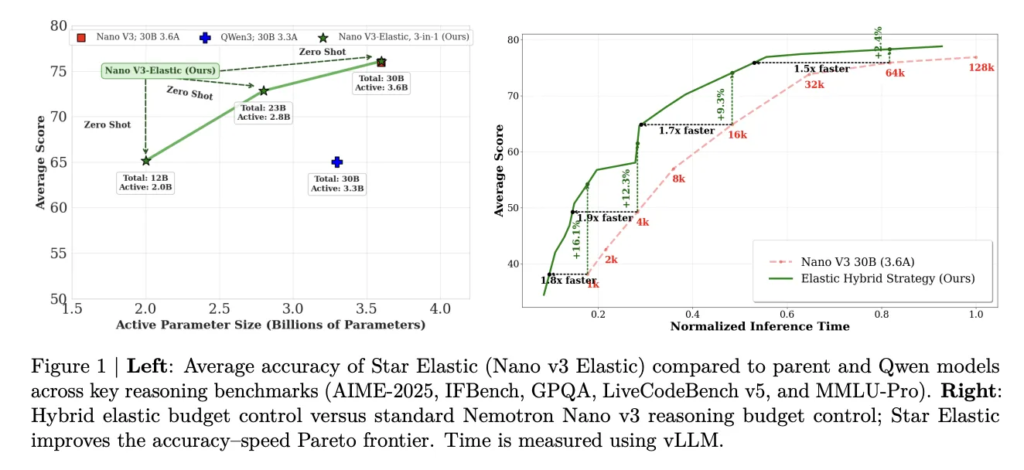
NVIDIA AI Brings Nemotron-3-Nano-30B to NVFP4 with Quantization Aware Distillation (QAD) for Efficient Reasoning Inference

NVIDIA has released Nemotron-Nano-3-30B-A3B-NVFP4, a production checkpoint that runs a 30B parameter reasoning model in 4 bit NVFP4 format while keeping accuracy close to its BF16 baseline. The model combines a hybrid Mamba2 Transformer Mixture of Experts architecture with a Quantization Aware Distillation (QAD) recipe designed specifically for NVFP4 deployment. Overall, it is an ultra-efficient

NVIDIA AI Brings Nemotron-3-Nano-30B to NVFP4 with Quantization Aware Distillation (QAD) for Efficient Reasoning Inference Read More »

Robbyant Open Sources LingBot World: a Real Time World Model for Interactive Simulation and Embodied AI

Robbyant, the embodied AI unit inside Ant Group, has open sourced LingBot-World, a large scale world model that turns video generation into an interactive simulator for embodied agents, autonomous driving and games. The system is designed to render controllable environments with high visual fidelity, strong dynamics and long temporal horizons, while staying responsive enough for

Robbyant Open Sources LingBot World: a Real Time World Model for Interactive Simulation and Embodied AI Read More »

AI2 Releases SERA, Soft Verified Coding Agents Built with Supervised Training Only for Practical Repository Level Automation Workflows

Allen Institute for AI (AI2) Researchers introduce SERA, Soft Verified Efficient Repository Agents, as a coding agent family that aims to match much larger closed systems using only supervised training and synthetic trajectories. What is SERA? SERA is the first release in AI2’s Open Coding Agents series. The flagship model, SERA-32B, is built on the

AI2 Releases SERA, Soft Verified Coding Agents Built with Supervised Training Only for Practical Repository Level Automation Workflows Read More »

DeepSeek AI Releases DeepSeek-OCR 2 with Causal Visual Flow Encoder for Layout Aware Document Understanding

DeepSeek AI released DeepSeek-OCR 2, an open source document OCR and understanding system that restructures its vision encoder to read pages in a causal order that is closer to how humans scan complex documents. The key component is DeepEncoder V2, a language model style transformer that converts a 2D page into a 1D sequence of

DeepSeek AI Releases DeepSeek-OCR 2 with Causal Visual Flow Encoder for Layout Aware Document Understanding Read More »