AI Paper Summary

Auto Added by WPeMatico

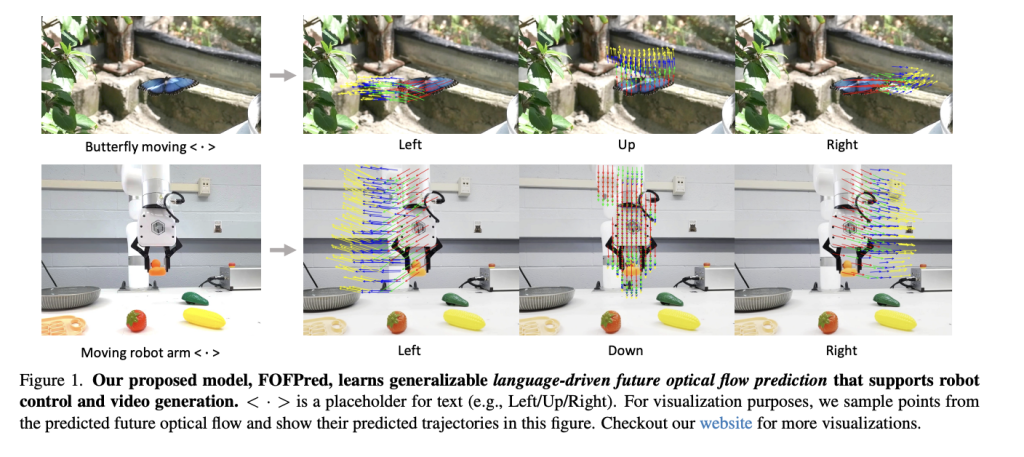
Salesforce AI Introduces FOFPred: A Language-Driven Future Optical Flow Prediction Framework that Enables Improved Robot Control and Video Generation

Salesforce AI research team present FOFPred, a language driven future optical flow prediction framework that connects large vision language models with diffusion transformers for dense motion forecasting in control and video generation settings. FOFPred takes one or more images and a natural language instruction such as ‘moving the bottle from right to left’ and predicts […]
Salesforce AI Introduces FOFPred: A Language-Driven Future Optical Flow Prediction Framework that Enables Improved Robot Control and Video Generation Read More »

Microsoft Research Releases OptiMind: A 20B Parameter Model that Turns Natural Language into Solver Ready Optimization Models

Microsoft Research has released OptiMind, an AI based system that converts natural language descriptions of complex decision problems into mathematical formulations that optimization solvers can execute. It targets a long standing bottleneck in operations research, where translating business intent into mixed integer linear programs usually needs expert modelers and days of work. What OptiMind Is

Microsoft Research Releases OptiMind: A 20B Parameter Model that Turns Natural Language into Solver Ready Optimization Models Read More »

Google AI Releases TranslateGemma: A New Family of Open Translation Models Built on Gemma 3 with Support for 55 Languages

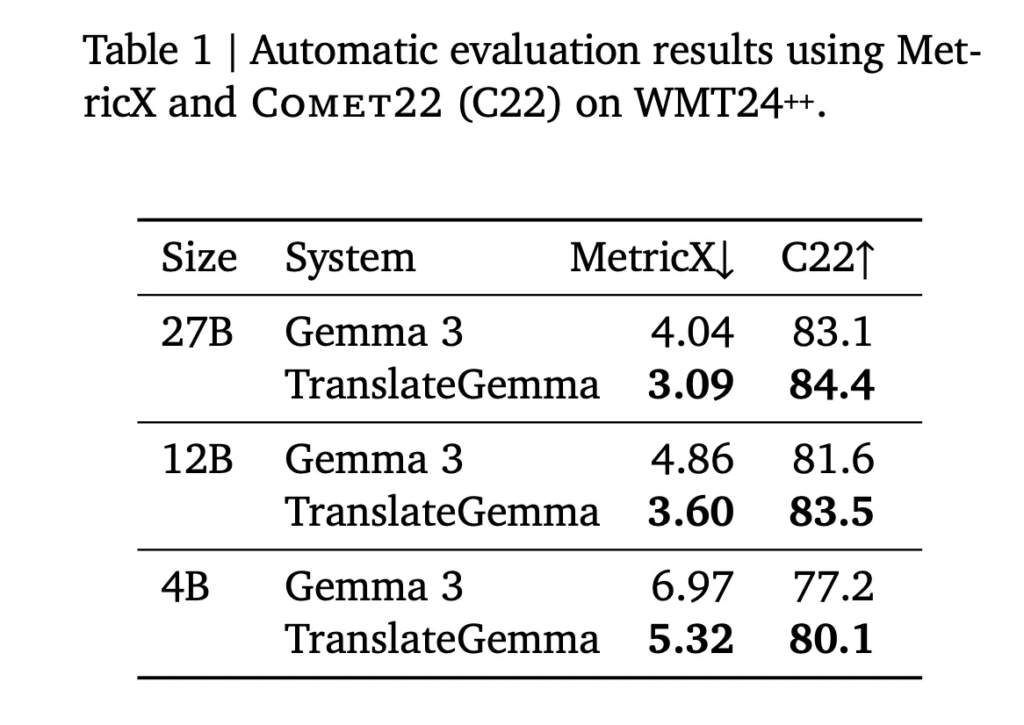
Google AI has released TranslateGemma, a suite of open machine translation models built on Gemma 3 and targeted at 55 languages. The family comes in 4B, 12B and 27B parameter sizes. It is designed to run across devices from mobile and edge hardware to laptops and a single H100 GPU or TPU instance in the

Google AI Releases TranslateGemma: A New Family of Open Translation Models Built on Gemma 3 with Support for 55 Languages Read More »

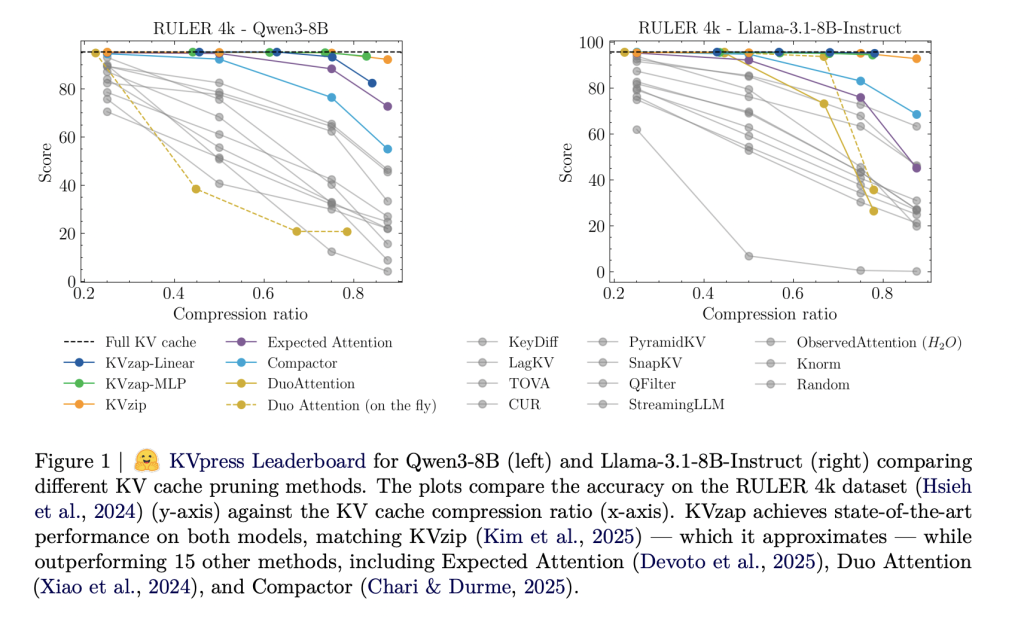
NVIDIA AI Open-Sourced KVzap: A SOTA KV Cache Pruning Method that Delivers near-Lossless 2x-4x Compression

As context lengths move into tens and hundreds of thousands of tokens, the key value cache in transformer decoders becomes a primary deployment bottleneck. The cache stores keys and values for every layer and head with shape (2, L, H, T, D). For a vanilla transformer such as Llama1-65B, the cache reaches about 335 GB

NVIDIA AI Open-Sourced KVzap: A SOTA KV Cache Pruning Method that Delivers near-Lossless 2x-4x Compression Read More »

DeepSeek AI Researchers Introduce Engram: A Conditional Memory Axis For Sparse LLMs

Transformers use attention and Mixture-of-Experts to scale computation, but they still lack a native way to perform knowledge lookup. They re-compute the same local patterns again and again, which wastes depth and FLOPs. DeepSeek’s new Engram module targets exactly this gap by adding a conditional memory axis that works alongside MoE rather than replacing it.

DeepSeek AI Researchers Introduce Engram: A Conditional Memory Axis For Sparse LLMs Read More »

How This Agentic Memory Research Unifies Long Term and Short Term Memory for LLM Agents

How do you design an LLM agent that decides for itself what to store in long term memory, what to keep in short term context and what to discard, without hand tuned heuristics or extra controllers? Can a single policy learn to manage both memory types through the same action space as text generation? Researchers

How This Agentic Memory Research Unifies Long Term and Short Term Memory for LLM Agents Read More »

Meta and Harvard Researchers Introduce the Confucius Code Agent (CCA): A Software Engineering Agent that can Operate at Large-Scale Codebases

How far can a mid sized language model go if the real innovation moves from the backbone into the agent scaffold and tool stack? Meta and Harvard researchers have released the Confucius Code Agent, an open sourced AI software engineer built on the Confucius SDK that is designed for industrial scale software repositories and long

Meta and Harvard Researchers Introduce the Confucius Code Agent (CCA): A Software Engineering Agent that can Operate at Large-Scale Codebases Read More »

Stanford Researchers Build SleepFM Clinical: A Multimodal Sleep Foundation AI Model for 130+ Disease Prediction

A team of Stanford Medicine researchers have introduced SleepFM Clinical, a multimodal sleep foundation model that learns from clinical polysomnography and predicts long term disease risk from a single night of sleep. The research work is published in Nature Medicine and the team has released the clinical code as the open source sleepfm-clinical repository on

Stanford Researchers Build SleepFM Clinical: A Multimodal Sleep Foundation AI Model for 130+ Disease Prediction Read More »

Tencent Researchers Release Tencent HY-MT1.5: A New Translation Models Featuring 1.8B and 7B Models Designed for Seamless on-Device and Cloud Deployment

Tencent Hunyuan researchers have released HY-MT1.5, a multilingual machine translation family that targets both mobile devices and cloud systems with the same training recipe and metrics. HY-MT1.5 consists of 2 translation models, HY-MT1.5-1.8B and HY-MT1.5-7B, supports mutual translation across 33 languages with 5 ethnic and dialect variations, and is available on GitHub and Hugging Face

Tencent Researchers Release Tencent HY-MT1.5: A New Translation Models Featuring 1.8B and 7B Models Designed for Seamless on-Device and Cloud Deployment Read More »

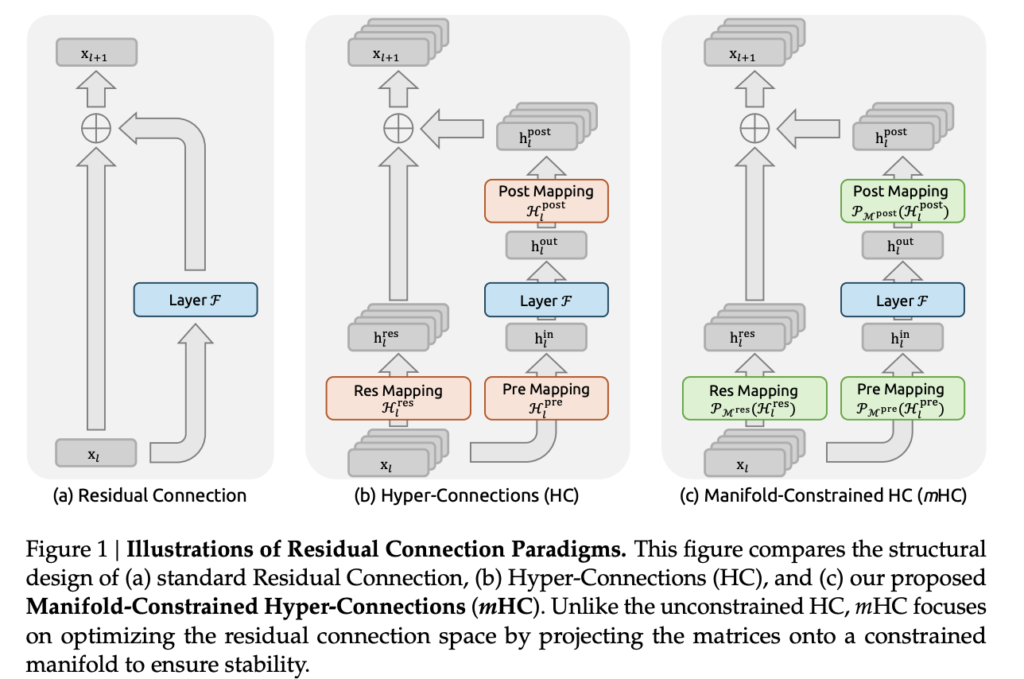
DeepSeek Researchers Apply a 1967 Matrix Normalization Algorithm to Fix Instability in Hyper Connections

DeepSeek researchers are trying to solve a precise issue in large language model training. Residual connections made very deep networks trainable, hyper connections widened that residual stream, and training then became unstable at scale. The new method mHC, Manifold Constrained Hyper Connections, keeps the richer topology of hyper connections but locks the mixing behavior on

DeepSeek Researchers Apply a 1967 Matrix Normalization Algorithm to Fix Instability in Hyper Connections Read More »