Tech News

Auto Added by WPeMatico

Mistral AI Releases Robostral Navigate: An 8B Model Enabling Robots to Navigate Complex Environments Using a Single RGB Camera

Mistral AI has released Robostral Navigate, its first model built for embodied navigation. The 8B model takes RGB images and a plain-language instruction, then moves a robot. Notably, it reaches 76.6% success on R2R-CE validation unseen using only a single RGB camera. What is Robostral Navigate? Robostral Navigate is an 8B model for robotic navigation […]
Mistral AI Releases Robostral Navigate: An 8B Model Enabling Robots to Navigate Complex Environments Using a Single RGB Camera Read More »

Anthropic Claude Sonnet 5 vs Sonnet 4.6 vs Opus 4.8: Agentic Coding Benchmarks, API Pricing, and Cost-Performance Tradeoffs Compared

Anthropic just shipped Claude Sonnet 5. They call it its most agentic Sonnet model yet. It plans, drives browsers and terminals, and runs autonomously across long tasks. Sonnet 5 is the default model for Free and Pro plans today. Max, Team, and Enterprise users can select it. It is also live in Claude Code and

Anthropic Claude Sonnet 5 vs Sonnet 4.6 vs Opus 4.8: Agentic Coding Benchmarks, API Pricing, and Cost-Performance Tradeoffs Compared Read More »

Skyfall AI Releases MORPHEUS: A Persistent Enterprise Simulation Benchmark That Makes Continual Reinforcement Learning Necessary Under Structured Non-Stationarity

Most reinforcement learning benchmarks reset the world after every episode. Real operations never reset. Skyfall AI’s MORPHEUS targets that gap. It is a persistent enterprise simulation platform for continual reinforcement learning (CRL). What is MORPHEUS? MORPHEUS is grounded in the Big World Hypothesis (Javed & Sutton, 2024). It says the world’s complexity exceeds any agent’s

Skyfall AI Releases MORPHEUS: A Persistent Enterprise Simulation Benchmark That Makes Continual Reinforcement Learning Necessary Under Structured Non-Stationarity Read More »

🔒

Stanford Researchers Introduce TRACE: A Capability-Targeted Agentic Training System That Turns Recurrent Agent Failures Into Synthetic RL Environment

Agentic LLMs often fail the same way, again and again. A Stanford research team traced this to missing, reusable capabilities. Their system, TRACE, diagnoses those gaps and trains for them directly. TRACE stands for Turning Recurrent Agent failures into Capability-targeted training Environments. It was released open-source under an MIT license. What problem does TRACE solve?

Stanford Researchers Introduce TRACE: A Capability-Targeted Agentic Training System That Turns Recurrent Agent Failures Into Synthetic RL Environment Read More »

Prime Intellect Releases Verifiers v1: Composable Tasksets, Harnesses, and Runtimes for Agentic RL Training and Evaluations

Prime Intellect launched verifiers 0.2.0. It previews a rewritten core, shipped under the new verifiers.v1 namespace. Modern evaluations now run coding agents with tools, compaction, and subagents. Accordingly, v1 rebuilds environments to run these agentic workloads at scale. What is verifiers v1? First, consider what verifiers is: Prime Intellect’s environment stack for agentic reinforcement learning

Prime Intellect Releases Verifiers v1: Composable Tasksets, Harnesses, and Runtimes for Agentic RL Training and Evaluations Read More »

▶

Meet NeuroVFM: A New Neuroimaging Foundation Model Trained With Vol-JEPA on Uncurated Clinical MRI and CT Volumes

Frontier models learn mostly from public internet data. However, clinical neuroimaging rarely appears there, because MRI and CT scans contain identifiable facial features. Consequently, general models underperform on brain-imaging tasks. A University of Michigan research team addresses this gap with NeuroVFM, published in Nature Medicine. What is NeuroVFM? At its core, NeuroVFM is a generalist

Meet NeuroVFM: A New Neuroimaging Foundation Model Trained With Vol-JEPA on Uncurated Clinical MRI and CT Volumes Read More »

🍳

Mira Murati’s Thinking Machines Lab Makes The Technical Case For Human-Centered AI Built On Customizable Model Weights

Thinking Machines Lab published a report to build AI that extends human will and judgment. Most AI in use today is trained in a handful of places, then frozen. The report argues that this design excludes the people a model serves. Instead, the Thinking Machines lab researchers want AI that is distributed, customizable, and shaped

Mira Murati’s Thinking Machines Lab Makes The Technical Case For Human-Centered AI Built On Customizable Model Weights Read More »

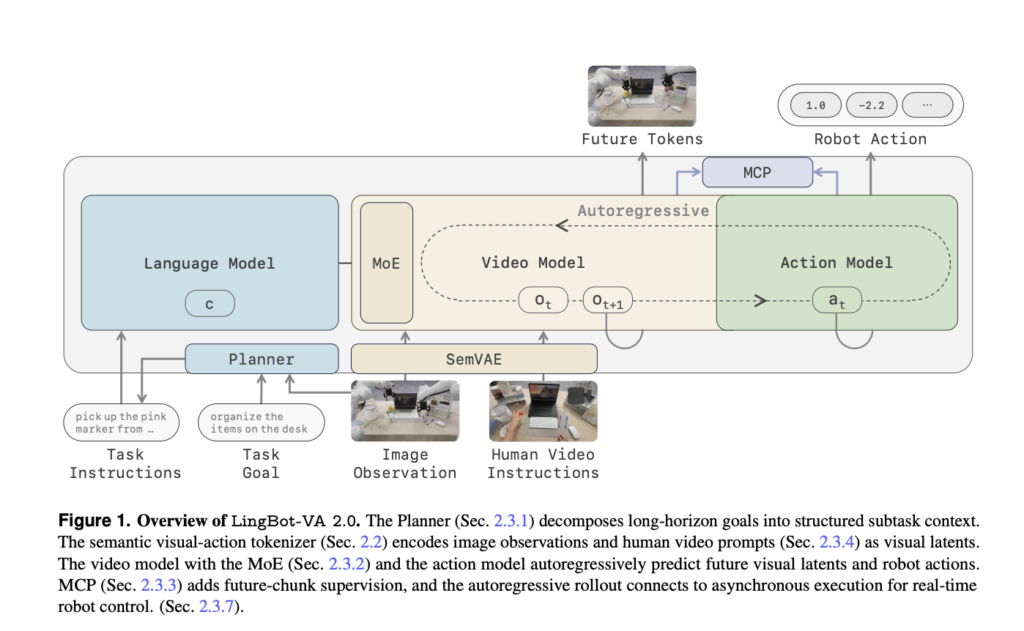
Ant Group’s Robbyant Unveils LingBot-VA 2.0: A Causal Video-Action Model Built Natively for Physical AI

Robbyant, the embodied AI unit inside Ant Group, has released the LingBot-VA 2.0.The first embodied-native foundation model. It describes a video-action foundation model for generalist robot manipulation. The research team pretrains the whole stack for embodiment instead of fine-tuning a video generator. What is LingBot-VA 2.0? Most video-action models reuse two components built for digital

Ant Group’s Robbyant Unveils LingBot-VA 2.0: A Causal Video-Action Model Built Natively for Physical AI Read More »

▶

Kyutai Releases MuScriptor: An Open-Weight Decoder-Only Transformer for Multi-Instrument Music Transcription to MIDI

Automatic Music Transcription (AMT) converts an audio recording into symbolic notes, usually MIDI. Single-instrument transcription already works reasonably well. However, transcribing a full multi-instrument mix stays difficult. Kyutai and Mirelo team now release MuScriptor to close that gap. It is an open-weight model trained on real, multi-instrument recordings across many genres. This article explains how

Kyutai Releases MuScriptor: An Open-Weight Decoder-Only Transformer for Multi-Instrument Music Transcription to MIDI Read More »

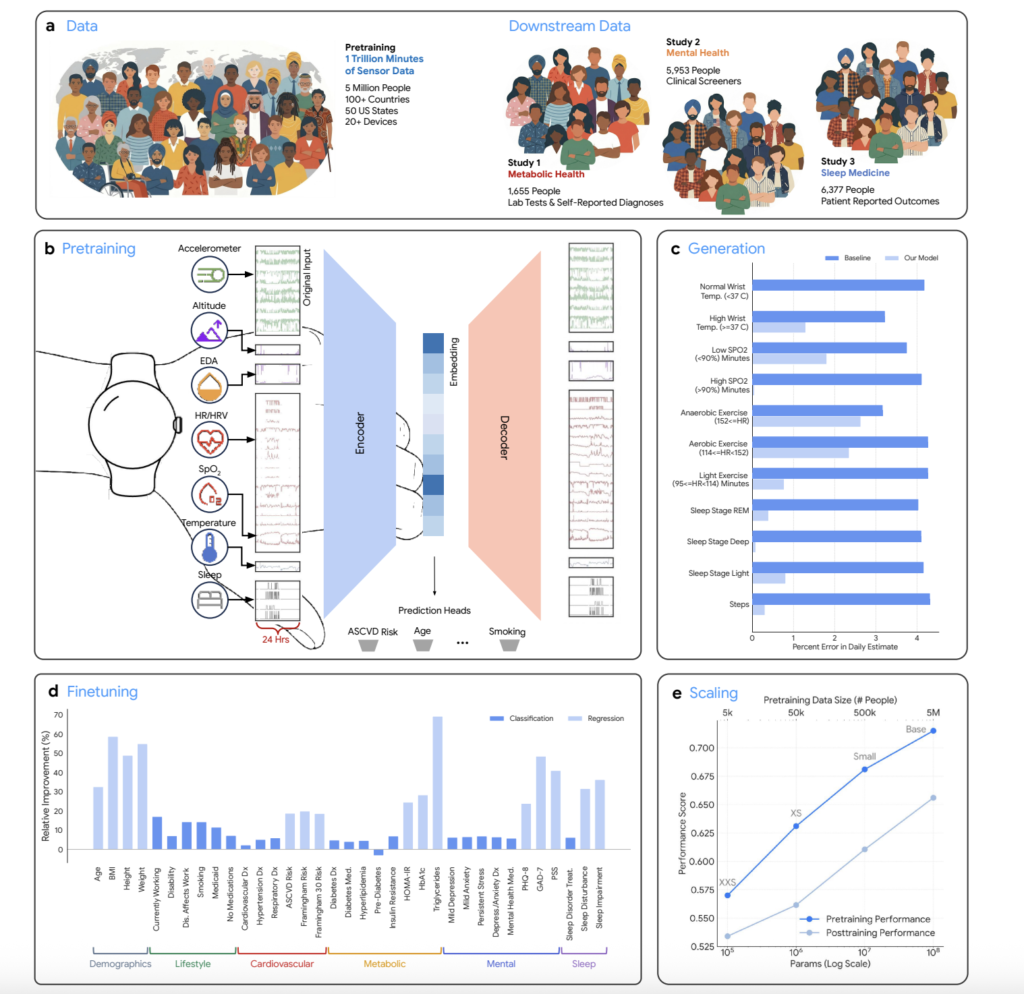
Google Research Introduces SensorFM: A Wearable Health Foundation Model Pretrained on One Trillion Minutes of Sensor Data

Most wearable health models are built one outcome at a time. That approach breaks down at thirty-five endpoints. Labels are expensive and retrospective annotation is infeasible. Google Research introduced SensorFM, a foundation model for wearable health pre-trained on more than 1 trillion minutes of sensor data from 5 million people. https://arxiv.org/pdf/2605.22759 What is SensorFM? SensorFM

Google Research Introduces SensorFM: A Wearable Health Foundation Model Pretrained on One Trillion Minutes of Sensor Data Read More »