Python

Auto Added by WPeMatico

LandingAI Releases Agentic Document Extraction Gen2 with DPT-3 Pro and DPT-3 Verity

LandingAI has shipped Agentic Document Extraction (ADE) Gen2, a rebuild of its document intelligence stack around a new model family called DPT-3. Gen1 treated a document as a flat list of chunks. Gen2 treats it as a tree, prices it by the characters it returns rather than by the page, and grounds every answer back

LandingAI Releases Agentic Document Extraction Gen2 with DPT-3 Pro and DPT-3 Verity Read More »
H Company Releases NeoMME: A Family of 260M and 800M Single-Tower Multimodal Encoders That Drop the Vision Tower and Causal Decoder

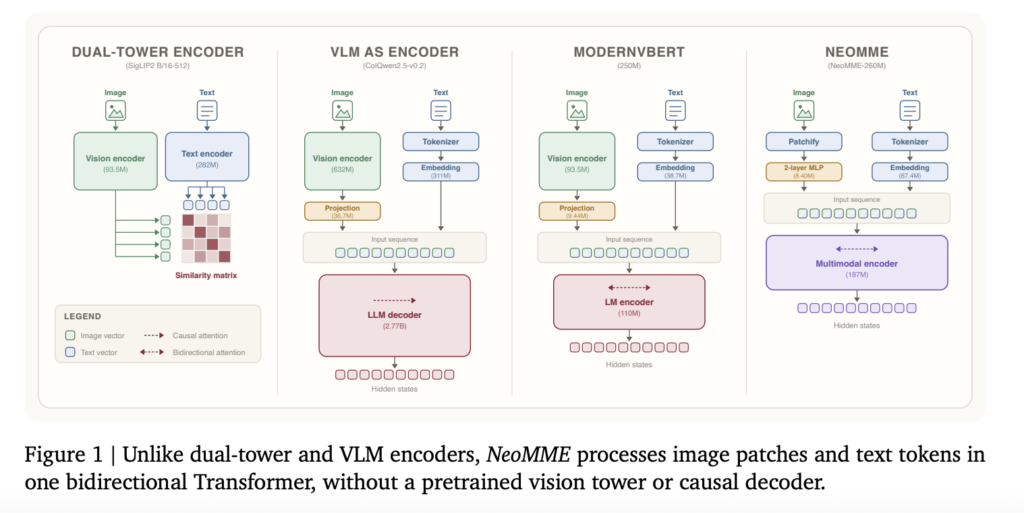
Most visual document retrievers in production today are hand-me-downs. ColPali and the models that followed it take a generative vision-language model and repurpose it as an encoder. The result still carries a separately pretrained vision tower and a causal decoder that never generates a token. That is parameter and compute overhead for a task that

H Company Releases NeoMME: A Family of 260M and 800M Single-Tower Multimodal Encoders That Drop the Vision Tower and Causal Decoder Read More »

GitHub Introduces Project HydraFusion: Runtime Multi-Model Orchestration That Builds a Workflow Per Coding Task in Copilot CLI

GitHub has released Project HydraFusion, a research preview that stops treating model choice as a one-time setting. Instead of routing your prompt to a single model, HydraFusion builds an execution plan per request. It can draft with one model, have a second model critique the draft, or escalate to a stronger model when a quality

GitHub Introduces Project HydraFusion: Runtime Multi-Model Orchestration That Builds a Workflow Per Coding Task in Copilot CLI Read More »

Qwen Developers Open-Sources zg (zvec-grep): A Local-First Search Layer Unifying ripgrep, BM25, and Vector Search

Coding agents spend a large share of their tool budget on search. When the target is a known symbol, ripgrep answers it exactly. When the target is a behavior described in plain language, keyword matching often misses, and the agent falls back to guessing terms, reading whole files, and assembling context by hand. Each of

Qwen Developers Open-Sources zg (zvec-grep): A Local-First Search Layer Unifying ripgrep, BM25, and Vector Search Read More »

Google AI Releases TimesFM-3: A 330M Parameter Zero-Shot Foundation Model For Multivariate Time Series Forecasting

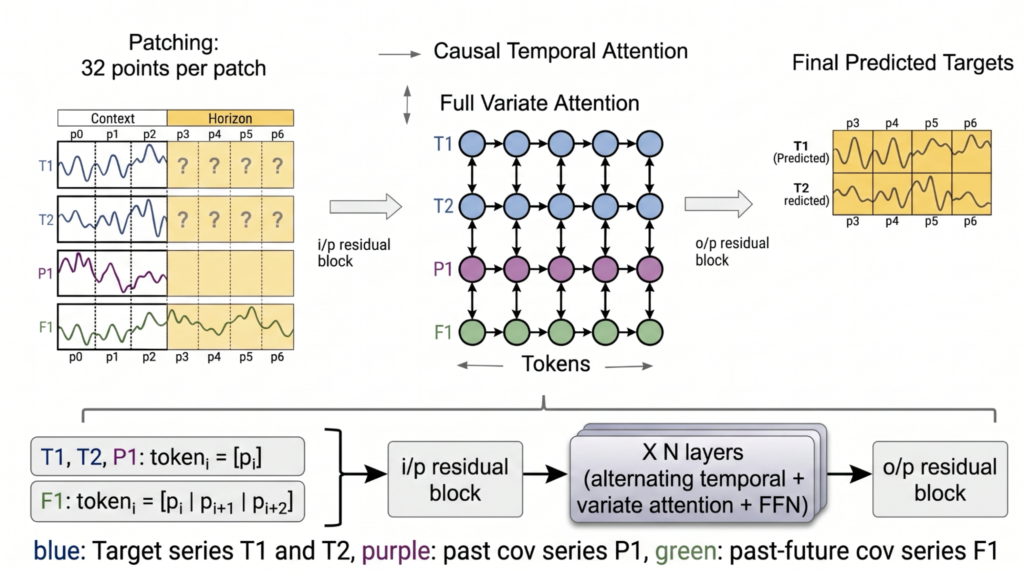
Google Research has released TimesFM-3, a 330 million parameter time series foundation model that forecasts multiple related series in a single forward pass. Every TimesFM checkpoint through 2.5 was univariate: one series, its own history, nothing else. TimesFM-3 is pretrained natively for multivariate forecasting on more than 1 trillion time points, and accepts multiple targets,

Google AI Releases TimesFM-3: A 330M Parameter Zero-Shot Foundation Model For Multivariate Time Series Forecasting Read More »

OpenClaw Releases OpenClaw 2.0: Guided Model Setup, 575 ms Control UI Startup, and One Trust Boundary Per Gateway

The OpenClaw team has just released OpenClaw 2.0. The team shipped nothing for nearly seven weeks, after 106 releases in the previous 230 days. The update rewrites installation and rebuilds the browser Control UI. It also moves sessions and transcripts into SQLite and adds shared cloud sessions. Is it deployable? Yes for single-operator and single-team

OpenClaw Releases OpenClaw 2.0: Guided Model Setup, 575 ms Control UI Startup, and One Trust Boundary Per Gateway Read More »

Vercel AI Open-Sources vgpu: A TypeScript WebGPU Library for AI Agent Shaders

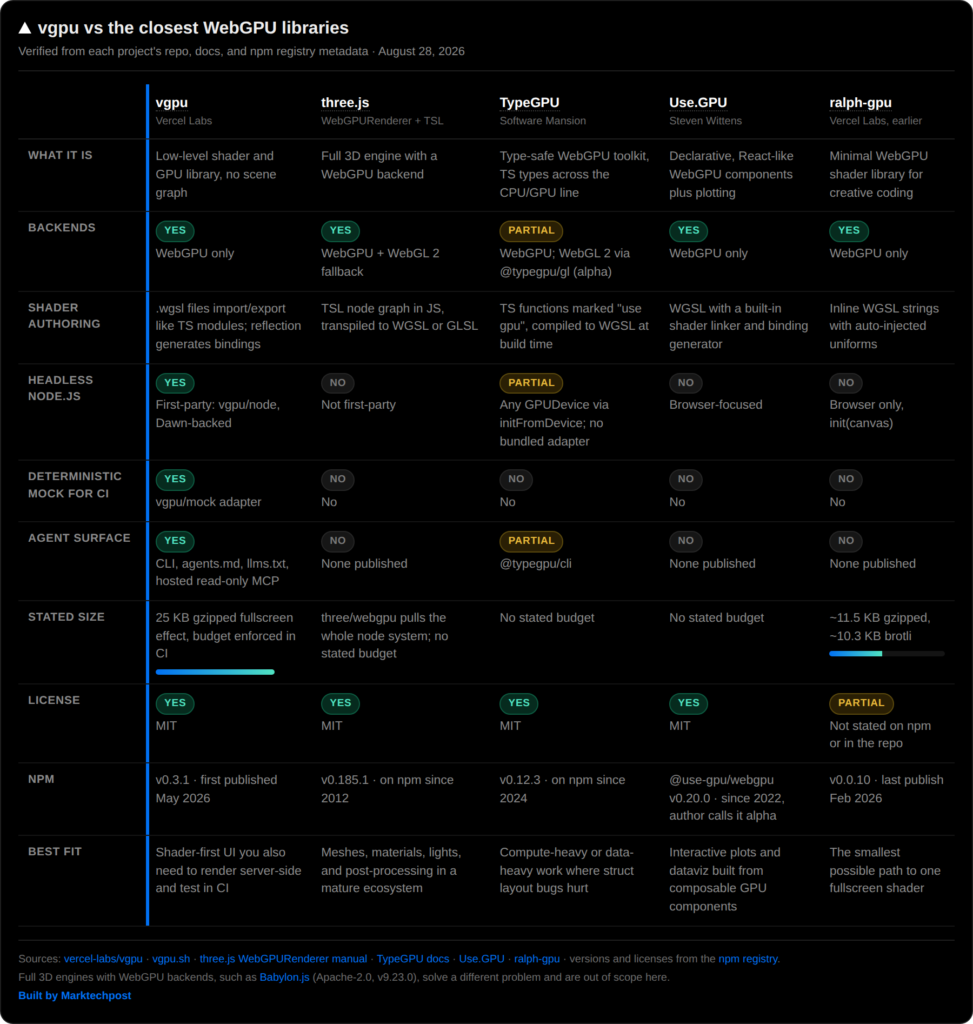
Shaders are still the hardest thing to ship on a normal web team. WebGPU gives you the hardware, then hands you adapters, bind group layouts, and pipeline descriptors before a single pixel moves. Vercel spent that cost internally building the shaders on vercel.com, and has now open-sourced the result. vgpu is a TypeScript library that

Vercel AI Open-Sources vgpu: A TypeScript WebGPU Library for AI Agent Shaders Read More »

How to Remove Claude Watermarks from Text, Code, and Files

Claude now marks AI-generated content. But it does not mark everything the same way. Anthropic currently uses embedded watermarks for text and signed C2PA provenance metadata for supported files. Code sits somewhere in between: it is still text, but its structure gives the watermark fewer places to work. I went into detail about Claude’s watermarks

How to Remove Claude Watermarks from Text, Code, and Files Read More »

NVIDIA Releases TensorRT Model Connect in Public Preview: Hugging Face Checkpoint to Native C++ Inference in Two Commands

NVIDIA has released TensorRT Model Connect (TRTMC) in public preview, an open-source project that takes a supported Hugging Face or local checkpoint to end-to-end TensorRT inference in two commands. There is no intermediate ONNX export step. The build produces a versioned .bundle artifact that runs through native C++ task APIs, so inference can execute in

NVIDIA Releases TensorRT Model Connect in Public Preview: Hugging Face Checkpoint to Native C++ Inference in Two Commands Read More »

NVIDIA Releases NemotronLabs VoiceChat 11B: An Open Full-Duplex Speech-to-Speech Model with ~450 ms Turn-Taking and Live Tool Calling

NVIDIA has released NemotronLabs VoiceChat 11B, an open 11B end-to-end speech-to-speech model for real-time, full-duplex conversation. Instead of chaining ASR, an LLM, and TTS, it performs streaming speech understanding and speech generation in one unified network. That removes the multi-model orchestration and API handoffs a cascaded stack requires, and cuts end-to-end latency: measured smooth turn-taking

NVIDIA Releases NemotronLabs VoiceChat 11B: An Open Full-Duplex Speech-to-Speech Model with ~450 ms Turn-Taking and Live Tool Calling Read More »