physical ai

Auto Added by WPeMatico

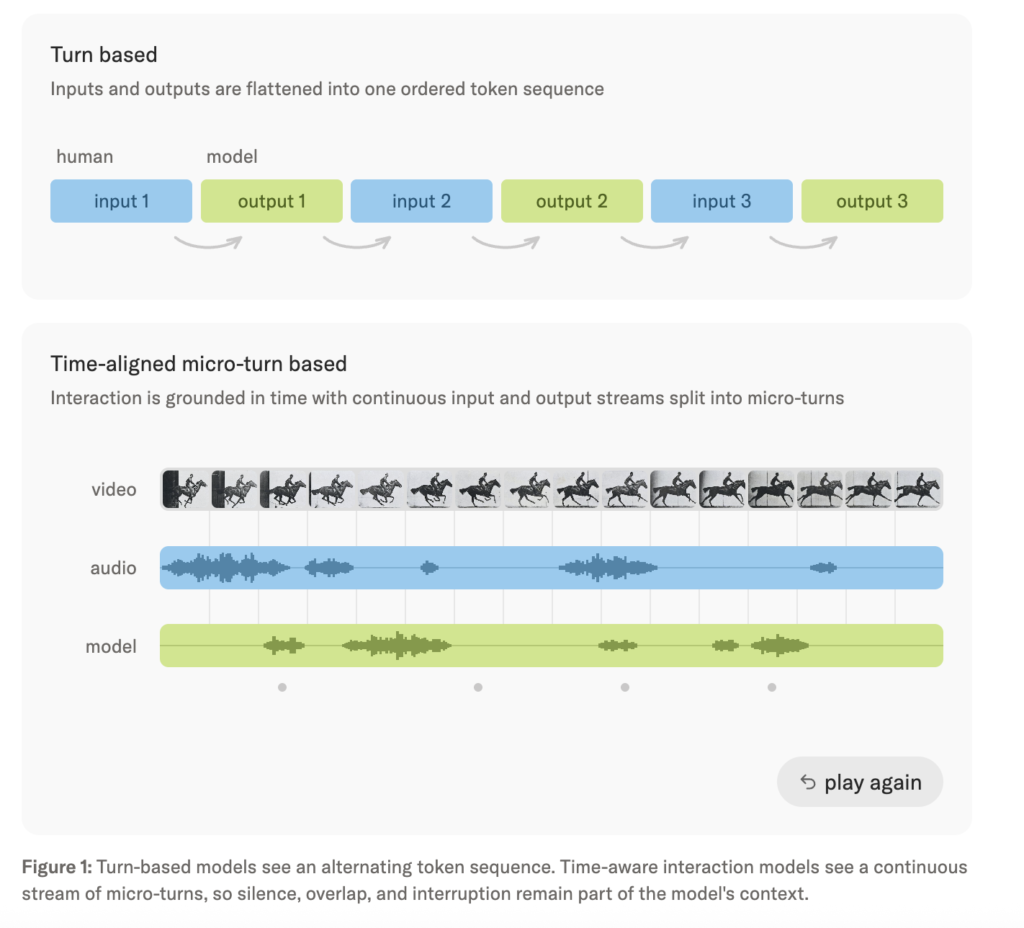
Mira Murati’s Thinking Machines Lab Introduces Interaction Models: A Native Multimodal Architecture for Real-Time Human-AI Collaboration

Most AI systems today work in turns. You type or speak, the model waits, processes your input, and then responds. That’s the entire interaction loop. Thinking Machines Lab, an AI research lab, is arguing that this model of interaction is a fundamental bottleneck. Thinking Machines Lab team introduced a research preview of a new class […]
Mira Murati’s Thinking Machines Lab Introduces Interaction Models: A Native Multimodal Architecture for Real-Time Human-AI Collaboration Read More »

Humanoid Robot Training Data

Humanoid Robot Training Data: What Teams Need Before Deployment

Humanoid robots are crossing the gap from lab demos to real warehouses, kitchens, and factory floors — but most teams discover the hard part isn’t the model. It’s the data behind it. Foundation models can recognize a cup; deploying a humanoid that picks one up, hands it to an elderly person, and adapts when the

Humanoid Robot Training Data: What Teams Need Before Deployment Read More »

Physical AI Training Data

Physical AI Training Data: The Missing Layer Between Vision and Action

A familiar pattern has emerged in robotics and autonomous systems: a flagship demo runs beautifully on stage, the same system stumbles in a live warehouse two weeks later, and the post-mortem blames “reality” for being messier than the test environment. Some voices in the field argue the missing layer is hardware — better grippers, force-torque

Physical AI Training Data: The Missing Layer Between Vision and Action Read More »

Egocentric Dataset

What Is an Egocentric Dataset? A Guide for Robotics & Embodied AI

An egocentric dataset is a structured collection of first-person video and sensor recordings — captured from a head, chest, or wrist-mounted camera — used to train robotics and embodied AI systems on how people see, move, and act. It’s the closest match to what a robot’s onboard camera will see during operation, which is why

What Is an Egocentric Dataset? A Guide for Robotics & Embodied AI Read More »

Physical AI raises governance questions for autonomous systems

Governance around Physical AI is becoming harder as autonomous AI systems move into robots, sensors, and industrial equipment. The issue is not only whether AI agents can complete tasks. It is how their actions are tested, monitored, and stopped when they interact with real-world systems. Industrial robotics already provides a large base for that discussion.

Physical AI raises governance questions for autonomous systems Read More »

Banner for AI & Big Data Expo by TechEx events.

What LG and NVIDIA’s talks reveal about the future of physical AI

LG is currently engaged in exploratory discussions with NVIDIA concerning physical AI, data centres, and mobility. Following a meeting in Seoul between LG CEO Ryu Jae-cheol and Madison Huang, Senior Director of Product Marketing for Omniverse and Robotics at NVIDIA, the core operational dependencies required to run complex automated systems are becoming apparent. While the

What LG and NVIDIA’s talks reveal about the future of physical AI Read More »

Kakao Mobility details Level 4 autonomous driving roadmap for physical AI

Kakao Mobility has set out plans to develop Level 4 autonomous driving technologies in-house as part of its physical AI strategy. Kim Jin-kyu, vice president and head of Kakao Mobility’s Physical AI division, presented the roadmap at the 2026 World IT Show conference at COEX in Seoul. His session focused on autonomous driving services built

Kakao Mobility details Level 4 autonomous driving roadmap for physical AI Read More »

Top 10 Physical AI Models Powering Real-World Robots in 2026

Top 10 Physical AI ModelsNVIDIA Isaac GR00T N-Series (N1.5 / N1.6 / N1.7)Google DeepMind Gemini Robotics 1.5Physical Intelligence π0 / π0.5 / π0.7Figure AI HelixOpenVLAOctoAGIBOT BFM and GCFMGemini Robotics On-DeviceNVIDIA Cosmos World Foundation ModelsSmolVLA (HuggingFace LeRobot) The gap between language model capabilities and robotic deployment has been narrowing considerably over the past 18 months. A

Top 10 Physical AI Models Powering Real-World Robots in 2026 Read More »

Google DeepMind Introduces Decoupled DiLoCo: An Asynchronous Training Architecture Achieving 88% Goodput Under High Hardware Failure Rates

Training frontier AI models is, at its core, a coordination problem. Thousands of chips must communicate with each other continuously, synchronizing every gradient update across the network. When one chip fails or even slows down, the entire training run can stall. As models scale toward hundreds of billions of parameters, that fragility becomes increasingly untenable.

Google DeepMind Introduces Decoupled DiLoCo: An Asynchronous Training Architecture Achieving 88% Goodput Under High Hardware Failure Rates Read More »

NVIDIA and Google infrastructure cuts AI inference costs

At the Google Cloud Next conference, Google and NVIDIA outlined their hardware roadmap designed to address the cost of AI inference at scale. The companies detailed the new A5X bare-metal instances, which run on NVIDIA Vera Rubin NVL72 rack-scale systems. Through hardware and software codesign, this architecture aims to deliver up to ten times lower

NVIDIA and Google infrastructure cuts AI inference costs Read More »