Open Source

Auto Added by WPeMatico

StepFun Releases Step 3.7 Flash: A 198B MoE Vision-Language Model for Coding Agents and Search Workflows

StepFun today released Step 3.7 Flash, a multimodal Mixture-of-Experts model targeting agentic use cases. It adds native vision input and improved tool-use reliability over Step 3.5 Flash. What is Step 3.7 Flash? Step 3.7 Flash is a 198B-parameter sparse Mixture-of-Experts (MoE) vision-language model. It pairs a 196B-parameter language backbone with a 1.8B-parameter vision encoder (ViT) […]

StepFun Releases Step 3.7 Flash: A 198B MoE Vision-Language Model for Coding Agents and Search Workflows Read More »

⚡

Meet mKernel: A Multi-GPU, Multi-Node Fused Kernel Library for GPU-Driven Communication

GPU communication overhead is a measurable bottleneck in production AI workloads. According to data cited by the mKernel project, communication can consume 43.6% of the forward pass and 32% of end-to-end training time. Across popular Mixture-of-Experts (MoE) models, inter-device communication can account for up to 47% of total execution time. Researchers from UC Berkeley’s UCCL

Meet mKernel: A Multi-GPU, Multi-Node Fused Kernel Library for GPU-Driven Communication Read More »

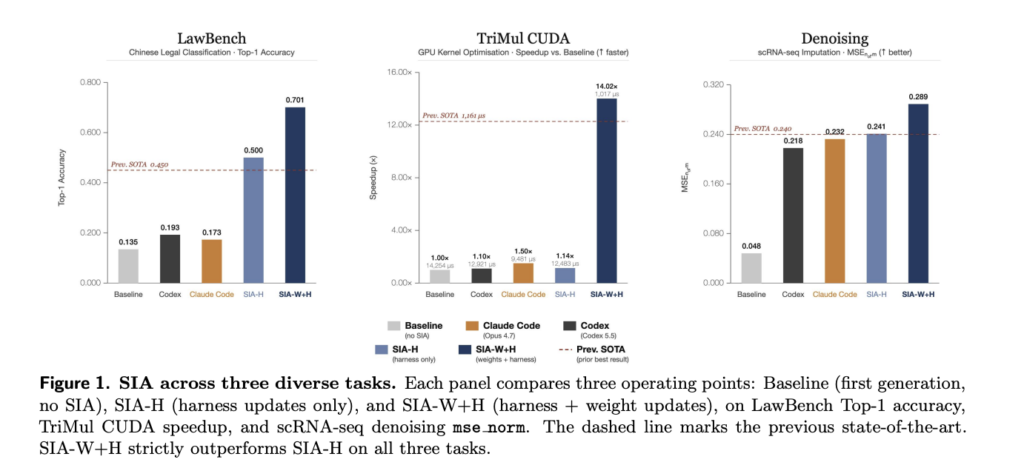
Hexo Labs Open-Sources SIA: A Self-Improving Agent That Updates Both the Harness and the Model Weights

Most AI agents stop improving once a human stops tuning them. The model is fixed. The scaffold around it is fixed. Hexo Labs wants to move both at once. It released SIA (Self-Improving AI) this week as an open-source framework under an MIT license. The core claim of this research is narrow but concrete. SIA

Hexo Labs Open-Sources SIA: A Self-Improving Agent That Updates Both the Harness and the Model Weights Read More »

Perplexity AI Open-Sources Unigram Tokenizer That Achieves 5x Lower p50 Latency Than Hugging Face tokenizers Crate

Perplexity AI’s research team reimplemented their Unigram tokenizer from scratch in Rust and open-sourced the code in pplx-garden, their inference technology repository. At production input lengths, the new encoder cuts p50 latency by roughly 5x versus the Hugging Face tokenizers crate, ~2x versus SentencePiece (C++), and ~1.5x versus IREE’s tokenizer (C), with zero steady-state heap

Perplexity AI Open-Sources Unigram Tokenizer That Achieves 5x Lower p50 Latency Than Hugging Face tokenizers Crate Read More »

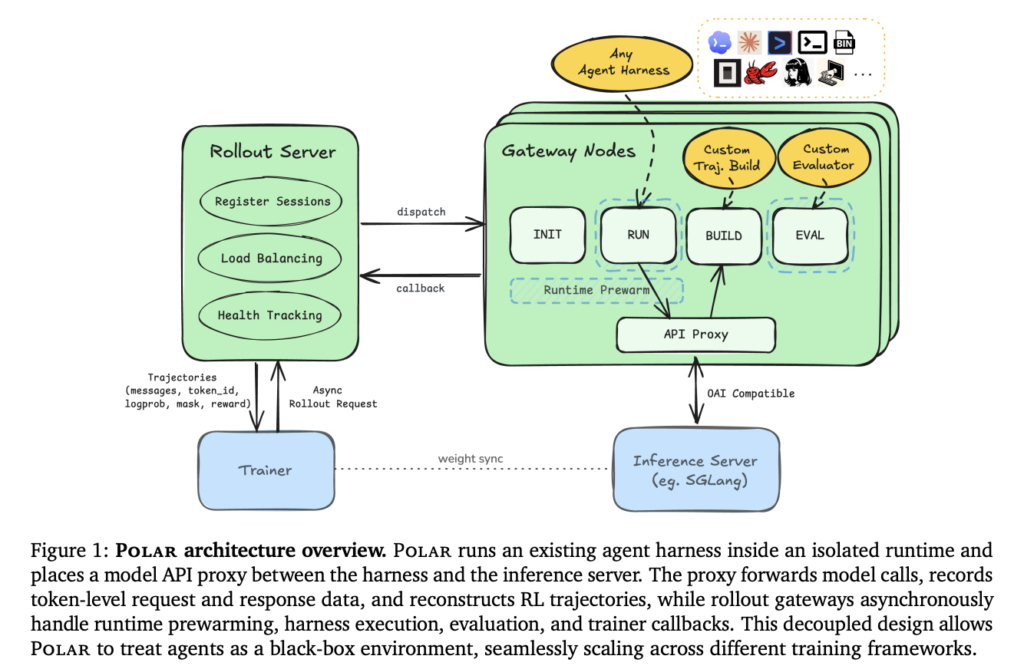
NVIDIA Releases Polar, a Token-Faithful Rollout Framework for GRPO Training Across Codex, Claude Code, and Qwen Code

Reinforcement learning for language agents is growing more complex. Agents now manage multi-turn tool use, long-running contexts, and multi-agent orchestration. The main engineering challenge is connecting existing agent software to training pipelines without breaking how those tools work. NVIDIA’s research team introduced Polar, a rollout framework that lets researchers run reinforcement learning over any agent

NVIDIA Releases Polar, a Token-Faithful Rollout Framework for GRPO Training Across Codex, Claude Code, and Qwen Code Read More »

Meet OmniVoice Studio: A Local, Open-Source Alternative to ElevenLabs

ElevenLabs charges between $5 and $330 per month for voice AI services. Every audio file you process goes through their cloud servers. For those looking for an open source alternative of ElevenLabs, OmniVoice Studio is good fit as an open-source desktop application that runs the same categories of tasks locally. It is a very interesting

Meet OmniVoice Studio: A Local, Open-Source Alternative to ElevenLabs Read More »

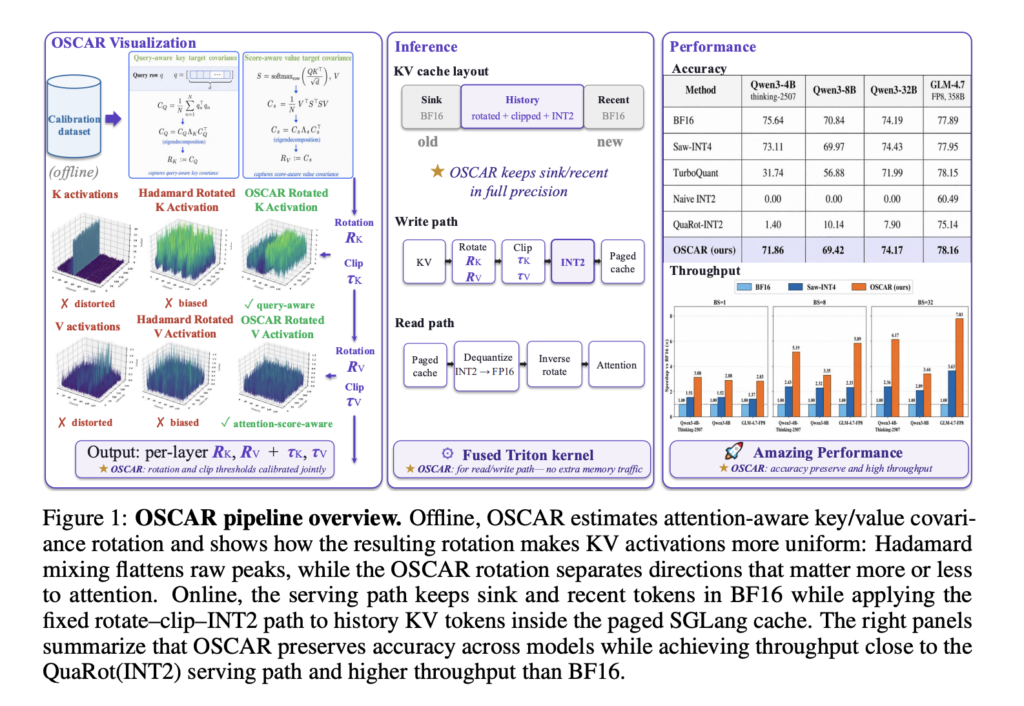
Together AI Open-Sources OSCAR: An Attention-Aware 2-Bit KV Cache Quantization System for Long-Context LLM Serving

Long-context inference makes the KV cache one of the main costs of serving LLMs. During autoregressive decoding, the cache grows with context length, batch size, and model depth. At high batch sizes and long contexts with 100K tokens across dozens of concurrent requests the KV cache consumes a large fraction of GPU memory. Compressing it

Together AI Open-Sources OSCAR: An Attention-Aware 2-Bit KV Cache Quantization System for Long-Context LLM Serving Read More »

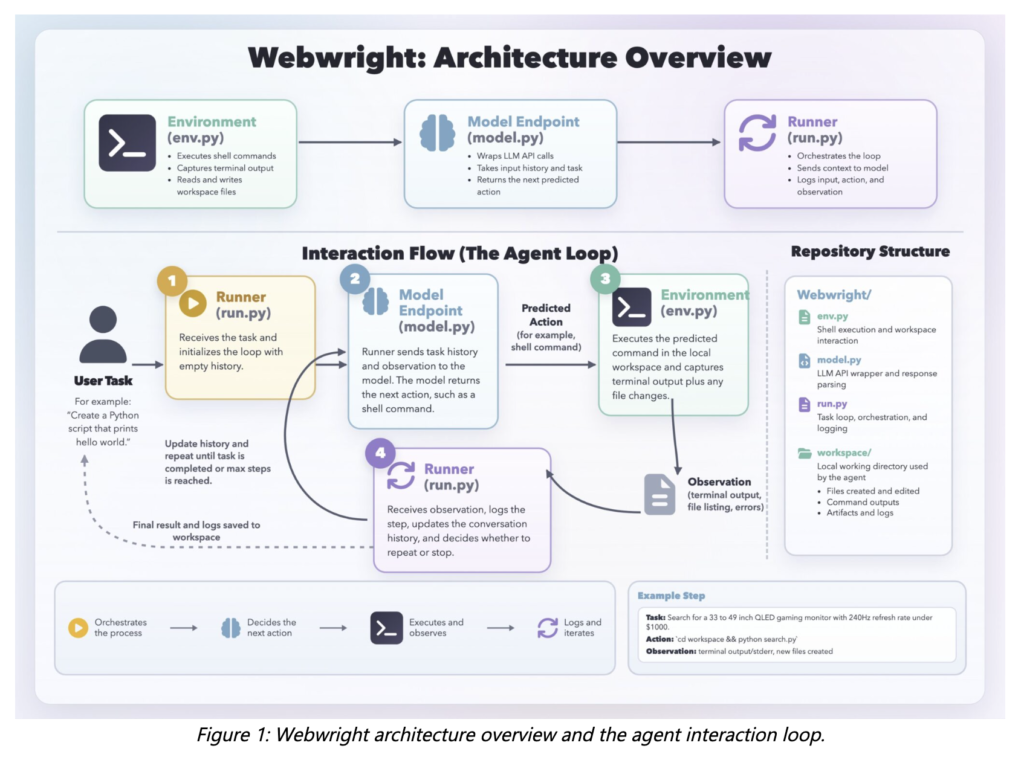
Microsoft Research Releases Webwright: A Terminal-Native Web Agent Framework That Scores 60.1% on Odysseys, Up from Base GPT-5.4’s 33.5%

Most web agents today drive a browser one action at a time. The model receives the current page state — as a screenshot or DOM text — and predicts the next click, keypress, or scroll. This action-at-a-time design made sense when language models had limited reasoning ability. As models have become more capable at writing

Microsoft Research Releases Webwright: A Terminal-Native Web Agent Framework That Scores 60.1% on Odysseys, Up from Base GPT-5.4’s 33.5% Read More »

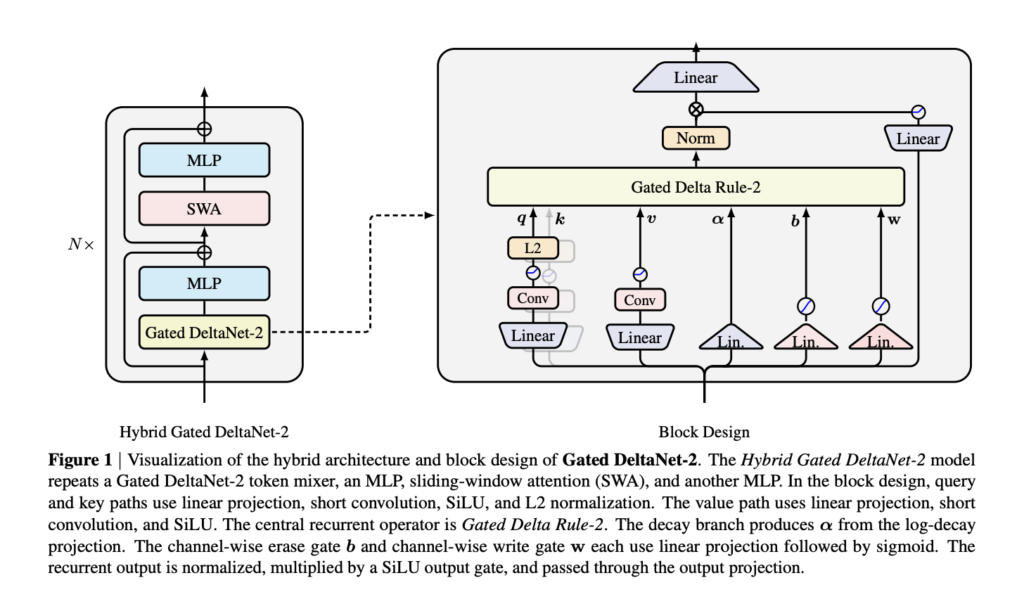
NVIDIA AI Releases Gated DeltaNet-2: A Linear Attention Layer That Decouples Erase and Write in the Delta Rule

Linear attention replaces the unbounded KV cache of softmax attention with a fixed-size recurrent state. This cuts sequence mixing to linear time and decoding to constant memory. The hard part is not what to forget. It is how to edit a compressed memory without scrambling existing associations. NVIDIA has released Gated DeltaNet-2, a linear attention

NVIDIA AI Releases Gated DeltaNet-2: A Linear Attention Layer That Decouples Erase and Write in the Delta Rule Read More »

Tencent Open-Sources TencentDB Agent Memory: A 4-Tier Local Memory Pipeline for AI Agents

Tencent has released TencentDB Agent Memory, an open-source memory system for AI agents. The project ships under the MIT license. It targets a problem familiar to anyone shipping long-horizon agents: context bloat and recall failure. It is symbolic short-term memory along with layered long-term memory. It integrates with OpenClaw as a plugin and with the

Tencent Open-Sources TencentDB Agent Memory: A 4-Tier Local Memory Pipeline for AI Agents Read More »