Machine Learning

Auto Added by WPeMatico

Google removes some AI health summaries after investigation finds “dangerous” flaws

On Sunday, Google removed some of its AI Overviews health summaries after a Guardian investigation found people were being put at risk by false and misleading information. The removals came after the newspaper found that Google’s generative AI feature delivered inaccurate health information at the top of search results, potentially leading seriously ill patients to

Google removes some AI health summaries after investigation finds “dangerous” flaws Read More »

How to Build Portable, In-Database Feature Engineering Pipelines with Ibis Using Lazy Python APIs and DuckDB Execution

In this tutorial, we demonstrate how we use Ibis to build a portable, in-database feature engineering pipeline that looks and feels like Pandas but executes entirely inside the database. We show how we connect to DuckDB, register data safely inside the backend, and define complex transformations using window functions and aggregations without ever pulling raw

How to Build Portable, In-Database Feature Engineering Pipelines with Ibis Using Lazy Python APIs and DuckDB Execution Read More »

3 Questions: How AI could optimize the power grid

Artificial intelligence has captured headlines recently for its rapidly growing energy demands, and particularly the surging electricity usage of data centers that enable the training and deployment of the latest generative AI models. But it’s not all bad news — some AI tools have the potential to reduce some forms of energy consumption and enable cleaner grids.One

3 Questions: How AI could optimize the power grid Read More »

Decoding the Arctic to predict winter weather

Every autumn, as the Northern Hemisphere moves toward winter, Judah Cohen starts to piece together a complex atmospheric puzzle. Cohen, a research scientist in MIT’s Department of Civil and Environmental Engineering (CEE), has spent decades studying how conditions in the Arctic set the course for winter weather throughout Europe, Asia, and North America. His research

Decoding the Arctic to predict winter weather Read More »

Stanford Researchers Build SleepFM Clinical: A Multimodal Sleep Foundation AI Model for 130+ Disease Prediction

A team of Stanford Medicine researchers have introduced SleepFM Clinical, a multimodal sleep foundation model that learns from clinical polysomnography and predicts long term disease risk from a single night of sleep. The research work is published in Nature Medicine and the team has released the clinical code as the open source sleepfm-clinical repository on

Stanford Researchers Build SleepFM Clinical: A Multimodal Sleep Foundation AI Model for 130+ Disease Prediction Read More »

A Coding Implementation to Build a Unified Apache Beam Pipeline Demonstrating Batch and Stream Processing with Event-Time Windowing Using DirectRunner

In this tutorial, we demonstrate how to build a unified Apache Beam pipeline that works seamlessly in both batch and stream-like modes using the DirectRunner. We generate synthetic, event-time–aware data and apply fixed windowing with triggers and allowed lateness to demonstrate how Apache Beam consistently handles both on-time and late events. By switching only the

A Coding Implementation to Build a Unified Apache Beam Pipeline Demonstrating Batch and Stream Processing with Event-Time Windowing Using DirectRunner Read More »

TII Abu-Dhabi Released Falcon H1R-7B: A New Reasoning Model Outperforming Others in Math and Coding with only 7B Params with 256k Context Window

Technology Innovation Institute (TII), Abu Dhabi, has released Falcon-H1R-7B, a 7B parameter reasoning specialized model that matches or exceeds many 14B to 47B reasoning models in math, code and general benchmarks, while staying compact and efficient. It builds on Falcon H1 7B Base and is available on Hugging Face under the Falcon-H1R collection. Falcon-H1R-7B is

TII Abu-Dhabi Released Falcon H1R-7B: A New Reasoning Model Outperforming Others in Math and Coding with only 7B Params with 256k Context Window Read More »

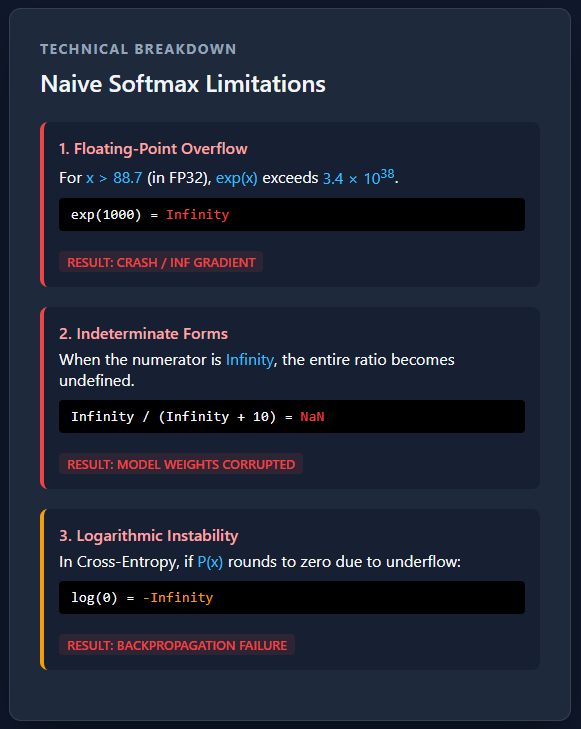
Implementing Softmax From Scratch: Avoiding the Numerical Stability Trap

In deep learning, classification models don’t just need to make predictions—they need to express confidence. That’s where the Softmax activation function comes in. Softmax takes the raw, unbounded scores produced by a neural network and transforms them into a well-defined probability distribution, making it possible to interpret each output as the likelihood of a specific

Implementing Softmax From Scratch: Avoiding the Numerical Stability Trap Read More »

Dummy Variable Trap in Machine Learning Explained Simply

In machine learning with categorical data, it is common to encode the categories as dummy variables (sometimes called one hot encoding) to encode categories as numerical values. This is a significant step since there are many algorithms that do not operate on other things other than numbers like linear regression. Nevertheless, there is one of the mistakes

Dummy Variable Trap in Machine Learning Explained Simply Read More »

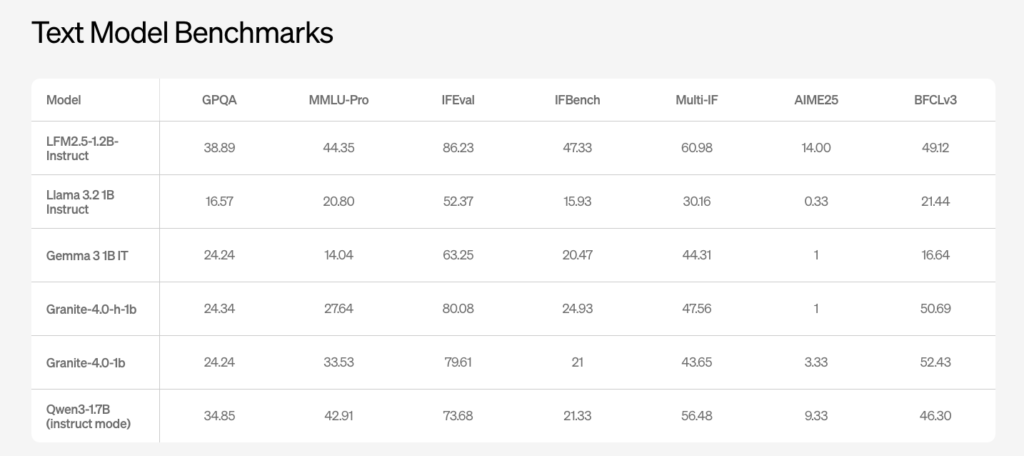
Liquid AI Releases LFM2.5: A Compact AI Model Family For Real On Device Agents

Liquid AI has introduced LFM2.5, a new generation of small foundation models built on the LFM2 architecture and focused at on device and edge deployments. The model family includes LFM2.5-1.2B-Base and LFM2.5-1.2B-Instruct and extends to Japanese, vision language, and audio language variants. It is released as open weights on Hugging Face and exposed through the

Liquid AI Releases LFM2.5: A Compact AI Model Family For Real On Device Agents Read More »