Machine Learning

Auto Added by WPeMatico

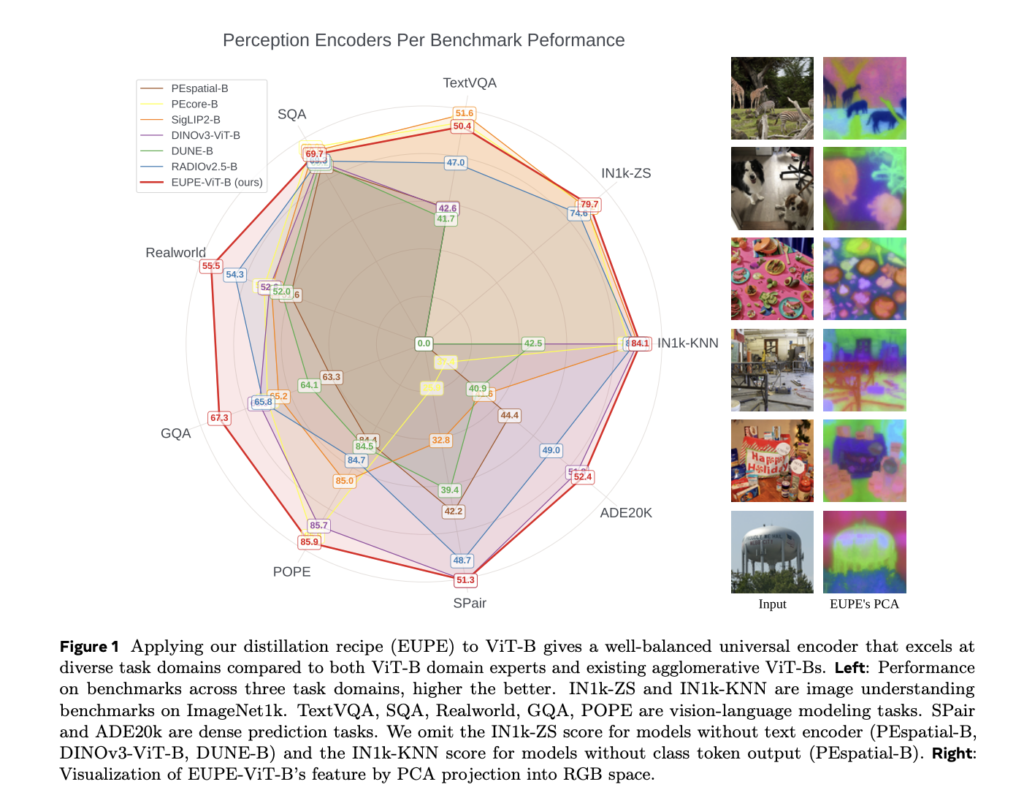
Meta AI Releases EUPE: A Compact Vision Encoder Family Under 100M Parameters That Rivals Specialist Models Across Image Understanding, Dense Prediction, and VLM Tasks

Running powerful AI on your smartphone isn’t just a hardware problem — it’s a model architecture problem. Most state-of-the-art vision encoders are enormous, and when you trim them down to fit on an edge device, they lose the capabilities that made them useful in the first place. Worse, specialized models tend to excel at one
Meta AI Releases EUPE: A Compact Vision Encoder Family Under 100M Parameters That Rivals Specialist Models Across Image Understanding, Dense Prediction, and VLM Tasks Read More »

Helping data centers deliver higher performance with less hardware

To improve data center efficiency, multiple storage devices are often pooled together over a network so many applications can share them. But even with pooling, significant device capacity remains underutilized due to performance variability across the devices.MIT researchers have now developed a system that boosts the performance of storage devices by handling three major sources

Helping data centers deliver higher performance with less hardware Read More »

An Implementation Guide to Running NVIDIA Transformer Engine with Mixed Precision, FP8 Checks, Benchmarking, and Fallback Execution

In this tutorial, we implement an advanced, practical implementation of the NVIDIA Transformer Engine in Python, focusing on how mixed-precision acceleration can be explored in a realistic deep learning workflow. We set up the environment, verify GPU and CUDA readiness, attempt to install the required Transformer Engine components, and handle compatibility issues gracefully so that

An Implementation Guide to Running NVIDIA Transformer Engine with Mixed Precision, FP8 Checks, Benchmarking, and Fallback Execution Read More »

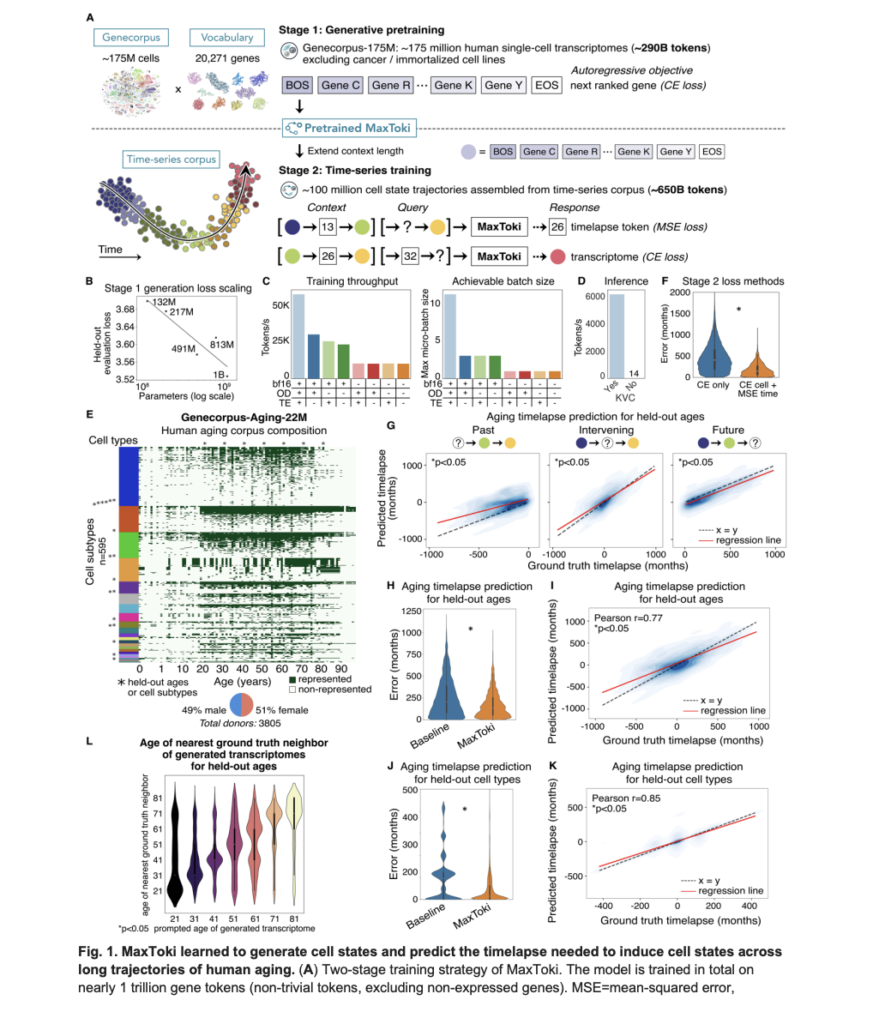
Meet MaxToki: The AI That Predicts How Your Cells Age — and What to Do About It

Most foundation models in biology have a fundamental blind spot: they see cells as frozen snapshots. Give a model a single-cell transcriptome — a readout of which genes are active in a cell at a given moment — and it can tell you a lot about what that cell is doing right now. What it

Meet MaxToki: The AI That Predicts How Your Cells Age — and What to Do About It Read More »

Architecture and Orchestration of Memory Systems in AI Agents

The evolution of artificial intelligence from stateless models to autonomous, goal-driven agents depends heavily on advanced memory architectures. While Large Language Models (LLMs) possess strong reasoning abilities and vast embedded knowledge, they lack persistent memory, making them unable to retain past interactions or adapt over time. This limitation leads to repeated context injection, increasing token

Architecture and Orchestration of Memory Systems in AI Agents Read More »

Meet ‘AutoAgent’: The Open-Source Library That Lets an AI Engineer and Optimize Its Own Agent Harness Overnight

There’s a particular kind of tedium that every AI engineer knows intimately: the prompt-tuning loop. You write a system prompt, run your agent against a benchmark, read the failure traces, tweak the prompt, add a tool, rerun. Repeat this a few dozen times and you might move the needle. It’s grunt work dressed up in

Meet ‘AutoAgent’: The Open-Source Library That Lets an AI Engineer and Optimize Its Own Agent Harness Overnight Read More »

5 Types of Loss Functions in Machine Learning

A loss function is what guides a model during training, translating predictions into a signal it can improve on. But not all losses behave the same—some amplify large errors, others stay stable in noisy settings, and each choice subtly shapes how learning unfolds. Modern libraries add another layer with reduction modes and scaling effects that

5 Types of Loss Functions in Machine Learning Read More »

Google DeepMind’s Research Lets an LLM Rewrite Its Own Game Theory Algorithms — And It Outperformed the Experts

Designing algorithms for Multi-Agent Reinforcement Learning (MARL) in imperfect-information games — scenarios where players act sequentially and cannot see each other’s private information, like poker — has historically relied on manual iteration. Researchers identify weighting schemes, discounting rules, and equilibrium solvers through intuition and trial-and-error. Google DeepMind researchers proposes AlphaEvolve, an LLM-powered evolutionary coding agent

Google DeepMind’s Research Lets an LLM Rewrite Its Own Game Theory Algorithms — And It Outperformed the Experts Read More »

Working to advance the nuclear renaissance

Today, there are 94 nuclear reactors operating in the United States, more than in any other country in the world, and these units collectively provide nearly 20 percent of the nation’s electricity. That is a major accomplishment, according to Dean Price, but he believes that our country needs much more out of nuclear energy, especially

Working to advance the nuclear renaissance Read More »

Open Sourcing Our Real-Time PPE Detection Mobile App

By Spritle Software Engineering Team Workplace safety isn’t negotiable. But manual safety compliance monitoring is slow, inconsistent, and doesn’t scale. We built a real-time Personal Protective Equipment (PPE) detection app that runs entirely on your smartphone — no cloud, no expensive hardware, no delays. The Problem We’re Solving Every year, thousands of workplace accidents happen

Open Sourcing Our Real-Time PPE Detection Mobile App Read More »