
For Devs

Auto Added by WPeMatico

Sakana AI Launches Fugu Max and Fugu Ultra v2 for Cheaper, Stronger Multi-Agent Orchestration

Sakana AI has released Fugu Max and Fugu Ultra v2, 2 new models in its Sakana Fugu family. Fugu is not a single foundation model. It is a learned orchestrator that routes work across a pool of other models behind 1 API. The new release tunes that architecture for 2 missions. Fugu Max targets the

Sakana AI Launches Fugu Max and Fugu Ultra v2 for Cheaper, Stronger Multi-Agent Orchestration Read More »

Meet Redis LangCache: A Managed Semantic Cache That Cuts LLM API Costs by Up to 90% and Returns Cache Hits Up to 15x Faster

Production LLM applications rarely receive a question nobody has asked before. Support assistants and RAG pipelines field the same intents thousands of times a day, each phrased differently, and most stacks treat every phrasing as a fresh, fully billed request. Redis LangCache is a fully managed semantic caching service that sits between the application and

Meet Redis LangCache: A Managed Semantic Cache That Cuts LLM API Costs by Up to 90% and Returns Cache Hits Up to 15x Faster Read More »

NVIDIA Details BioNeMo Inference Runtime (BioIR): 2.90x Higher Boltz-2 Folding Throughput and 58.5K Residues per GPU-Hour on 8xH100

Biomolecular structure prediction has shifted from single-target runs to proteome-scale worklists. The bottleneck is no longer whether a model can fold a protein. It is how fast an entire queue of independent targets moves through parsing, featurization, GPU inference, and output writing. NVIDIA’s new technical deep dive walks through BioNeMo Inference Runtime (BioIR), a Python

NVIDIA Details BioNeMo Inference Runtime (BioIR): 2.90x Higher Boltz-2 Folding Throughput and 58.5K Residues per GPU-Hour on 8xH100 Read More »

OpenAI Launches the Agents API in Public Beta, Putting the Codex Harness Behind One API Call

OpenAI has released the Agents API in public beta. It gives developers the same harness and infrastructure that run Codex. OpenAI hosts and maintains the harness. Developers run the agent’s compute in an OpenAI-managed sandbox, their own infrastructure, or a partner sandbox. Is it deployable? Yes. It is live for all developers in public beta.

OpenAI Launches the Agents API in Public Beta, Putting the Codex Harness Behind One API Call Read More »

Google Open-Sources Mantis: A Modular Skills Toolkit That Lets Coding Agents Find, Reproduce and Patch Vulnerabilities

Google has open-sourced Mantis, a stack-agnostic toolkit of security review skills that lets an AI coding agent run the whole vulnerability lifecycle. It finds a suspected flaw, strips the false positives, reproduces the bug inside a sandbox, writes a minimal patch, re-attacks that patch, and scores the residual risk. Mantis is not a scanner you

Google Open-Sources Mantis: A Modular Skills Toolkit That Lets Coding Agents Find, Reproduce and Patch Vulnerabilities Read More »

NVIDIA Announces CUDA Rust with cuda-oxide (SIMT) and cutile-rs (Tile) for Compile-Time-Safe GPU Kernels

NVIDIA has announced CUDA Rust, a push to make Rust a first-class language for writing GPU kernels. Rust code could already launch CUDA kernels, but the kernel body usually had to be written elsewhere. CUDA Rust closes that gap with two NVlabs open-source projects: cuda-oxide for the SIMT model and cutile-rs for the newer Tile

NVIDIA Announces CUDA Rust with cuda-oxide (SIMT) and cutile-rs (Tile) for Compile-Time-Safe GPU Kernels Read More »

▶

Perplexity Details Its GPU Embedding Stack: How Ivy, Tulip and ROSE Serve pplx-embed

Retrieval quality in an AI search product is bounded by two things: how good the embedding model is, and how cheaply you can run it across an index. This week, Perplexity Engineering team published Fast Embeddings on GPUs, an under-the-hood account of the second — the serving infrastructure behind pplx-embed and the ranking models used

Perplexity Details Its GPU Embedding Stack: How Ivy, Tulip and ROSE Serve pplx-embed Read More »

GitHub Introduces Project HydraFusion: Runtime Multi-Model Orchestration That Builds a Workflow Per Coding Task in Copilot CLI

GitHub has released Project HydraFusion, a research preview that stops treating model choice as a one-time setting. Instead of routing your prompt to a single model, HydraFusion builds an execution plan per request. It can draft with one model, have a second model critique the draft, or escalate to a stronger model when a quality

GitHub Introduces Project HydraFusion: Runtime Multi-Model Orchestration That Builds a Workflow Per Coding Task in Copilot CLI Read More »

Meta AI Released Muse Spark 1.3: An Agentic Coding Model That Uses ~20% Fewer Tool Calls and ~25% Fewer Tokens Than Muse Spark 1.2

This week, Meta Superintelligence Labs released Muse Spark 1.3. It is the fourth Muse Spark release in five months, and the target is long-horizon agentic and coding work rather than single-turn generation. The framing in Meta’s post is usability: sustaining a long thread, collaborating with the user, and knowing when it is stuck. Is it

Meta AI Released Muse Spark 1.3: An Agentic Coding Model That Uses ~20% Fewer Tool Calls and ~25% Fewer Tokens Than Muse Spark 1.2 Read More »

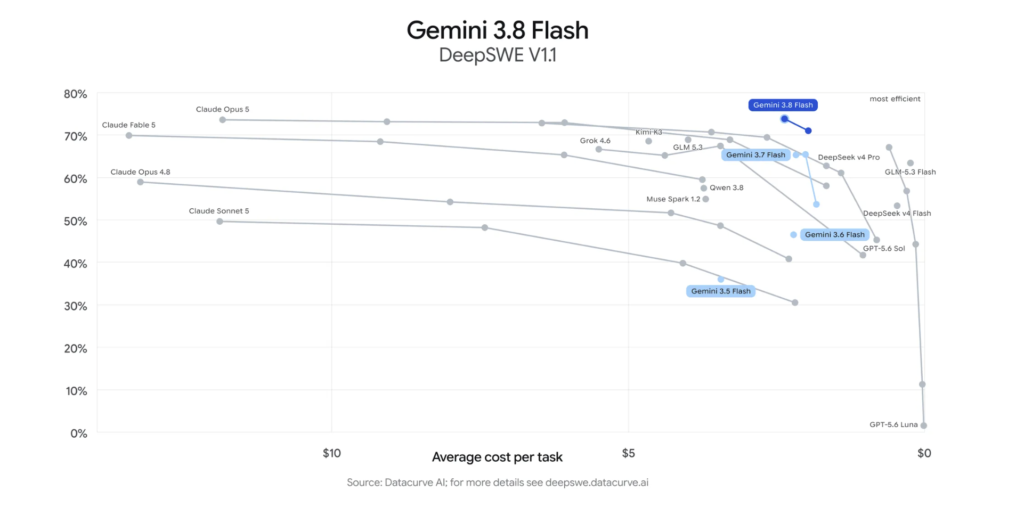
Google DeepMind Releases Gemini 3.8 Flash and Gemini 3.8 Flash Cyber: One Core Model, Two Access Envelopes

Google just announced Gemini 3.8 Flash and Gemini 3.8 Flash Cyber, three weeks after Gemini 3.7 Flash and marking the third Flash release in six weeks. Both variants run on the same foundational intelligence, refined through long-running agentic loops that recursively evaluate the underlying models. What separates them is not architecture, it is the safety

Google DeepMind Releases Gemini 3.8 Flash and Gemini 3.8 Flash Cyber: One Core Model, Two Access Envelopes Read More »