
For Devs

Auto Added by WPeMatico

Prime Intellect Launches Prime Inference: Serverless and Reserved Serving for Frontier Open Models

Prime Intellect has launched Prime Inference, a serving platform for frontier open-source models. It offers serverless endpoints and reserved capacity on Prime’s own GPUs across multiple datacenters. Before public release, it processed nearly a trillion tokens per day internally. That traffic came from RL rollouts, synthetic data generation, evaluations and long-running coding agents. What is
Prime Intellect Launches Prime Inference: Serverless and Reserved Serving for Frontier Open Models Read More »

Microsoft AI Releases MAI-Transcribe-2-Streaming: #1 Real-Time Speech-to-Text Model on Artificial Analysis

Microsoft AI has released MAI-Transcribe-2-Streaming, its first streaming speech-to-text (STT) model. It launched on October 1, 2026, alongside 2 text-to-speech models, MAI-Voice-2.1 and MAI-Voice-2.1-Flash. Artificial Analysis ranks it #1 of 38 models for final and first partial transcript accuracy. The model targets voice agents, live captions and dictation, where latency decides the experience. What Microsoft

Microsoft AI Releases MAI-Transcribe-2-Streaming: #1 Real-Time Speech-to-Text Model on Artificial Analysis Read More »

NVIDIA Announces DGX Spark 64GB: A 1-PetaFLOP Grace Blackwell Desktop for Local AI Agents, Fine-Tuning, and Inference

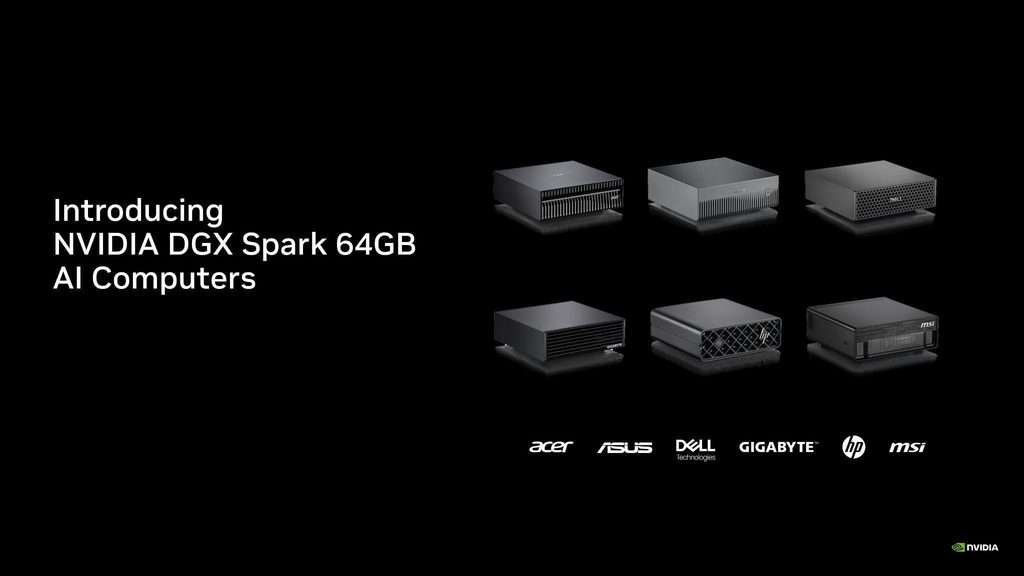
NVIDIA announced a new 64GB configuration of DGX Spark — from Acer, ASUS, Dell, Gigabyte, HP and MSI — its GB10-powered desktop AI system. It gives developers a way to start with one system for local models and agents, then cluster two 64GB units for 128GB of memory across the cluster and more compute when

NVIDIA Announces DGX Spark 64GB: A 1-PetaFLOP Grace Blackwell Desktop for Local AI Agents, Fine-Tuning, and Inference Read More »

Datalab Introduces OmniExtractBench to Fix Bias and Opacity in Extraction Benchmarks

Datalab has released OmniExtractBench, an open benchmark for structured document extraction. It tests how accurately a system fills a JSON schema from a PDF. The benchmark pools 620 documents from 4 existing benchmarks. One deterministic scorer grades all of them and explains each decision. The release lands while extraction vendors publish their own leaderboards. Datalab

Datalab Introduces OmniExtractBench to Fix Bias and Opacity in Extraction Benchmarks Read More »

AWS Strands Labs Releases Strands Decider 2B: An Open Source Decision Model That Picks Options in About 115 ms

AWS Strands Labs releases Strands Decider 2B, an open source decision model. It does not generate text. It reads a state and typed questions, then returns a choice, a yes/no probability, or a score with a calibrated confidence. The model has 1.9 billion parameters and runs locally on a CPU, a consumer GPU, or an

AWS Strands Labs Releases Strands Decider 2B: An Open Source Decision Model That Picks Options in About 115 ms Read More »

Cloudflare Releases Clef and Clef-flash: Open-Weight Decision Models That Return Typed Probabilities Instead of Text

Cloudflare has released Clef and Clef-flash, the first models trained by its Workers AI team. They are decision models, not chatbots. Each reads an input state and a schema of typed questions. It returns a probability for every allowed answer, with no free-form text. Both are open-weight under Apache 2.0 and compatible with TypeSafe AI’s

Cloudflare Releases Clef and Clef-flash: Open-Weight Decision Models That Return Typed Probabilities Instead of Text Read More »

A Coding Guide to Google Research’s Kauldron: Configs That Are Plain Data, Components Wired by String, and a JAX Trainer You Can Read End to End

In this tutorial, we implement Kauldron, the JAX training library from Google Research that describes itself as optimized for research velocity and modularity, and we take those two words literally by testing what they actually buy us. We install it, then spend the first half of the notebook on the three mechanisms that make Kauldron

A Coding Guide to Google Research’s Kauldron: Configs That Are Plain Data, Components Wired by String, and a JAX Trainer You Can Read End to End Read More »

Cohere Releases Embed 5: How It Compares to Voyage 4 Large, Gemini Embedding 2, and OpenAI

Cohere has released Embed 5, a new embedding model family. It targets enterprise search, RAG, and agentic retrieval. The model family ships in 2 tiers. Embed 5 Pro targets maximum retrieval quality. Embed 5 Fast targets latency and cost on the live query path. Both accept text, images, and fused text plus image inputs. Both

Cohere Releases Embed 5: How It Compares to Voyage 4 Large, Gemini Embedding 2, and OpenAI Read More »

NVIDIA Releases Kumo Tabular: Open Tabular Foundation Models That Predict New Rows in a Single Forward Pass

NVIDIA has released Kumo Tabular, a new family of tabular foundation models (TFMs) for classification and regression. If you have followed TabPFN or TabICL, the setup will look familiar. The model takes labeled rows as context and predicts new rows in one forward pass. There is no training, no hyperparameter tuning, and no feature engineering.

NVIDIA Releases Kumo Tabular: Open Tabular Foundation Models That Predict New Rows in a Single Forward Pass Read More »

Perplexity Releases pplx-embed-v2-context-9b-preview: A Contextual Embedding Model That Retrieves Answers and Their Supporting Evidence

Perplexity Research and turbopuffer have released pplx-embed-v2-context-9b-preview, a contextual embedding model for RAG pipelines. Each chunk is embedded with the full document in view. The real change is the training signal. The model learns to retrieve the answer along with the context needed to verify it, not one ‘gold passage.’ P Is it deployable? Yes,

Perplexity Releases pplx-embed-v2-context-9b-preview: A Contextual Embedding Model That Retrieves Answers and Their Supporting Evidence Read More »