Editors Pick

Auto Added by WPeMatico

Perplexity AI Open-Sources Unigram Tokenizer That Achieves 5x Lower p50 Latency Than Hugging Face tokenizers Crate

Perplexity AI’s research team reimplemented their Unigram tokenizer from scratch in Rust and open-sourced the code in pplx-garden, their inference technology repository. At production input lengths, the new encoder cuts p50 latency by roughly 5x versus the Hugging Face tokenizers crate, ~2x versus SentencePiece (C++), and ~1.5x versus IREE’s tokenizer (C), with zero steady-state heap […]

Perplexity AI Open-Sources Unigram Tokenizer That Achieves 5x Lower p50 Latency Than Hugging Face tokenizers Crate Read More »

✅

A Coding Guide to Implement a pgvector-Powered Semantic, Hybrid, Sparse, and Quantized Vector Search System

In this tutorial, we build a complete pgvector playground inside Google Colab and explore how PostgreSQL can work as a powerful vector database for modern AI applications. We start by installing PostgreSQL, compiling the pgvector extension, connecting through Psycopg, and registering vector types for smooth Python integration. Then, we create embeddings with SentenceTransformers, store them

A Coding Guide to Implement a pgvector-Powered Semantic, Hybrid, Sparse, and Quantized Vector Search System Read More »

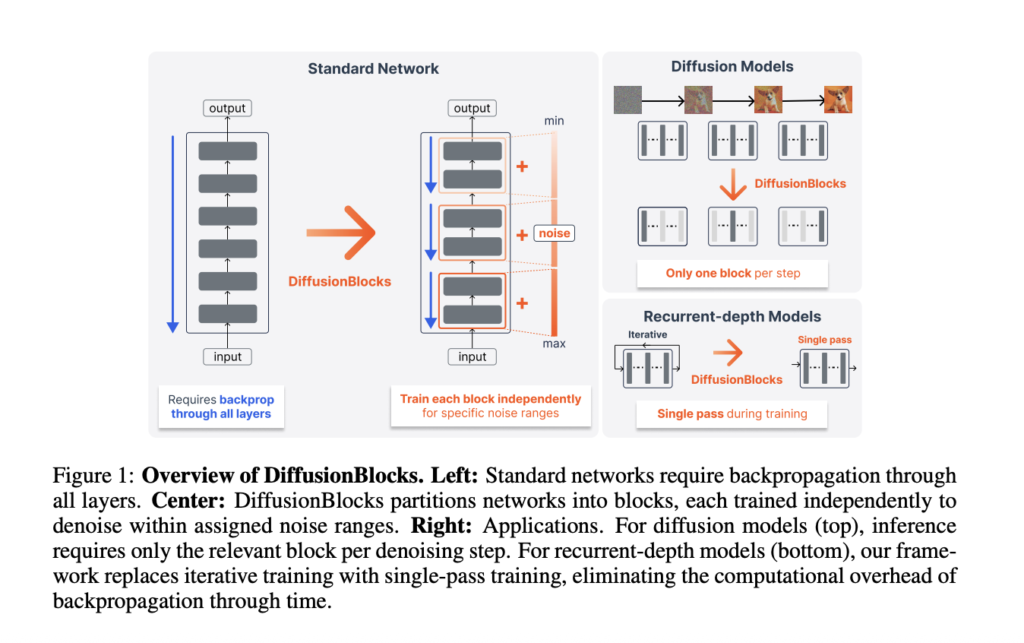
Sakana AI Proposes DiffusionBlocks: a Block-wise Training Framework That Converts Residual Networks into Independently Trainable Denoising Modules

Researchers from Sakana AI and the University of Tokyo propose DiffusionBlocks. It trains transformer-based networks one block at a time. Training memory is reduced by a factor of B, where B is the number of blocks. Performance is maintained across diverse architectures. The Memory Problem in Neural Network Training End-to-end backpropagation requires storing intermediate activations

Sakana AI Proposes DiffusionBlocks: a Block-wise Training Framework That Converts Residual Networks into Independently Trainable Denoising Modules Read More »

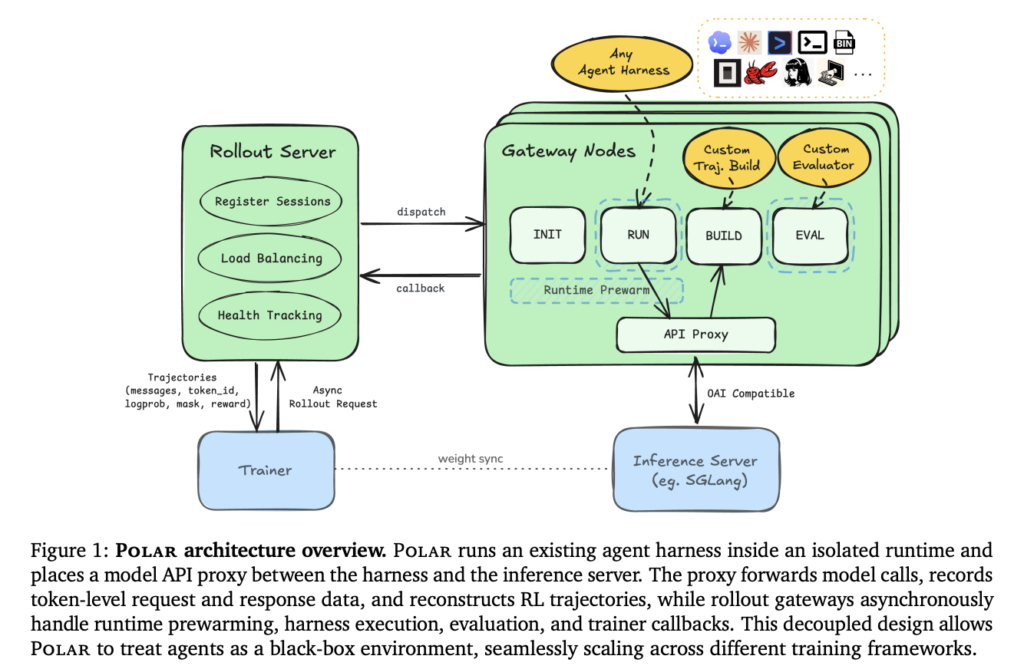
NVIDIA Releases Polar, a Token-Faithful Rollout Framework for GRPO Training Across Codex, Claude Code, and Qwen Code

Reinforcement learning for language agents is growing more complex. Agents now manage multi-turn tool use, long-running contexts, and multi-agent orchestration. The main engineering challenge is connecting existing agent software to training pipelines without breaking how those tools work. NVIDIA’s research team introduced Polar, a rollout framework that lets researchers run reinforcement learning over any agent

NVIDIA Releases Polar, a Token-Faithful Rollout Framework for GRPO Training Across Codex, Claude Code, and Qwen Code Read More »

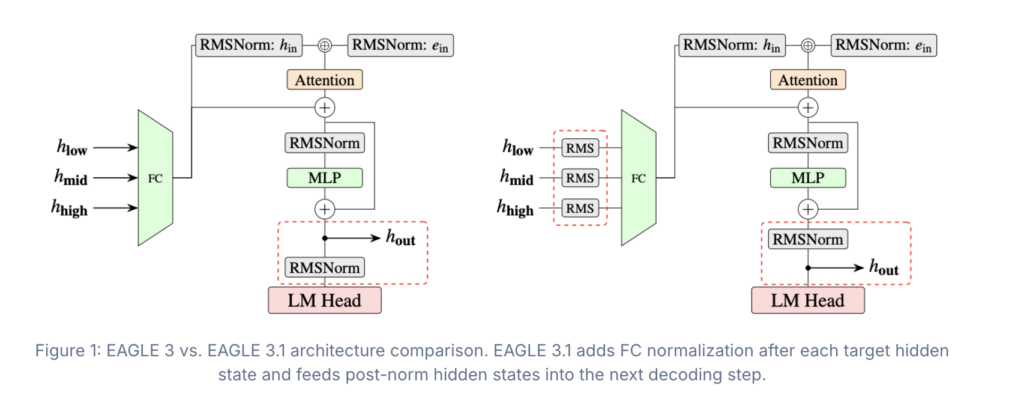
https://vllm.ai/blog/2026-05-26-eagle-3-1

Meet EAGLE 3.1: The Speculative Decoding Algorithm That Fixes Attention Drift in LLM Inference

Speculative decoding is a technique for speeding up large language model inference. A small, fast draft model proposes several tokens. The large target model verifies them in parallel. If accepted, inference is faster. If rejected, the system falls back gracefully. EAGLE Team, vLLM Team, and TorchSpec Team has launched the EAGLE series including EAGLE 1,

Meet EAGLE 3.1: The Speculative Decoding Algorithm That Fixes Attention Drift in LLM Inference Read More »

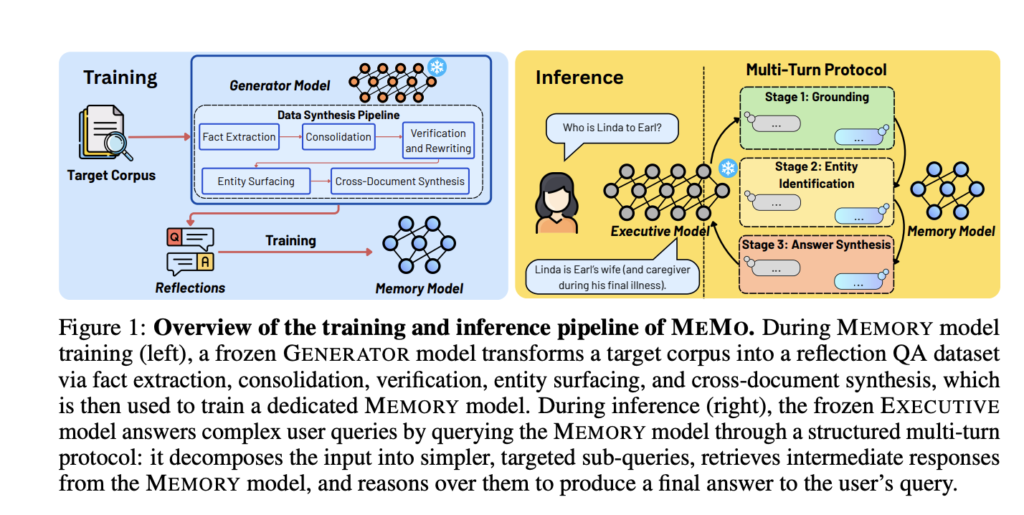
MEMO: A Modular Framework for Training a Dedicated Memory Model on New Knowledge Without Modifying LLM Parameters

Large language models become static after pretraining. Their knowledge does not update as the world changes. Retraining a full LLM is too expensive at modern scales. Fine-tuning risks degrading previously learned knowledge. Retrieval-augmented generation (RAG) struggles when answers require reasoning across many documents. A team of researchers from the National University of Singapore, MIT CSAIL,

MEMO: A Modular Framework for Training a Dedicated Memory Model on New Knowledge Without Modifying LLM Parameters Read More »

Design a High-Precision Retrieve-and-Rerank Pipeline with ZeroEntropy Zerank-2 Reranker

In this tutorial, we use zeroentropy/zerank-2-reranker, a 4B Qwen3-based cross-encoder reranker, to improve retrieval quality. We start by setting up the runtime, loading the reranker, and understanding how it scores query-document pairs. Then, we move from simple pairwise scoring to a practical two-stage retrieve-and-rerank pipeline, where a fast bi-encoder first retrieves candidates and zerank-2 reranks

Design a High-Precision Retrieve-and-Rerank Pipeline with ZeroEntropy Zerank-2 Reranker Read More »

Stability AI Releases Stable Audio 3: A Family of Fast Latent Diffusion Models for Audio Generation and Editing

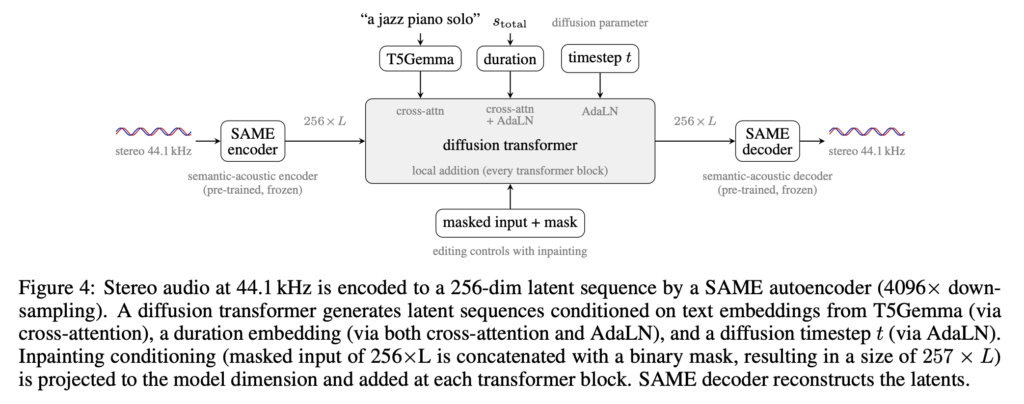
Stability AI has released open weights for Stable Audio 3 along with a technical research paper. Stable Audio 3 is a family of latent diffusion models that generate stereo audio at 44.1 kHz. The models support variable-length outputs, inpainting-based editing, and fast inference. What Is Stable Audio 3? Stable Audio 3 is a family of

Stability AI Releases Stable Audio 3: A Family of Fast Latent Diffusion Models for Audio Generation and Editing Read More »

Meet OmniVoice Studio: A Local, Open-Source Alternative to ElevenLabs

ElevenLabs charges between $5 and $330 per month for voice AI services. Every audio file you process goes through their cloud servers. For those looking for an open source alternative of ElevenLabs, OmniVoice Studio is good fit as an open-source desktop application that runs the same categories of tasks locally. It is a very interesting

Meet OmniVoice Studio: A Local, Open-Source Alternative to ElevenLabs Read More »

Design a Complete Multimodal RLVR Pipeline with Open-MM-RL, Vision-Language Prompting, Reward Scoring, and GRPO Export

In this tutorial, we explore the TuringEnterprises/Open-MM-RL dataset as a practical foundation for multimodal reasoning and reinforcement learning with verifiable rewards. We load the dataset, inspect its schema, analyze domains, formats, question lengths, answer types, and image distributions, and visualize representative examples from each domain. We also build a lightweight reward function that checks exact,

Design a Complete Multimodal RLVR Pipeline with Open-MM-RL, Vision-Language Prompting, Reward Scoring, and GRPO Export Read More »