
Applications

Auto Added by WPeMatico

OpenBMB Releases MiniCPM5-2B: A 2.52B Dense Model Averaging 53.9 Across 34 Benchmarks and Built to Run On Device

OpenBMB has released MiniCPM5-2B, the second checkpoint in the MiniCPM5 series and the follow-up to MiniCPM5-1B. It is a dense causal language model with 2,516,756,480 parameters, of which 1,981,982,720 sit outside the embeddings. It uses 42 layers, grouped-query attention with 16 query heads and 2 key/value heads, and a native context window of 131,072 tokens. […]
OpenBMB Releases MiniCPM5-2B: A 2.52B Dense Model Averaging 53.9 Across 34 Benchmarks and Built to Run On Device Read More »

Axis Robotics Releases AXIS: A Browser-Based Data Engine With 207 Robot Manipulation Tasks and 50,129 Trajectories

Robot manipulation datasets have grown far slower than the models trained on them, mostly because collection stays closed and centralized. Expert operators gather demonstrations on lab hardware, process them offline, and ship a fixed benchmark that never grows again. A research team from Axis Robotics, UC Berkeley, Georgia Tech, NTU… is proposing a different shape

Axis Robotics Releases AXIS: A Browser-Based Data Engine With 207 Robot Manipulation Tasks and 50,129 Trajectories Read More »

IFM Releases K2 Horizon: Six Apache 2.0 Models From 0.9B to 375B

Most open model launches release one checkpoint and a benchmark table. The Institute of Foundation Models (IFM) released something wider last week. IFM is the frontier lab launched by MBZUAI in May 2025. K2 Horizon is a fleet of six models: 375B-A23B, 36B-A4B, 32B, 7B, 3.7B and 0.9B. Shipping alongside them are the pre-training corpus,

IFM Releases K2 Horizon: Six Apache 2.0 Models From 0.9B to 375B Read More »

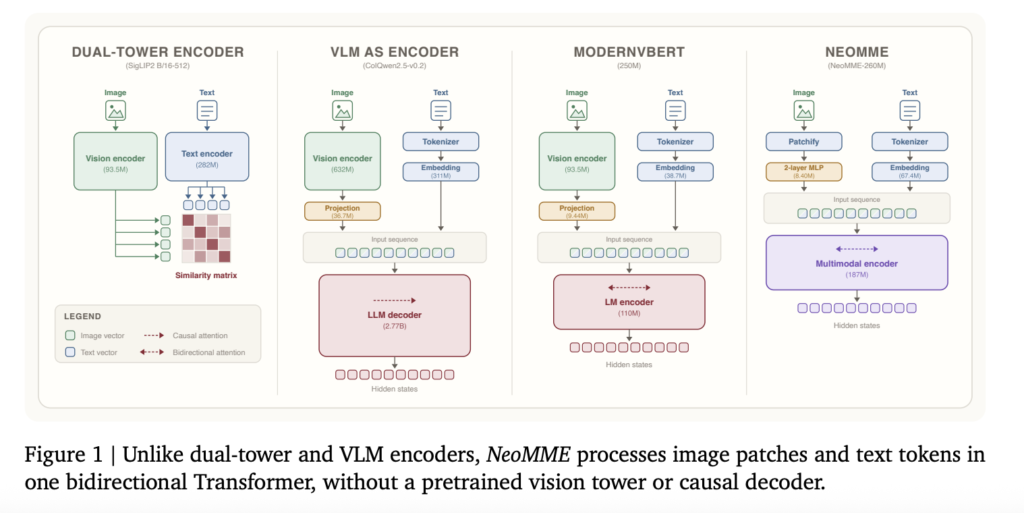
H Company Releases NeoMME: A Family of 260M and 800M Single-Tower Multimodal Encoders That Drop the Vision Tower and Causal Decoder

Most visual document retrievers in production today are hand-me-downs. ColPali and the models that followed it take a generative vision-language model and repurpose it as an encoder. The result still carries a separately pretrained vision tower and a causal decoder that never generates a token. That is parameter and compute overhead for a task that

H Company Releases NeoMME: A Family of 260M and 800M Single-Tower Multimodal Encoders That Drop the Vision Tower and Causal Decoder Read More »

Meta FAIR Introduces AI Research Preference Models (RPMs): Ranking ML Experiments Before Spending GPU Hours

AI research agents can already propose, implement and score their own machine learning experiments. Idea generation is cheap; verification is not. Training one candidate can consume hours to days of GPU time, so an agent proposes far more candidates than it can afford to run. Which ones get run is the real lever on research

Meta FAIR Introduces AI Research Preference Models (RPMs): Ranking ML Experiments Before Spending GPU Hours Read More »

UC Berkeley Researchers Release CUA-Lite, an Open Platform Unifying Sandboxes, Data, Evaluation and RL for Computer-Use Agents

A team of researchers from UC Berkeley have released CUA-Lite, an open platform for computer-use agents (CUAs). The argument behind it is infrastructural rather than model-centric: training and benchmarking a CUA requires four pieces: agents, environments, traces, and a framework to evaluate and train them and all four are currently fragmented across separate repositories with

UC Berkeley Researchers Release CUA-Lite, an Open Platform Unifying Sandboxes, Data, Evaluation and RL for Computer-Use Agents Read More »

▶

Perplexity Details Its GPU Embedding Stack: How Ivy, Tulip and ROSE Serve pplx-embed

Retrieval quality in an AI search product is bounded by two things: how good the embedding model is, and how cheaply you can run it across an index. This week, Perplexity Engineering team published Fast Embeddings on GPUs, an under-the-hood account of the second — the serving infrastructure behind pplx-embed and the ranking models used

Perplexity Details Its GPU Embedding Stack: How Ivy, Tulip and ROSE Serve pplx-embed Read More »

GitHub Introduces Project HydraFusion: Runtime Multi-Model Orchestration That Builds a Workflow Per Coding Task in Copilot CLI

GitHub has released Project HydraFusion, a research preview that stops treating model choice as a one-time setting. Instead of routing your prompt to a single model, HydraFusion builds an execution plan per request. It can draft with one model, have a second model critique the draft, or escalate to a stronger model when a quality

GitHub Introduces Project HydraFusion: Runtime Multi-Model Orchestration That Builds a Workflow Per Coding Task in Copilot CLI Read More »

Adaption Labs Introduces ‘Invent a Dataset’: Training Data Generated From a Task Description, Not a Seed Corpus

This week, Adaption Labs released Invent a Dataset. The feature generates a structured, training-ready dataset from a description of the behavior you want a model to learn. You do not arrive with a seed corpus, a predefined schema, or a labeling guide. Is it deployable? Yes, with one caveat. Invent a Dataset is live now

Adaption Labs Introduces ‘Invent a Dataset’: Training Data Generated From a Task Description, Not a Seed Corpus Read More »

Google Launches Agentic Video Understanding for Gemini Flash Models, Cutting Video Tokens by Up to 88%

Video has been the most expensive modality to reason over. A Gemini model handed a 90-minute lecture has, until now, ingested the whole thing at a fixed one frame per second, whether the question was ‘summarize this’ or ‘what time does the speaker switch to the pricing slide?’ That single-pass design forces a bad trade:

Google Launches Agentic Video Understanding for Gemini Flash Models, Cutting Video Tokens by Up to 88% Read More »