Applications

Auto Added by WPeMatico

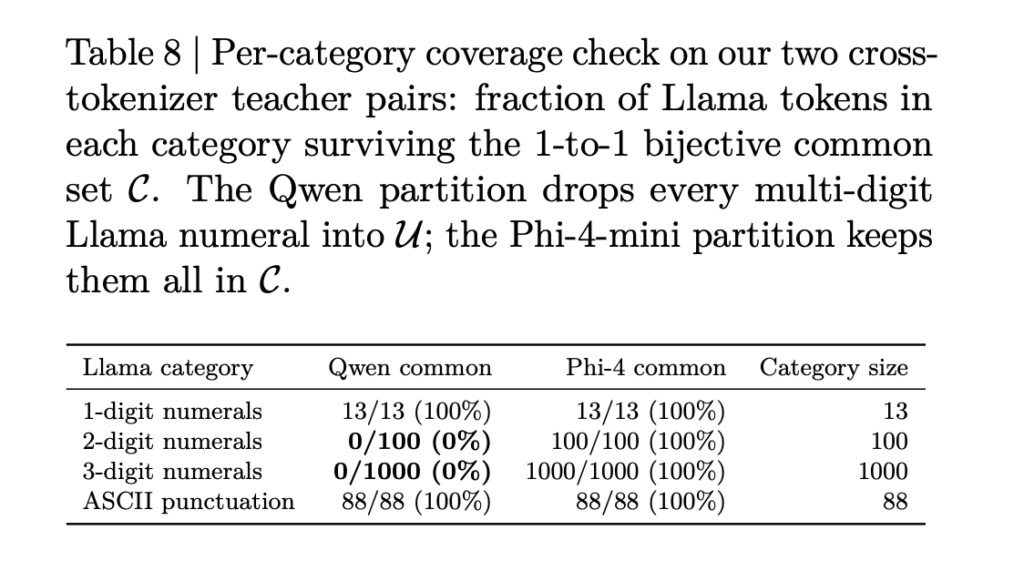
NVIDIA Introduces X-Token: Projection-Guided Cross-Tokenizer KD That Outperforms GOLD by +3.82 Average Points on Llama-3.2-1B

Knowledge distillation (KD) transfers “dark knowledge” from a large teacher model to a smaller student. The student learns from the teacher’s full output probability distribution over tokens, not just correct answers. This is done via per-position Kullback–Leibler (KL) divergence over next-token probability distributions. This formulation requires a shared tokenizer. A practitioner committed to Llama-3.2-1B cannot […]

NVIDIA Introduces X-Token: Projection-Guided Cross-Tokenizer KD That Outperforms GOLD by +3.82 Average Points on Llama-3.2-1B Read More »

StepFun Releases Step 3.7 Flash: A 198B MoE Vision-Language Model for Coding Agents and Search Workflows

StepFun today released Step 3.7 Flash, a multimodal Mixture-of-Experts model targeting agentic use cases. It adds native vision input and improved tool-use reliability over Step 3.5 Flash. What is Step 3.7 Flash? Step 3.7 Flash is a 198B-parameter sparse Mixture-of-Experts (MoE) vision-language model. It pairs a 196B-parameter language backbone with a 1.8B-parameter vision encoder (ViT)

StepFun Releases Step 3.7 Flash: A 198B MoE Vision-Language Model for Coding Agents and Search Workflows Read More »

⚡

Meet mKernel: A Multi-GPU, Multi-Node Fused Kernel Library for GPU-Driven Communication

GPU communication overhead is a measurable bottleneck in production AI workloads. According to data cited by the mKernel project, communication can consume 43.6% of the forward pass and 32% of end-to-end training time. Across popular Mixture-of-Experts (MoE) models, inter-device communication can account for up to 47% of total execution time. Researchers from UC Berkeley’s UCCL

Meet mKernel: A Multi-GPU, Multi-Node Fused Kernel Library for GPU-Driven Communication Read More »

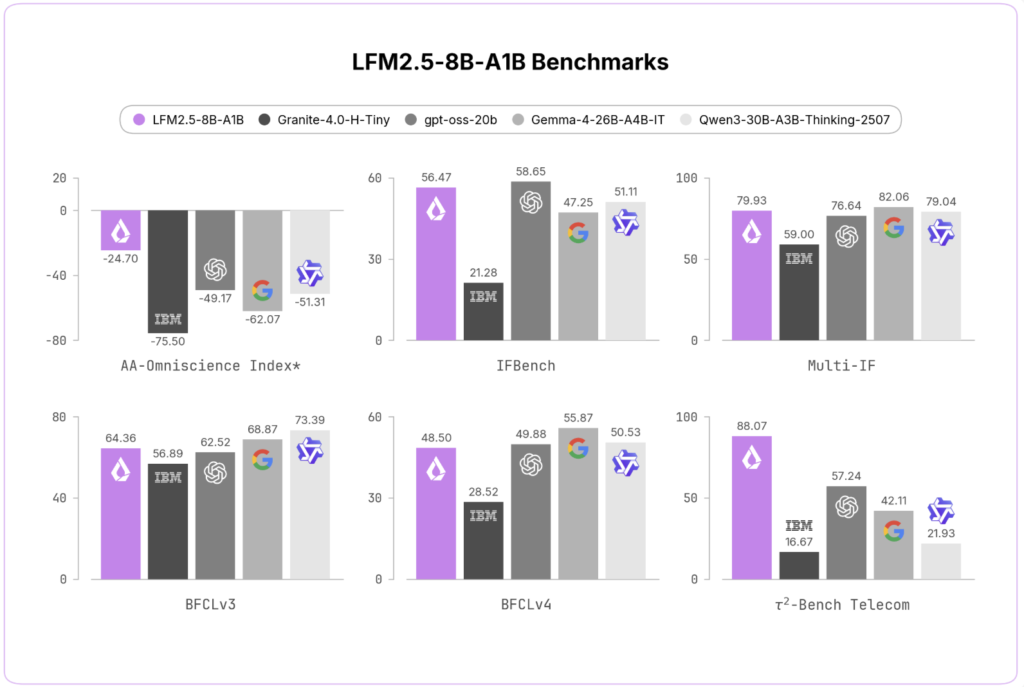
Liquid AI Releases LFM2.5-8B-A1B: An On-Device MoE Model With 8.3B Total and 1.5B Active Parameters

Liquid AI just shipped LFM2.5-8B-A1B. It is an on-device Mixture-of-Experts (MoE) model built for tool calling. The model holds 8.3B total parameters but activates only 1.5B per token. That sparsity is what lets it run on consumer hardware. The release follows LFM2-8B-A1B, which Liquid AI team published earlier. LFM2.5 is a new family of hybrid

Liquid AI Releases LFM2.5-8B-A1B: An On-Device MoE Model With 8.3B Total and 1.5B Active Parameters Read More »

Anthropic Ships Claude Opus 4.8 Alongside Dynamic Workflows and Cheaper Fast Mode, With Workflows Capped at 1,000 Subagents

Anthropic just launched Claude Opus 4.8. Also, there two Claude Code updates shipped with it. Dynamic workflows run many subagents in parallel. Fast mode now supports Opus 4.8 at a lower price. Both are research previews. What Dynamic Workflows Actually Are A dynamic workflow is a JavaScript script that orchestrates subagents at scale. Claude writes

Anthropic Ships Claude Opus 4.8 Alongside Dynamic Workflows and Cheaper Fast Mode, With Workflows Capped at 1,000 Subagents Read More »

Perplexity AI Open-Sources Unigram Tokenizer That Achieves 5x Lower p50 Latency Than Hugging Face tokenizers Crate

Perplexity AI’s research team reimplemented their Unigram tokenizer from scratch in Rust and open-sourced the code in pplx-garden, their inference technology repository. At production input lengths, the new encoder cuts p50 latency by roughly 5x versus the Hugging Face tokenizers crate, ~2x versus SentencePiece (C++), and ~1.5x versus IREE’s tokenizer (C), with zero steady-state heap

Perplexity AI Open-Sources Unigram Tokenizer That Achieves 5x Lower p50 Latency Than Hugging Face tokenizers Crate Read More »

✅

A Coding Guide to Implement a pgvector-Powered Semantic, Hybrid, Sparse, and Quantized Vector Search System

In this tutorial, we build a complete pgvector playground inside Google Colab and explore how PostgreSQL can work as a powerful vector database for modern AI applications. We start by installing PostgreSQL, compiling the pgvector extension, connecting through Psycopg, and registering vector types for smooth Python integration. Then, we create embeddings with SentenceTransformers, store them

A Coding Guide to Implement a pgvector-Powered Semantic, Hybrid, Sparse, and Quantized Vector Search System Read More »

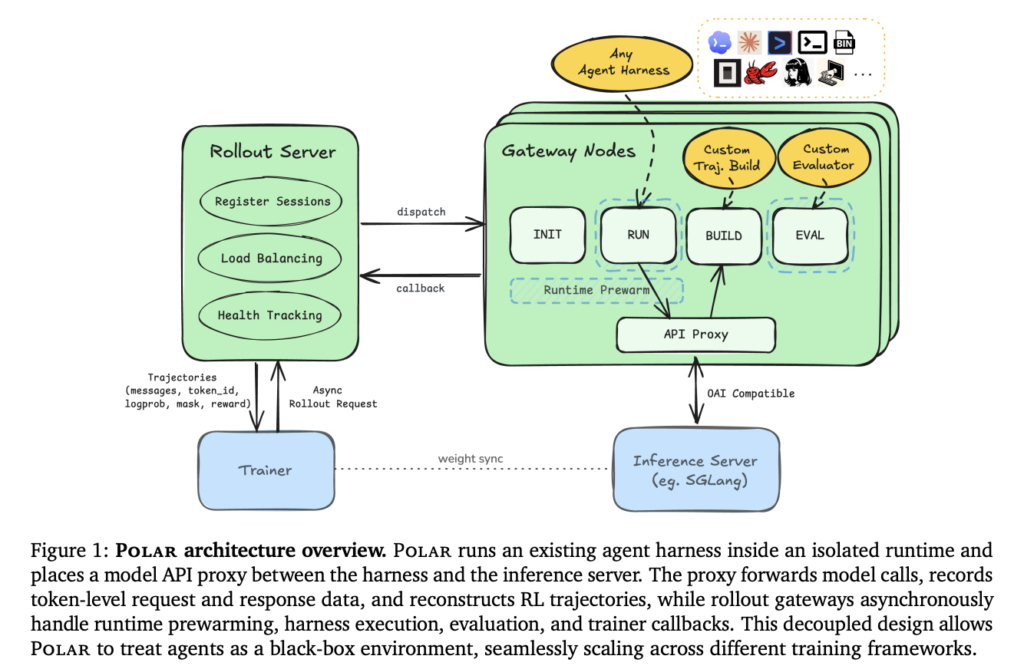
NVIDIA Releases Polar, a Token-Faithful Rollout Framework for GRPO Training Across Codex, Claude Code, and Qwen Code

Reinforcement learning for language agents is growing more complex. Agents now manage multi-turn tool use, long-running contexts, and multi-agent orchestration. The main engineering challenge is connecting existing agent software to training pipelines without breaking how those tools work. NVIDIA’s research team introduced Polar, a rollout framework that lets researchers run reinforcement learning over any agent

NVIDIA Releases Polar, a Token-Faithful Rollout Framework for GRPO Training Across Codex, Claude Code, and Qwen Code Read More »

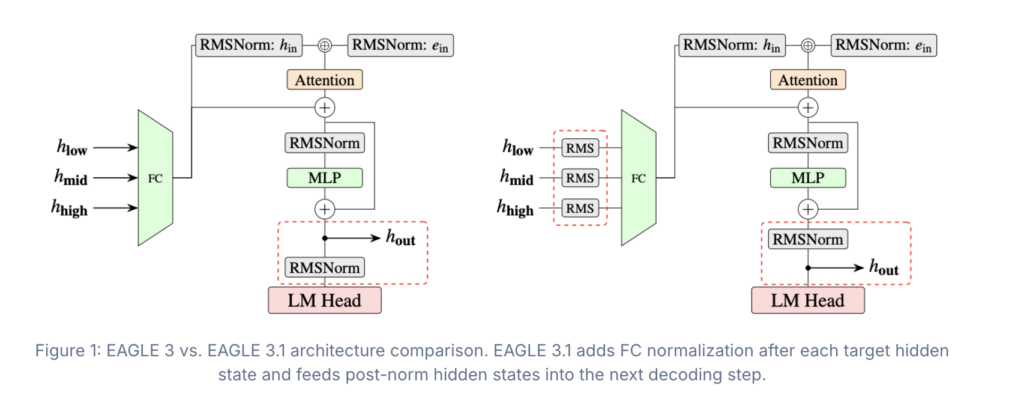
https://vllm.ai/blog/2026-05-26-eagle-3-1

Meet EAGLE 3.1: The Speculative Decoding Algorithm That Fixes Attention Drift in LLM Inference

Speculative decoding is a technique for speeding up large language model inference. A small, fast draft model proposes several tokens. The large target model verifies them in parallel. If accepted, inference is faster. If rejected, the system falls back gracefully. EAGLE Team, vLLM Team, and TorchSpec Team has launched the EAGLE series including EAGLE 1,

Meet EAGLE 3.1: The Speculative Decoding Algorithm That Fixes Attention Drift in LLM Inference Read More »

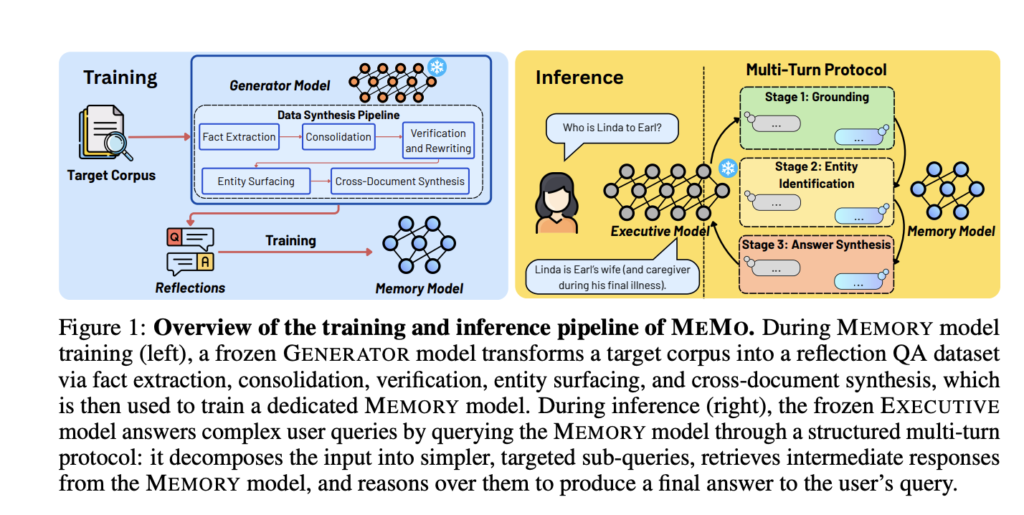
MEMO: A Modular Framework for Training a Dedicated Memory Model on New Knowledge Without Modifying LLM Parameters

Large language models become static after pretraining. Their knowledge does not update as the world changes. Retraining a full LLM is too expensive at modern scales. Fine-tuning risks degrading previously learned knowledge. Retrieval-augmented generation (RAG) struggles when answers require reasoning across many documents. A team of researchers from the National University of Singapore, MIT CSAIL,

MEMO: A Modular Framework for Training a Dedicated Memory Model on New Knowledge Without Modifying LLM Parameters Read More »