
AI Shorts

Auto Added by WPeMatico

NVIDIA Releases TensorRT Model Connect in Public Preview: Hugging Face Checkpoint to Native C++ Inference in Two Commands

NVIDIA has released TensorRT Model Connect (TRTMC) in public preview, an open-source project that takes a supported Hugging Face or local checkpoint to end-to-end TensorRT inference in two commands. There is no intermediate ONNX export step. The build produces a versioned .bundle artifact that runs through native C++ task APIs, so inference can execute in […]
NVIDIA Releases TensorRT Model Connect in Public Preview: Hugging Face Checkpoint to Native C++ Inference in Two Commands Read More »

Cartesia Ships Sonic-3.6: A Streaming TTS Model That Now Leads Both Artificial Analysis Speech Arenas

Cartesia has released Sonic-3.6, the newest version of its real-time text-to-speech model. It arrives roughly three months after Sonic-3.5. The new change is naturalness, and this one is independently checkable. Sonic 3.6 now holds #1 on both Artificial Analysis speech leaderboards — 1,283 Elo on the Provider Voice board and 1,123 on the Controlled Voice

Cartesia Ships Sonic-3.6: A Streaming TTS Model That Now Leads Both Artificial Analysis Speech Arenas Read More »

Nous Research Ships Bot Mode for Hermes Agent, Turning Agent Profiles Into a Roster of Named Bots

Nous Research has shipped Bot Mode for Hermes Agent, its MIT-licensed open source agent. Bot Mode replaces the single-agent session list with a roster of named bots. Each bot is a real Hermes profile, with its own chat, memory, skills, and pinned model. Bots message each other through a persistent Agent Inbox and hand work

Nous Research Ships Bot Mode for Hermes Agent, Turning Agent Profiles Into a Roster of Named Bots Read More »

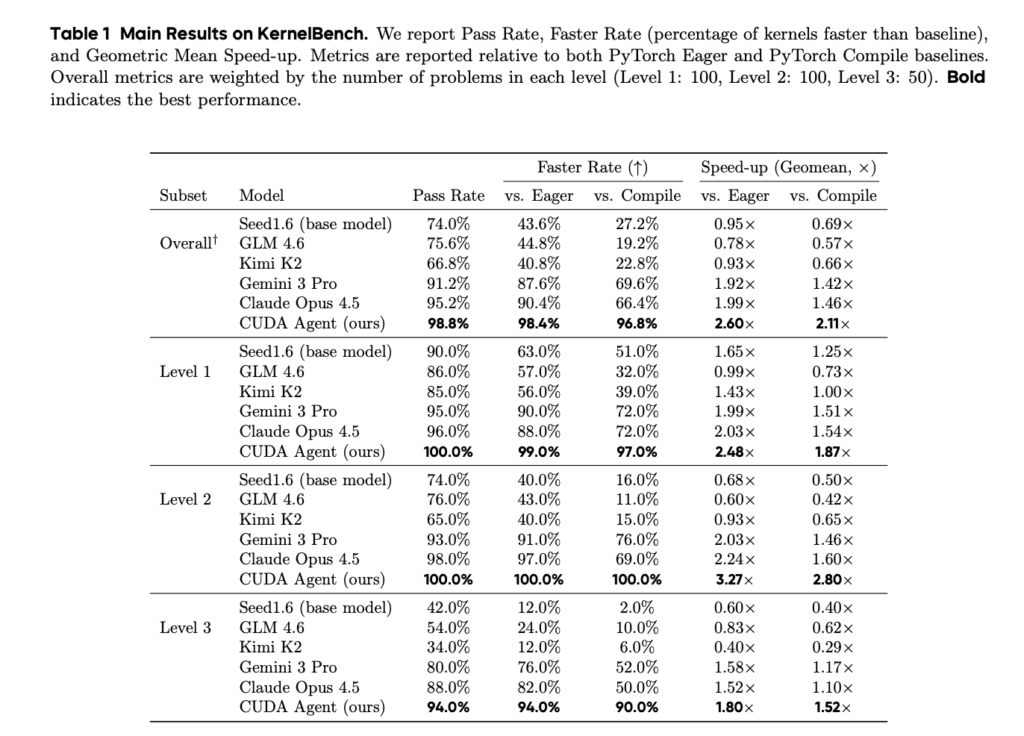
ByteDance Seed and Tsinghua AIR Introduces CUDA Agent: A Large-Scale Agentic RL System for CUDA Kernel Generation

ByteDance Seed and Tsinghua AIR have released CUDA Agent, an agentic reinforcement learning system that trains a large language model to write GPU kernels that beat a compiler. The gap it targets is narrow but stubborn: frontier models already produce correct CUDA, they just produce slow CUDA. On KernelBench, the base model Seed1.6 passes 74.0%

ByteDance Seed and Tsinghua AIR Introduces CUDA Agent: A Large-Scale Agentic RL System for CUDA Kernel Generation Read More »

MiniMax Releases MiniMax-Music3: An Open-Weights Music Model Generating Complete Five-Minute Songs From Lyrics and a Structured Caption

MiniMax released MiniMax-Music3, an open-weights text-to-music model. The model takes two separate inputs: lyrics carrying section tags, and a detailed music description. It returns a complete song of up to five minutes in a single generation, as 32 kHz, 16-bit stereo WAV. The architecture pairs a Hybrid-LM, an 8B Global LLM with a 0.6B Local

MiniMax Releases MiniMax-Music3: An Open-Weights Music Model Generating Complete Five-Minute Songs From Lyrics and a Structured Caption Read More »

DeepSeek AI Releases DeepSeek Harness in Developer Preview: An MIT-Licensed Agent Harness Where Everything is a Plugin

DeepSeek released DeepSeek Harness v0.1 in developer preview and published the full source code under the MIT license. The project ships as dsh at deepseek-ai/deepseek-harness. A harness is the layer between a model and the environment it acts in — the tools, files, sandboxes, and control loop that let an agent keep working. DeepSeek frames

DeepSeek AI Releases DeepSeek Harness in Developer Preview: An MIT-Licensed Agent Harness Where Everything is a Plugin Read More »

Z.ai Ships GLM-5.3 Without Retraining the Base Model: Better at Complex Coding and Long-Horizon Tasks

Z.ai just released GLM-5.3. GLM-5.3 runs on the same 743B base model as GLM-5.2. Every reported gain comes from scaled post-training: more task environments, more environment types, longer training. The results land in two places. Coding jumps most on the longest-horizon benchmarks, with Terminal-Bench 3.0 moving from 4.6 to 28.3. Cybersecurity moved further than Z.ai

Z.ai Ships GLM-5.3 Without Retraining the Base Model: Better at Complex Coding and Long-Horizon Tasks Read More »

Meet Needle 2: An Open 45M-Parameter Tool-Calling Model That Ships as a 14MB Binary and Runs a Full Session in 28MB of RAM

Cactus Compute has released Needle 2, an open 45M-parameter model for tool calling, device use, and structured extraction. The entire model ships as a single 14MB binary that runs a full session in about 28MB of RAM. Weights are trained and deployed at CQ2-bit using Cactus Quants, and the model is sealed inside the company’s

Meet Needle 2: An Open 45M-Parameter Tool-Calling Model That Ships as a 14MB Binary and Runs a Full Session in 28MB of RAM Read More »

Google AI Just Released Gemini 3.7 Flash: A Coding and Agent Model at $0.75/1M Input Tokens

Google has released Gemini 3.7 Flash, the newest model in its Flash tier, three weeks after Gemini 3.6 Flash. The model card describes it as a refinement of 3.6 Flash with algorithmic improvements to the core reasoning foundation — not a new pretraining run. It accepts text, images, audio, and video across a 1M-token context

Google AI Just Released Gemini 3.7 Flash: A Coding and Agent Model at $0.75/1M Input Tokens Read More »

Liquid AI Releases LFM2.5-VL-3B: A 3B Vision-Language Model That Reads Screens, Grounds Objects, and Calls Tools On-Device

Yesterday, Liquid AI released LFM2.5-VL-3B. It is a 3.1B-parameter vision-language model built for on-device deployment. The model reads digital screens across mobile, web, and desktop. It grounds objects to coordinates, parses documents and charts, and calls tools from text or image input. Liquid AI reports an average of 69.4 across 28 vision benchmarks. That matches

Liquid AI Releases LFM2.5-VL-3B: A 3B Vision-Language Model That Reads Screens, Grounds Objects, and Calls Tools On-Device Read More »