
Context Rot in Large Language Models
Why it matters: Context rot makes LLMs fail long before the window fills. See why, how to measure it, and the context engineering fixes that keep answers reliable.
Auto Added by WPeMatico
Why it matters: Context rot makes LLMs fail long before the window fills. See why, how to measure it, and the context engineering fixes that keep answers reliable.
Meta has released Muse Glimmer, a 30-billion-parameter multimodal model distilled from Muse Spark. It is tuned for always-on local agent workflows, and ships under Apache 2.0. A 30B model normally needs over 55 GB of memory at full precision. Meta compresses it to roughly 4-bit, then adds block-level speculative decoding so it answers fast enough
Long-running agents accumulate state that no transcript captures. A coding agent at step 10 holds edited files, a running dev server, installed packages, and a warm prompt cache. When it misreads a traceback and rewrites a file that was already correct, neither available recovery path is cheap: patching forward grows the context and the token
This year, many data teams have added AI agents to their roadmaps. The excitement is real: an agent that turns a two-day analysis into a two-minute conversation can change how analysts and business teams work together. But agents are only as reliable as the data foundation beneath them. Point them at raw tables or outdated
Building Trustworthy Snowflake AI Agents with Semantic Governance Read More »
Tencent Cloud has open-sourced TencentDB Agent Memory v2.0, a team-level memory hub for AI agents. The idea is super simple: if project context was already explained once, a new session should not need it repeated. The system turns conversations, documents and code into four reusable memory assets — Chat Memory, Skill, LLM-Wiki and Code-Graph —
Microsoft has open sourced code-testing-generator, a polyglot agent that writes unit tests and then proves they work. It ships in the dotnet-test plugin inside the MIT-licensed dotnet/skills repository. The agent targets a gap that coding assistants usually leave open. A prompt like ‘generate unit tests’ does not say which framework, file location or assertions to
Cloudflare has released Kitesurf, a stateless web browser built specifically for AI agents. It runs entirely in V8 isolates on Cloudflare Workers, with no Chromium underneath. Browser engines like Chromium were built for humans, and their memory and compute overhead makes one-browser-per-agent prohibitively expensive. Agents do not need tabs, extensions, or pixel-perfect 60-fps rendering. They
Prime Intellect has open-sourced Prime Agent, a self-improving coding harness designed around two abstractions, the Recursive Language Model (RLM) and Continual Harness. Fixed tool schemas and context compaction force a model to work around its own scaffolding. Prime Agent replaces both with a persistent Python REPL and a rewritable harness. With Opus 5, it reports
SkillOpt is a text-space optimizer developed by a team of researchers from Microsoft, Shanghai Jiao Tong University, Tongji University, and Fudan University. SkillOpt trains a single natural-language skill document while the target model stays frozen. An optimizer model reads scored rollouts and proposes bounded add/delete/replace edits. A held-out selection split accepts an edit only when
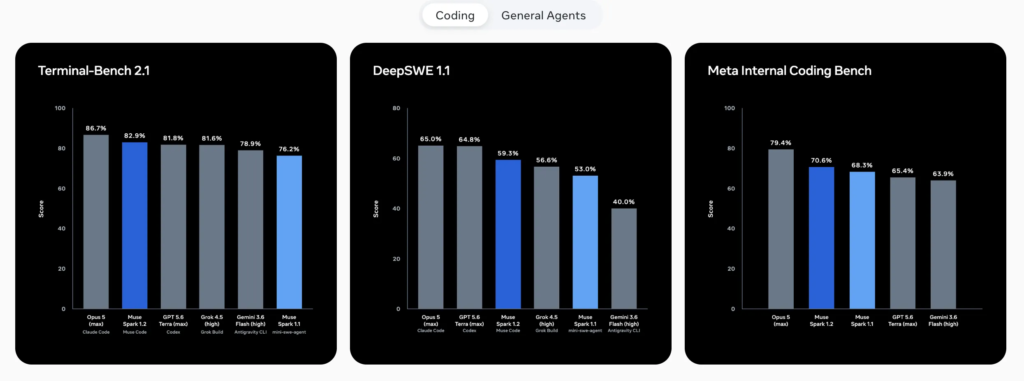
Meta AI has released Muse Code (in beta), a terminal coding agent in beta, powered by its new Muse Spark 1.2 model. Meta positions the pair as its next step toward the frontier, with larger models on the way. Muse Code targets complex software engineering across large repositories: it plans changes, writes code, and validates