AI Agents

Auto Added by WPeMatico

Alibaba Tongyi Lab Releases MAI-UI: A Foundation GUI Agent Family that Surpasses Gemini 2.5 Pro, Seed1.8 and UI-Tars-2 on AndroidWorld

Alibaba Tongyi Lab have released MAI-UI—a family of foundation GUI agents. It natively integrates MCP tool use, agent user interaction, device–cloud collaboration, and online RL, establishing state-of-the-art results in general GUI grounding and mobile GUI navigation, surpassing Gemini-2.5-Pro, Seed1.8, and UI-Tars-2 on AndroidWorld. The system targets three specific gaps that early GUI agents often ignore, […]

Alibaba Tongyi Lab Releases MAI-UI: A Foundation GUI Agent Family that Surpasses Gemini 2.5 Pro, Seed1.8 and UI-Tars-2 on AndroidWorld Read More »

How to Build a Robust Multi-Agent Pipeline Using CAMEL with Planning, Web-Augmented Reasoning, Critique, and Persistent Memory

In this tutorial, we build an advanced, end-to-end multi-agent research workflow using the CAMEL framework. We design a coordinated society of agents, Planner, Researcher, Writer, Critic, and Finalizer, that collaboratively transform a high-level topic into a polished, evidence-grounded research brief. We securely integrate the OpenAI API, orchestrate agent interactions programmatically, and add lightweight persistent memory

How to Build a Robust Multi-Agent Pipeline Using CAMEL with Planning, Web-Augmented Reasoning, Critique, and Persistent Memory Read More »

Edge Agents vs. Cloud Agents: Why the Wrong Choice Can Kill AI Performance

Artificial Intelligence is no longer confined to massive servers or centralized clouds. As we move deeper into 2025, AI has become distributed, autonomous, and embedded in every layer of digital infrastructure. But with this shift comes a new strategic question for every engineering and business leader: Where should your AI agent actually live — on

Edge Agents vs. Cloud Agents: Why the Wrong Choice Can Kill AI Performance Read More »

Track and Monitor AI Agents Using MLflow: Complete Guide for Agentic Systems

More machine learning systems now rely on AI agents, which makes careful safety evaluation essential. With more and more vulnerabilities coming to the fray, it’s nigh impossible for a single unified protocol to stay up to date with them all. This piece introduces MLflow as a practical framework for testing and monitoring agentic systems through

Track and Monitor AI Agents Using MLflow: Complete Guide for Agentic Systems Read More »

NVIDIA AI Researchers Release NitroGen: An Open Vision Action Foundation Model For Generalist Gaming Agents

NVIDIA AI research team released NitroGen, an open vision action foundation model for generalist gaming agents that learns to play commercial games directly from pixels and gamepad actions using internet video at scale. NitroGen is trained on 40,000 hours of gameplay across more than 1,000 games and comes with an open dataset, a universal simulator,

NVIDIA AI Researchers Release NitroGen: An Open Vision Action Foundation Model For Generalist Gaming Agents Read More »

Google A2UI Explained: How AI Agents Build Secure, Native User Interfaces

We have entered the time of multi-agent artificial intelligence. However, there is a very important issue: in what way can remote AI agents produce rich and interactive experiences without exposing the system to security risks? Google A2UI (Agent-to-UI) protocol addresses this question in a very smart way, allowing agents to create user interfaces that are

Google A2UI Explained: How AI Agents Build Secure, Native User Interfaces Read More »

Build AI Agents with RapidAPI for Real-Time Data

Agent creation has become easier than ever but have you ever thought – how can we make them more powerful than they already are? I recently thought of one possible way – what if they had realtime information about specific categories like finance and movies. That would be really cool, right? While exploring this option,

Build AI Agents with RapidAPI for Real-Time Data Read More »

😊

MiniMax Releases M2.1: An Enhanced M2 Version with Features like Multi-Coding Language Support, API Integration, and Improved Tools for Structured Coding

Just months after releasing M2—a fast, low-cost model designed for agents and code—MiniMax has introduced an enhanced version: MiniMax M2.1. M2 already stood out for its efficiency, running at roughly 8% of the cost of Claude Sonnet while delivering significantly higher speed. More importantly, it introduced a different computational and reasoning pattern, particularly in how

MiniMax Releases M2.1: An Enhanced M2 Version with Features like Multi-Coding Language Support, API Integration, and Improved Tools for Structured Coding Read More »

A Coding Guide to Build an Autonomous Multi-Agent Logistics System with Route Planning, Dynamic Auctions, and Real-Time Visualization Using Graph-Based Simulation

In this tutorial, we build an advanced, fully autonomous logistics simulation in which multiple smart delivery trucks operate within a dynamic city-wide road network. We design the system so that each truck behaves as an agent capable of bidding on delivery orders, planning optimal routes, managing battery levels, seeking charging stations, and maximizing profit through

A Coding Guide to Build an Autonomous Multi-Agent Logistics System with Route Planning, Dynamic Auctions, and Real-Time Visualization Using Graph-Based Simulation Read More »

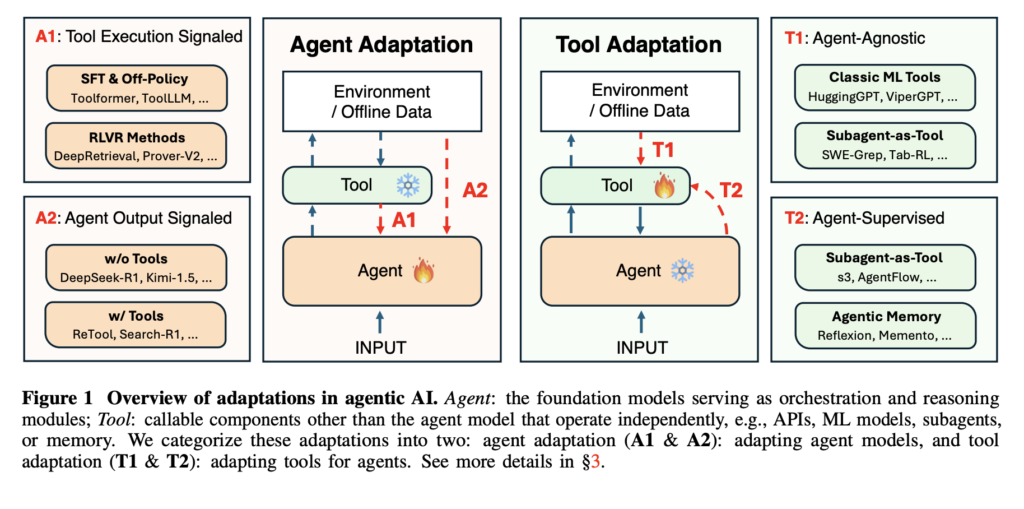
This AI Paper from Stanford and Harvard Explains Why Most ‘Agentic AI’ Systems Feel Impressive in Demos and then Completely Fall Apart in Real Use

Agentic AI systems sit on top of large language models and connect to tools, memory, and external environments. They already support scientific discovery, software development, and clinical research, yet they still struggle with unreliable tool use, weak long horizon planning, and poor generalization. The latest research paper ‘Adaptation of Agentic AI‘ from Stanford, Harvard, UC

This AI Paper from Stanford and Harvard Explains Why Most ‘Agentic AI’ Systems Feel Impressive in Demos and then Completely Fall Apart in Real Use Read More »