AI Infrastructure

Auto Added by WPeMatico

Google AI Research Introduces PaperOrchestra: A Multi-Agent Framework for Automated AI Research Paper Writing

Writing a research paper is brutal. Even after the experiments are done, a researcher still faces weeks of translating messy lab notes, scattered results tables, and half-formed ideas into a polished, logically coherent manuscript formatted precisely to a conference’s specifications. For many fresh researchers, that translation work is where papers go to die. A team […]
Google AI Research Introduces PaperOrchestra: A Multi-Agent Framework for Automated AI Research Paper Writing Read More »

A Comprehensive Implementation Guide to ModelScope for Model Search, Inference, Fine-Tuning, Evaluation, and Export

In this tutorial, we explore ModelScope through a practical, end-to-end workflow that runs smoothly on Colab. We begin by setting up the environment, verifying dependencies, and confirming GPU availability so we can work with the framework reliably from the start. From there, we interact with the ModelScope Hub to search for models, download snapshots, load

A Comprehensive Implementation Guide to ModelScope for Model Search, Inference, Fine-Tuning, Evaluation, and Export Read More »

Z.AI Introduces GLM-5.1: An Open-Weight 754B Agentic Model That Achieves SOTA on SWE-Bench Pro and Sustains 8-Hour Autonomous Execution

Z.AI, the AI platform developed by the team behind the GLM model family, has released GLM-5.1 — its next-generation flagship model developed specifically for agentic engineering. Unlike models optimized for clean, single-turn benchmarks, GLM-5.1 is built for agentic tasks, with significantly stronger coding capabilities than its predecessor, and achieves state-of-the-art performance on SWE-Bench Pro while

Z.AI Introduces GLM-5.1: An Open-Weight 754B Agentic Model That Achieves SOTA on SWE-Bench Pro and Sustains 8-Hour Autonomous Execution Read More »

How to Deploy Open WebUI with Secure OpenAI API Integration, Public Tunneling, and Browser-Based Chat Access

In this tutorial, we build a complete Open WebUI setup in Colab, in a practical, hands-on way, using Python. We begin by installing the required dependencies, then securely provide our OpenAI API key through terminal-based secret input so that sensitive credentials are not exposed directly in the notebook. From there, we configure the environment variables

How to Deploy Open WebUI with Secure OpenAI API Integration, Public Tunneling, and Browser-Based Chat Access Read More »

An Implementation Guide to Running NVIDIA Transformer Engine with Mixed Precision, FP8 Checks, Benchmarking, and Fallback Execution

In this tutorial, we implement an advanced, practical implementation of the NVIDIA Transformer Engine in Python, focusing on how mixed-precision acceleration can be explored in a realistic deep learning workflow. We set up the environment, verify GPU and CUDA readiness, attempt to install the required Transformer Engine components, and handle compatibility issues gracefully so that

An Implementation Guide to Running NVIDIA Transformer Engine with Mixed Precision, FP8 Checks, Benchmarking, and Fallback Execution Read More »

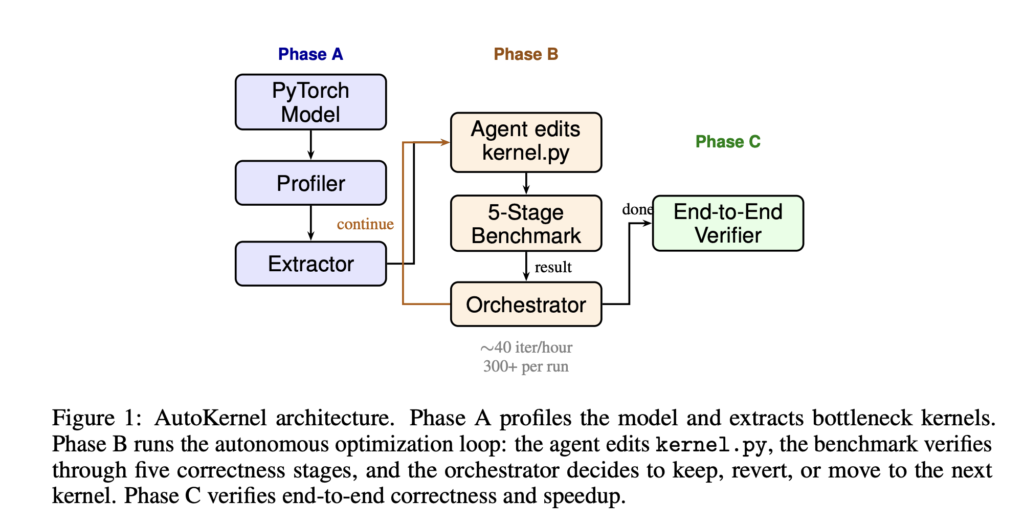
RightNow AI Releases AutoKernel: An Open-Source Framework that Applies an Autonomous Agent Loop to GPU Kernel Optimization for Arbitrary PyTorch Models

Writing fast GPU code is one of the most grueling specializations in machine learning engineering. Researchers from RightNow AI want to automate it entirely. The RightNow AI research team has released AutoKernel, an open-source framework that applies an autonomous LLM agent loop to GPU kernel optimization for arbitrary PyTorch models. The approach is straightforward: give

RightNow AI Releases AutoKernel: An Open-Source Framework that Applies an Autonomous Agent Loop to GPU Kernel Optimization for Arbitrary PyTorch Models Read More »

Step by Step Guide to Build an End-to-End Model Optimization Pipeline with NVIDIA Model Optimizer Using FastNAS Pruning and Fine-Tuning

In this tutorial, we build a complete end-to-end pipeline using NVIDIA Model Optimizer to train, prune, and fine-tune a deep learning model directly in Google Colab. We start by setting up the environment and preparing the CIFAR-10 dataset, then define a ResNet architecture and train it to establish a strong baseline. From there, we apply

Step by Step Guide to Build an End-to-End Model Optimization Pipeline with NVIDIA Model Optimizer Using FastNAS Pruning and Fine-Tuning Read More »

Defeating the ‘Token Tax’: How Google Gemma 4, NVIDIA, and OpenClaw are Revolutionizing Local Agentic AI: From RTX Desktops to DGX Spark

Run Google’s latest omni-capable open models faster on NVIDIA RTX AI PCs, from NVIDIA Jetson Orin Nano, GeForce RTX desktops to the new DGX Spark, to build personalized, always-on AI assistants like OpenClaw without paying a massive “token tax” for every action. The landscape of modern AI is shifting rapidly. We are moving away from

Defeating the ‘Token Tax’: How Google Gemma 4, NVIDIA, and OpenClaw are Revolutionizing Local Agentic AI: From RTX Desktops to DGX Spark Read More »

Hugging Face Releases TRL v1.0: A Unified Post-Training Stack for SFT, Reward Modeling, DPO, and GRPO Workflows

Hugging Face has officially released TRL (Transformer Reinforcement Learning) v1.0, marking a pivotal transition for the library from a research-oriented repository to a stable, production-ready framework. For AI professionals and developers, this release codifies the Post-Training pipeline—the essential sequence of Supervised Fine-Tuning (SFT), Reward Modeling, and Alignment—into a unified, standardized API. In the early stages

Hugging Face Releases TRL v1.0: A Unified Post-Training Stack for SFT, Reward Modeling, DPO, and GRPO Workflows Read More »

Liquid AI Released LFM2.5-350M: A Compact 350M Parameter Model Trained on 28T Tokens with Scaled Reinforcement Learning

In the current landscape of generative AI, the ‘scaling laws’ have generally dictated that more parameters equal more intelligence. However, Liquid AI is challenging this convention with the release of LFM2.5-350M. This model is actually a technical case study in intelligence density with additional pre-training (from 10T to 28T tokens) and large-scale reinforcement learning The

Liquid AI Released LFM2.5-350M: A Compact 350M Parameter Model Trained on 28T Tokens with Scaled Reinforcement Learning Read More »