Tech News

Auto Added by WPeMatico

Hugging Face Releases TRL v1.0: A Unified Post-Training Stack for SFT, Reward Modeling, DPO, and GRPO Workflows

Hugging Face has officially released TRL (Transformer Reinforcement Learning) v1.0, marking a pivotal transition for the library from a research-oriented repository to a stable, production-ready framework. For AI professionals and developers, this release codifies the Post-Training pipeline—the essential sequence of Supervised Fine-Tuning (SFT), Reward Modeling, and Alignment—into a unified, standardized API. In the early stages […]

Hugging Face Releases TRL v1.0: A Unified Post-Training Stack for SFT, Reward Modeling, DPO, and GRPO Workflows Read More »

Google AI Releases Veo 3.1 Lite: Giving Developers Low Cost High Speed Video Generation via The Gemini API

Google has announced the release of Veo 3.1 Lite, a new model tier within its generative video portfolio designed to address the primary bottleneck for production-scale deployments: pricing. While the generative video space has seen rapid progress in visual fidelity, the cost per second of generated content has remained high, often prohibitive for developers building

Google AI Releases Veo 3.1 Lite: Giving Developers Low Cost High Speed Video Generation via The Gemini API Read More »

Liquid AI Released LFM2.5-350M: A Compact 350M Parameter Model Trained on 28T Tokens with Scaled Reinforcement Learning

In the current landscape of generative AI, the ‘scaling laws’ have generally dictated that more parameters equal more intelligence. However, Liquid AI is challenging this convention with the release of LFM2.5-350M. This model is actually a technical case study in intelligence density with additional pre-training (from 10T to 28T tokens) and large-scale reinforcement learning The

Liquid AI Released LFM2.5-350M: A Compact 350M Parameter Model Trained on 28T Tokens with Scaled Reinforcement Learning Read More »

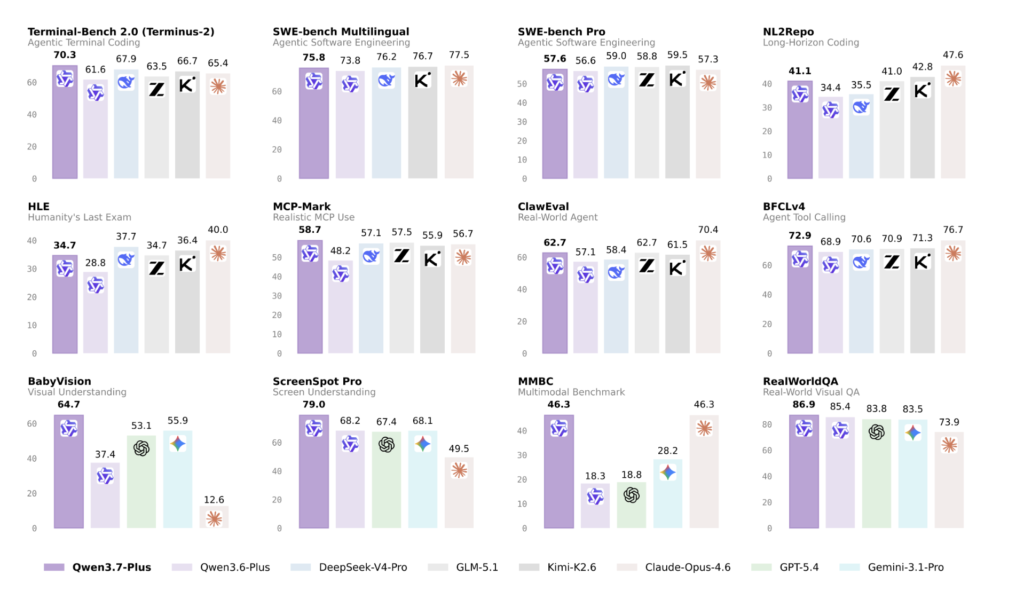
Alibaba Qwen Team Releases Qwen3.5 Omni: A Native Multimodal Model for Text, Audio, Video, and Realtime Interaction

The landscape of multimodal large language models (MLLMs) has shifted from experimental ‘wrappers’—where separate vision or audio encoders are stitched onto a text-based backbone—to native, end-to-end ‘omnimodal’ architectures. Alibaba Qwen team latest release, Qwen3.5-Omni, represents a significant milestone in this evolution. Designed as a direct competitor to flagship models like Gemini 3.1 Pro, the Qwen3.5-Omni

Alibaba Qwen Team Releases Qwen3.5 Omni: A Native Multimodal Model for Text, Audio, Video, and Realtime Interaction Read More »

Salesforce AI Research Releases VoiceAgentRAG: A Dual-Agent Memory Router that Cuts Voice RAG Retrieval Latency by 316x

In the world of voice AI, the difference between a helpful assistant and an awkward interaction is measured in milliseconds. While text-based Retrieval-Augmented Generation (RAG) systems can afford a few seconds of ‘thinking’ time, voice agents must respond within a 200ms budget to maintain a natural conversational flow. Standard production vector database queries typically add

Salesforce AI Research Releases VoiceAgentRAG: A Dual-Agent Memory Router that Cuts Voice RAG Retrieval Latency by 316x Read More »

Agent-Infra Releases AIO Sandbox: An All-in-One Runtime for AI Agents with Browser, Shell, Shared Filesystem, and MCP

In the development of autonomous agents, the technical bottleneck is shifting from model reasoning to the execution environment. While Large Language Models (LLMs) can generate code and multi-step plans, providing a functional and isolated environment for that code to run remains a significant infrastructure challenge. Agent-Infra’s Sandbox, an open-source project, addresses this by providing an

Agent-Infra Releases AIO Sandbox: An All-in-One Runtime for AI Agents with Browser, Shell, Shared Filesystem, and MCP Read More »

Meet A-Evolve: The PyTorch Moment For Agentic AI Systems Replacing Manual Tuning With Automated State Mutation And Self-Correction

A team of researchers associated with Amazon has released A-Evolve, a universal infrastructure designed to automate the development of autonomous AI agents. The framework aims to replace the ‘manual harness engineering’ that currently defines agent development with a systematic, automated evolution process. The project is being described as a potential ‘PyTorch moment’ for agentic AI.

Meet A-Evolve: The PyTorch Moment For Agentic AI Systems Replacing Manual Tuning With Automated State Mutation And Self-Correction Read More »

Chroma Releases Context-1: A 20B Agentic Search Model for Multi-Hop Retrieval, Context Management, and Scalable Synthetic Task Generation

In the current AI landscape, the ‘context window’ has become a blunt instrument. We’ve been told that if we simply expand the memory of a frontier model, the retrieval problem disappears. But as any AI professionals building RAG (Retrieval-Augmented Generation) systems knows, stuffing a million tokens into a prompt often leads to higher latency, astronomical

Chroma Releases Context-1: A 20B Agentic Search Model for Multi-Hop Retrieval, Context Management, and Scalable Synthetic Task Generation Read More »

NVIDIA AI Unveils ProRL Agent: A Decoupled Rollout-as-a-Service Infrastructure for Reinforcement Learning of Multi-Turn LLM Agents at Scale

NVIDIA researchers introduced ProRL AGENT, a scalable infrastructure designed for reinforcement learning (RL) training of multi-turn LLM agents. By adopting a ‘Rollout-as-a-Service’ philosophy, the system decouples agentic rollout orchestration from the training loop. This architectural shift addresses the inherent resource conflicts between I/O-intensive environment interactions and GPU-intensive policy updates that currently bottleneck agent development. The

NVIDIA AI Unveils ProRL Agent: A Decoupled Rollout-as-a-Service Infrastructure for Reinforcement Learning of Multi-Turn LLM Agents at Scale Read More »

openJiuwen Community Releases ‘JiuwenClaw’: A Self Evolving AI Agent for Task Management

Over the past year, AI agents have evolved from merely answering questions to attempting to get real tasks done. However, a significant bottleneck has emerged: while most agents may appear intelligent during a conversation, they often ‘drop the ball’ when it comes to executing real-world tasks. Whether it’s an office workflow that breaks when requirements

openJiuwen Community Releases ‘JiuwenClaw’: A Self Evolving AI Agent for Task Management Read More »