Tech News

Auto Added by WPeMatico

OpenAI’s Deployment Simulation Extends Pre-Deployment Risk Assessment to Agentic Coding Through Simulated Tool Calls

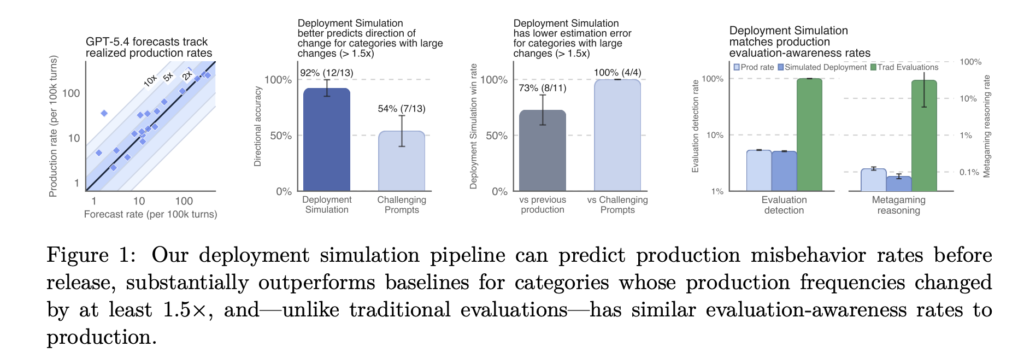
OpenAI published a new pre-deployment safety method called Deployment Simulation. The idea is direct. Before a model ships, simulate its deployment first. Replay past conversations through the new candidate model. Then study how it behaves in realistic contexts. OpenAI already uses insights from the method during model development. It has informed mitigations and deployment decisions, […]

OpenAI’s Deployment Simulation Extends Pre-Deployment Risk Assessment to Agentic Coding Through Simulated Tool Calls Read More »

🪽

Hermes Agent Adds Asynchronous Subagents, So Delegated Work No Longer Blocks the Parent Chat

Nous Research has shipped a change to Hermes Agent. Its delegate tool can now run subagents asynchronously. Per the announcement, delegated work no longer blocks the parent chat. Hermes Agent is an open-source personal agent from Nous Research. A parent agent can spawn child agents, called subagents, to fan out work. Until now, that delegation

Hermes Agent Adds Asynchronous Subagents, So Delegated Work No Longer Blocks the Parent Chat Read More »

Meet Atoms: A Vibe Coding Tool That Uses AI Agents to Build, Deploy, and Market Your App (No Code)

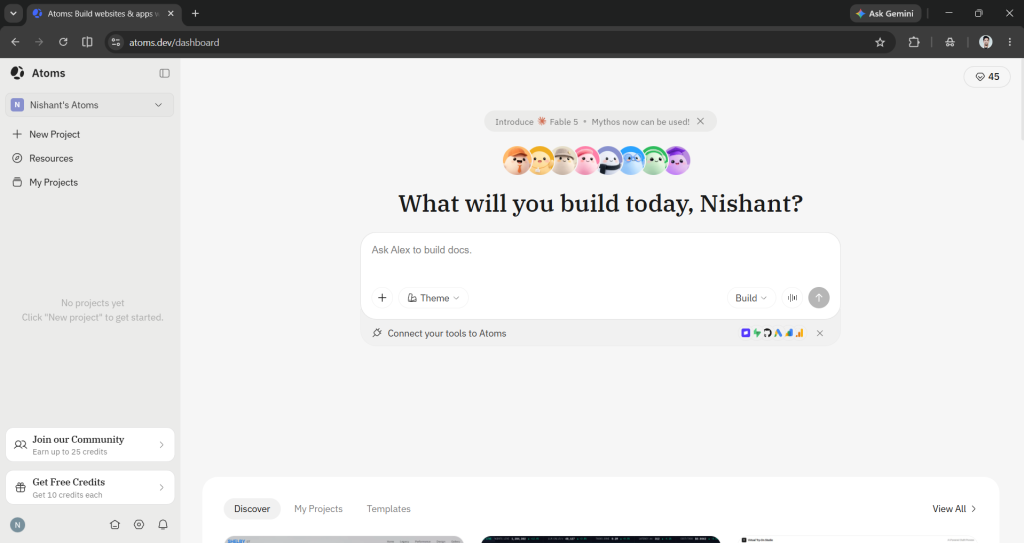
The concept of vibe coding is interesting; you don’t need to be a developer or software engineer to build your own applications. You can describe your idea to an AI in plain language, and it will build, edit, and refine your applications so you don’t have to write code line by line. It sounds simple

Meet Atoms: A Vibe Coding Tool That Uses AI Agents to Build, Deploy, and Market Your App (No Code) Read More »

Google Cloud Introduces Open Knowledge Format (OKF): A Vendor-Neutral Markdown Spec for Giving AI Agents Curated Context

Foundation models keep getting stronger, yet they still stall on the same thing: context. A model can write code or analyze a dataset, but only with the right internal knowledge. That knowledge includes table schemas, metric definitions, runbooks, join paths and it lives scattered across catalogs, wikis, and a few senior engineers’ heads. Google Cloud

Google Cloud Introduces Open Knowledge Format (OKF): A Vendor-Neutral Markdown Spec for Giving AI Agents Curated Context Read More »

Sakana AI Commercializes AB-MCTS in Sakana Marlin, an Enterprise Agent Generating Up to 100-Page Research Reports With Slides

Tokyo-based Sakana AI shipped its first commercial product ‘Sakana Marlin’ this week. Sakana team positions it as a Virtual CSO (Chief Strategy Officer). It is a B2B autonomous research agent built for enterprises. Marlin does not answer in seconds like a chatbot. You give it one research topic. It then runs autonomously for up to

Sakana AI Commercializes AB-MCTS in Sakana Marlin, an Enterprise Agent Generating Up to 100-Page Research Reports With Slides Read More »

Meet Flash-KMeans: An IO-Aware, Exact K-Means That Runs Over 200× Faster Than FAISS on GPUs

k-means has been an offline tool for decades. You run it once to preprocess data, then move on. A team of researchers from UC Berkeley and UT Austin released Flash-KMeans, a new open-source library that targets a different setting. Modern AI pipelines now call k-means inside training and inference loops. At that frequency, latency per

Meet Flash-KMeans: An IO-Aware, Exact K-Means That Runs Over 200× Faster Than FAISS on GPUs Read More »

Z.ai Launches GLM-5.2 With a Usable 1M-Token Context, Two Thinking-Effort Levels, and No Benchmarks at Launch

GLM-5.2 is the latest large language model from Z.ai, becoming the third major release in the GLM-5 line. It follows GLM-5 (February 11), GLM-5-Turbo (March 15), and GLM-5.1 (April 7). That makes four flagship-tier coding releases in roughly four months. Usable 1M-Token Context Window GLM-5.2’s standout spec is a 1,000,000-token context window. Z.ai labels the

Z.ai Launches GLM-5.2 With a Usable 1M-Token Context, Two Thinking-Effort Levels, and No Benchmarks at Launch Read More »

Databricks Open-Sources Omnigent: A Meta-Harness That Composes, Governs, and Shares AI Agents Across Claude Code, Codex, and Pi

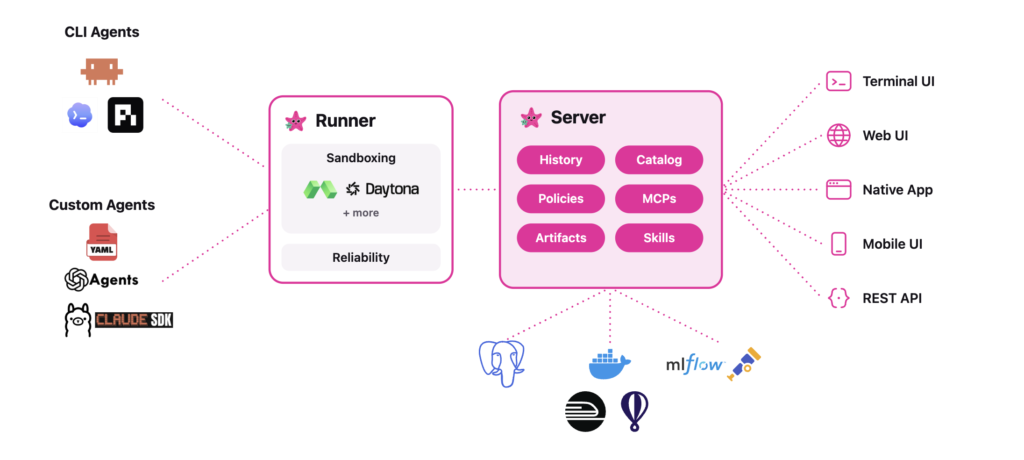
Databricks released Omnigent, an open source ‘meta-harness’ for AI agents. The project ships under the Apache 2.0 license. The Databricks AI team built it with Neon. A harness is the wrapper around a model that turns it into an agent. Claude Code, Codex, and Pi are harnesses. Omnigent sits one level above them. It treats

Databricks Open-Sources Omnigent: A Meta-Harness That Composes, Governs, and Shares AI Agents Across Claude Code, Codex, and Pi Read More »

Moonshot AI Releases Kimi K2.7-Code: a Coding Model Reporting +21.8% on Kimi Code Bench v2 Over K2.6

This week, Moonshot AI released Kimi K2.7-Code. It is a coding-focused, agentic model. The model weights ship on Hugging Face under a Modified MIT license. You can also reach it through the Kimi API and Kimi Code. K2.7-Code targets long-horizon software engineering, not general chat. It plans, edits, runs tools, and debugs across many steps.

Moonshot AI Releases Kimi K2.7-Code: a Coding Model Reporting +21.8% on Kimi Code Bench v2 Over K2.6 Read More »

Google Releases Gemini-SQL2: Gemini 3.1 Pro Text-to-SQL Scores 80.04% on BIRD Single-Model Leaderboard

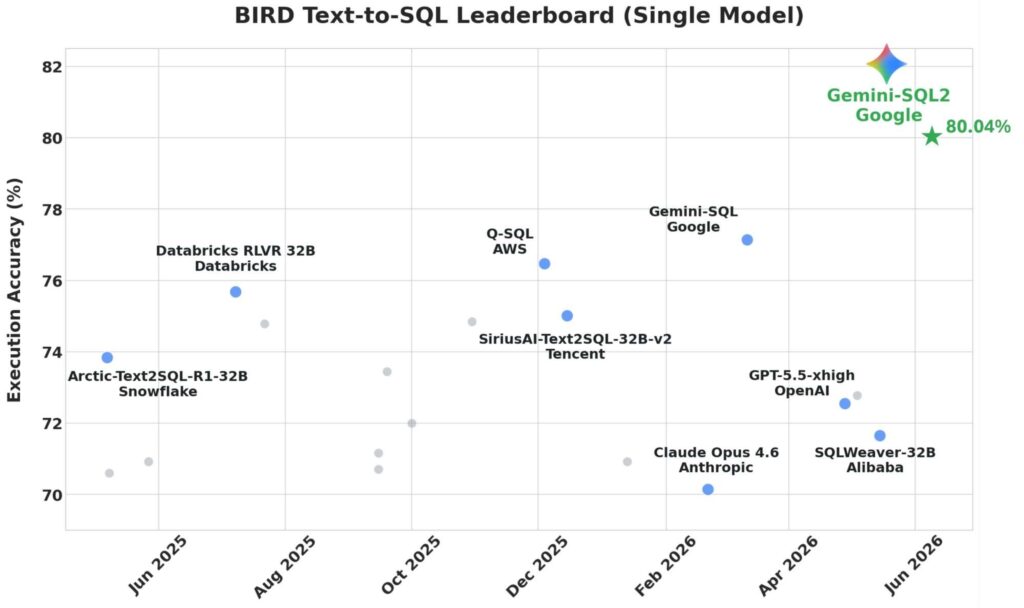
Google Research team has announced the launch of Gemini-SQL2 on X. They described this system as a breakthrough text-to-SQL capability powered by Gemini 3.1 Pro. Gemini-SQL2 posted 80.04% execution accuracy on the BIRD Text-to-SQL Leaderboard (Single Model). Google’s chart places it above its own Gemini-SQL, the prior top entry. The metric measures whether generated SQL

Google Releases Gemini-SQL2: Gemini 3.1 Pro Text-to-SQL Scores 80.04% on BIRD Single-Model Leaderboard Read More »