New Releases

Auto Added by WPeMatico

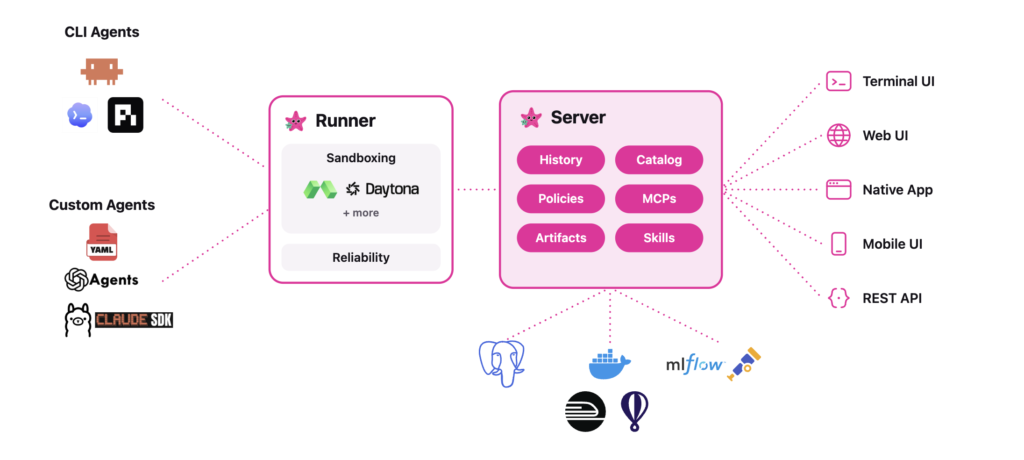
TinyFish AI Releases Full Web Infrastructure Platform for AI Agents: Search, Fetch, Browser, and Agent Under One API Key

AI agents struggle with tasks that require interacting with the live web — fetching a competitor’s pricing page, extracting structured data from a JavaScript-heavy dashboard, or automating a multi-step workflow on a real site. The tooling has been fragmented, requiring teams to stitch together separate providers for search, browser automation, and content retrieval. TinyFish, a […]

TinyFish AI Releases Full Web Infrastructure Platform for AI Agents: Search, Fetch, Browser, and Agent Under One API Key Read More »

TinyFish Launches Full Web Infrastructure Platform for AI Agents — Search, Fetch, Browser, and Agent Under One API Key

AI agents struggle with tasks that require interacting with the live web — fetching a competitor’s pricing page, extracting structured data from a JavaScript-heavy dashboard, or automating a multi-step workflow on a real site. The tooling has been fragmented, requiring teams to stitch together separate providers for search, browser automation, and content retrieval. TinyFish, a

TinyFish Launches Full Web Infrastructure Platform for AI Agents — Search, Fetch, Browser, and Agent Under One API Key Read More »

NVIDIA and the University of Maryland Researchers Released Audio Flamingo Next (AF-Next): A Super Powerful and Open Large Audio-Language Model

Understanding audio has always been the multimodal frontier that lags behind vision. While image-language models have rapidly scaled toward real-world deployment, building open models that robustly reason over speech, environmental sounds, and music — especially at length — has remained quite hard. NVIDIA and the University of Maryland researchers are now taking a direct swing

NVIDIA and the University of Maryland Researchers Released Audio Flamingo Next (AF-Next): A Super Powerful and Open Large Audio-Language Model Read More »

Google AI Research Proposes Vantage: An LLM-Based Protocol for Measuring Collaboration, Creativity, and Critical Thinking

Standardized tests can tell you whether a student knows calculus or can parse a passage of text. What they cannot reliably tell you is whether that student can resolve a disagreement with a teammate, generate genuinely original ideas under pressure, or critically dismantle a flawed argument. These are the so-called durable skills — collaboration, creativity,

Google AI Research Proposes Vantage: An LLM-Based Protocol for Measuring Collaboration, Creativity, and Critical Thinking Read More »

MiniMax Releases MMX-CLI: A Command-Line Interface That Gives AI Agents Native Access to Image, Video, Speech, Music, Vision, and Search

MiniMax, the AI research company behind the MiniMax omni-modal model stack, has released MMX-CLI — Node.js-based command-line interface that exposes the MiniMax AI platform’s full suite of generative capabilities, both to human developers working in a terminal and to AI agents running in tools like Cursor, Claude Code, and OpenCode. What Problem Is MMX-CLI Solving?

MiniMax Releases MMX-CLI: A Command-Line Interface That Gives AI Agents Native Access to Image, Video, Speech, Music, Vision, and Search Read More »

MiniMax Just Open Sourced MiniMax M2.7: A Self-Evolving Agent Model that Scores 56.22% on SWE-Pro and 57.0% on Terminal Bench 2

MiniMax has officially open-sourced MiniMax M2.7, making the model weights publicly available on Hugging Face. Originally announced on March 18, 2026, MiniMax M2.7 is the MiniMax’s most capable open-source model to date — and its first model to actively participate in its own development cycle, a meaningful shift in how large language models are built

MiniMax Just Open Sourced MiniMax M2.7: A Self-Evolving Agent Model that Scores 56.22% on SWE-Pro and 57.0% on Terminal Bench 2 Read More »

Liquid AI Releases LFM2.5-VL-450M: a 450M-Parameter Vision-Language Model with Bounding Box Prediction, Multilingual Support, and Sub-250ms Edge Inference

Liquid AI just released LFM2.5-VL-450M, an updated version of its earlier LFM2-VL-450M vision-language model. The new release introduces bounding box prediction, improved instruction following, expanded multilingual understanding, and function calling support — all within a 450M-parameter footprint designed to run directly on edge hardware ranging from embedded AI modules like NVIDIA Jetson Orin, to mini-PC

Liquid AI Releases LFM2.5-VL-450M: a 450M-Parameter Vision-Language Model with Bounding Box Prediction, Multilingual Support, and Sub-250ms Edge Inference Read More »

Researchers from MIT, NVIDIA, and Zhejiang University Propose TriAttention: A KV Cache Compression Method That Matches Full Attention at 2.5× Higher Throughput

Long-chain reasoning is one of the most compute-intensive tasks in modern large language models. When a model like DeepSeek-R1 or Qwen3 works through a complex math problem, it can generate tens of thousands of tokens before arriving at an answer. Every one of those tokens must be stored in what is called the KV cache

Researchers from MIT, NVIDIA, and Zhejiang University Propose TriAttention: A KV Cache Compression Method That Matches Full Attention at 2.5× Higher Throughput Read More »

NVIDIA Releases AITune: An Open-Source Inference Toolkit That Automatically Finds the Fastest Inference Backend for Any PyTorch Model

Deploying a deep learning model into production has always involved a painful gap between the model a researcher trains and the model that actually runs efficiently at scale. TensorRT exists, Torch-TensorRT exists, TorchAO exists — but wiring them together, deciding which backend to use for which layer, and validating that the tuned model still produces

NVIDIA Releases AITune: An Open-Source Inference Toolkit That Automatically Finds the Fastest Inference Backend for Any PyTorch Model Read More »

Meta Superintelligence Lab Releases Muse Spark: A Multimodal Reasoning Model With Thought Compression and Parallel Agents

Meta Superintelligence Labs recently made a significant move by unveiling ‘Muse Spark’ — the first model in the Muse family. Muse Spark is a natively multimodal reasoning model with support for tool-use, visual chain of thought, and multi-agent orchestration. https://ai.meta.com/static-resource/muse-spark-eval-methodology What ‘Natively Multimodal’ Actually Means When Meta describes Muse Spark as ‘natively multimodal,’ it means

Meta Superintelligence Lab Releases Muse Spark: A Multimodal Reasoning Model With Thought Compression and Parallel Agents Read More »