Machine Learning

Auto Added by WPeMatico

Kimi AI and kvcache-ai Open Sources ‘AgentENV’: A Distributed System that Powers Agentic Reinforcement Learning (RL) Training for Kimi K3

Moonshot AI’s Kimi team and kvcache-ai have open-sourced AgentENV (AENV), a distributed platform for running agent environments at scale. AgentENV powers agentic reinforcement learning (RL) training for Kimi K3, Moonshot’s 2.8-trillion-parameter Mixture-of-Experts model. The code ships under an MIT license. Why Environment Infra Holds Back Agentic RL Agentic RL does not just sample text. It […]
Kimi AI and kvcache-ai Open Sources ‘AgentENV’: A Distributed System that Powers Agentic Reinforcement Learning (RL) Training for Kimi K3 Read More »

KwaiKAT Team Releases KAT-Coder-V2.5: An Agentic Coding Model Trained on 100,000+ Verifiable Repository Environments

The KwaiKAT Team at Kuaishou has introduced the KAT-Coder-V2.5. It is a coding model trained to operate inside real, executable repositories rather than emit single-turn code. The served model is available through StreamLake. An open-weight variant, KAT-Coder-V2.5-Dev, was released separately on Hugging Face under Apache-2.0. AutoBuilder: environments that actually run the intended tests The research

KwaiKAT Team Releases KAT-Coder-V2.5: An Agentic Coding Model Trained on 100,000+ Verifiable Repository Environments Read More »

FAIRChem v2 UMA for Multidomain Atomistic Simulation across Molecules, Catalysts, Materials, Vibrations, and Molecular Dynamics

In this tutorial, we explore FAIRChem v2 and the UMA universal machine-learning interatomic potential as a unified framework for atomistic simulation across molecular chemistry, catalysis, and inorganic materials. We configure an environment, authenticate with Hugging Face to access the gated UMA model weights, and initialize task-specific calculators for the omol, oc20, and omat domains. We

FAIRChem v2 UMA for Multidomain Atomistic Simulation across Molecules, Catalysts, Materials, Vibrations, and Molecular Dynamics Read More »

Sakana AI Releases Fugu-Cyber: An Orchestration Model Reporting 86.9% on CyberGym and 72.1% on CTI-REALM

Sakana AI has released Fugu-Cyber (model ID is fugu-cyber-v1.0), a cybersecurity-specialized addition to its Fugu orchestration family. It is not just a new frontier model. It is a third endpoint on the Fugu orchestrator, tuned for security reasoning. Sakana launched that orchestrator a month earlier. Sakana reports a success rate of 86.9% on CyberGym and

Sakana AI Releases Fugu-Cyber: An Orchestration Model Reporting 86.9% on CyberGym and 72.1% on CTI-REALM Read More »

Meet Open Dreamer: A JAX/Flax Reproduction of the Dreamer 4 World Model Pipeline, With the Full Training Recipe Published

A small group of AI researchers (Reactor) have released Open Dreamer, an open implementation of the Dreamer 4 world-model pipeline written in JAX and Flax NNX. What actually shipped Two repositories were released. next-state/open-dreamer holds the training pipeline: a causal video tokenizer, an action-conditioned latent dynamics model, rollout generation, and FVD scoring. reactor-team/open-dreamer holds a

Meet Open Dreamer: A JAX/Flax Reproduction of the Dreamer 4 World Model Pipeline, With the Full Training Recipe Published Read More »

Datalab Marker v2 vs MinerU, Docling, and Liteparse: Benchmark Breakdown

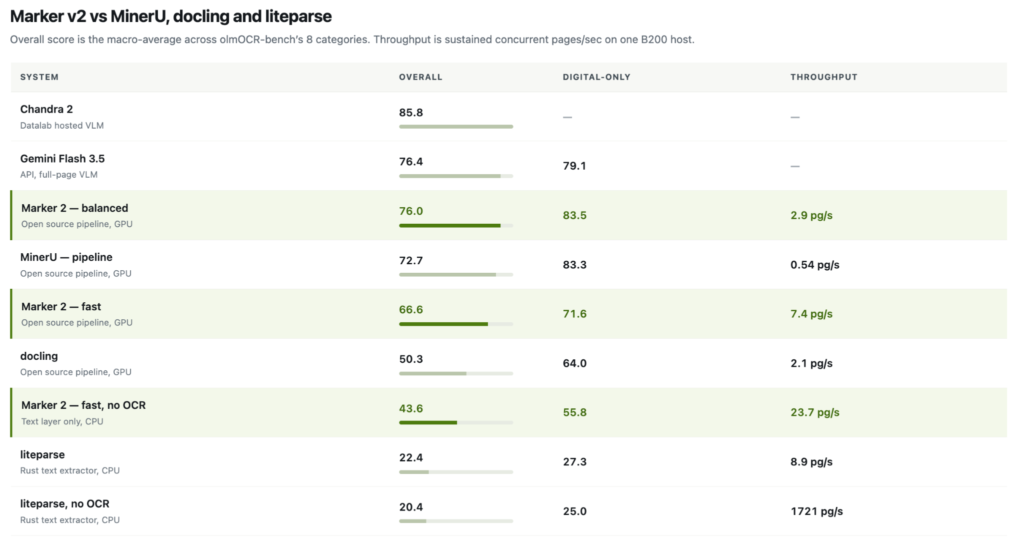
Datalab has released Marker 2, a full rewrite of its open source document conversion pipeline. Marker converts PDF, image, PPTX, DOCX, XLSX, HTML, and EPUB files into markdown, JSON, HTML, or chunks. The Datalab team rebuilt it around three components shipped over the preceding months: Surya OCR 2, a 20M-param fast layout model, and a

Datalab Marker v2 vs MinerU, Docling, and Liteparse: Benchmark Breakdown Read More »

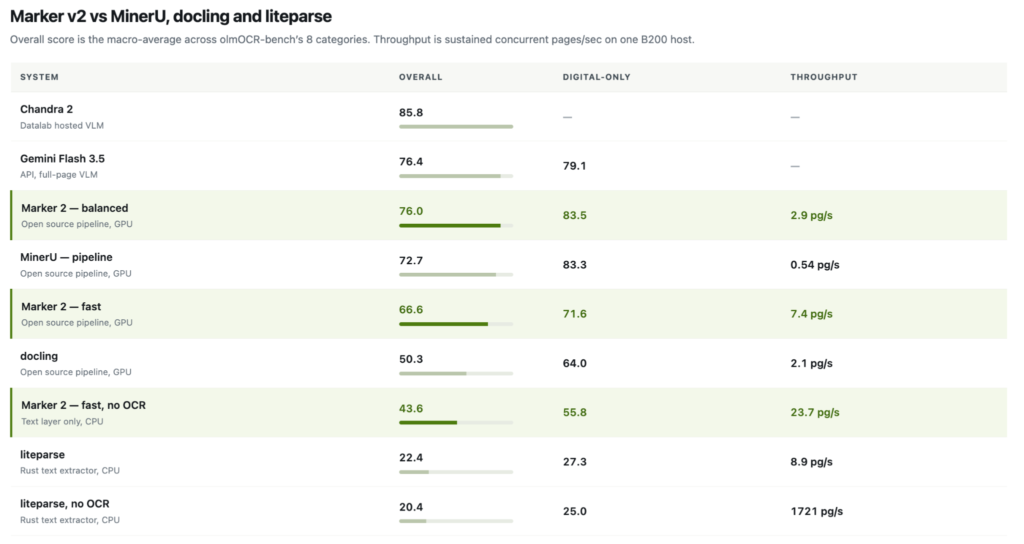
Datalab’s Marker 2 vs MinerU, Docling and LiteParse: 76.0 on olmOCR-bench at 5× MinerU’s Throughput

Datalab has released Marker 2, a full rewrite of its open source document conversion pipeline. Marker converts PDF, image, PPTX, DOCX, XLSX, HTML, and EPUB files into markdown, JSON, HTML, or chunks. The Datalab team rebuilt it around three components shipped over the preceding months: Surya OCR 2, a 20M-param fast layout model, and a

Datalab’s Marker 2 vs MinerU, Docling and LiteParse: 76.0 on olmOCR-bench at 5× MinerU’s Throughput Read More »

Meet the New Claude Opus 5: Frontier-Class Agentic Coding and Computer Use at Unchanged Opus Pricing

Today, Anthropic released Claude Opus 5. It replaces Claude Opus 4.8 as the Opus-tier flagship. Pricing is unchanged at $5 per million input tokens and $25 per million output tokens. The Anthropic team positions Opus 5 as approaching the intelligence of Claude Fable 5 at half the price. It is now the default model on

Meet the New Claude Opus 5: Frontier-Class Agentic Coding and Computer Use at Unchanged Opus Pricing Read More »

How to build predictive health care AI from data to decision

Explore how SAS Health and SAS Viya help healthcare organizations transform clinical and operational data into predictive, AI-driven decisioning workflows that improve patient outcomes through risk identification, model deployment, and governed agentic AI. The post How to build predictive health care AI from data to decision appeared first on SAS Blogs.

How to build predictive health care AI from data to decision Read More »

Banner for the AI & Big Data Expo event series.

Meta, Microsoft, Nvidia, IBM, and others back open-weight AI

Two dozen companies and organisations signed an open letter urging US policymakers to protect open-weight AI models. The letter, published today (PDF), carries signatures from a list that spans direct commercial rivals and organisations with little obvious overlap in business model: Meta, Microsoft, Nvidia, IBM, Dell Technologies, CrowdStrike, Palantir, ServiceNow, Hugging Face, Perplexity, Mistral, Andreessen

Meta, Microsoft, Nvidia, IBM, and others back open-weight AI Read More »