Staff

Auto Added by WPeMatico

ClawHub Security Signals: A Coding Guide to End-to-End Security Signal Analysis and Verdict Classification on the AI Skills Dataset

In this tutorial, we use the ClawHub Security Signals dataset to examine how different security scanners assess AI skills and related files. We load the dataset directly from the Hugging Face Parquet conversion to avoid compatibility issues with newer dataset metadata, then inspect the main columns, verdict distribution, scanner outputs, and severity labels. After exploring […]
ClawHub Security Signals: A Coding Guide to End-to-End Security Signal Analysis and Verdict Classification on the AI Skills Dataset Read More »

Xiaomi MiMo and TileRT Push a 1-Trillion-Parameter Model Past 1000 Tokens Per Second on Commodity GPUs

Inference speed is becoming a competitive metric for large language models. Xiaomi’s MiMo team just released MiMo-V2.5-Pro-UltraSpeed, built in collaboration with the TileRT systems group. It decodes faster than 1000 tokens per second on a 1-trillion-parameter model. Xiaomi team describes this as a first at trillion-parameter scale. Demos show generation peaks near 1200 tokens per

Xiaomi MiMo and TileRT Push a 1-Trillion-Parameter Model Past 1000 Tokens Per Second on Commodity GPUs Read More »

Microsoft AI Introduces MAI-Transcribe-1.5: 2.4% WER on Artificial Analysis, Best-in-Class FLEURS Accuracy, and Up to 5x Faster Long-Audio Transcription

Last week Microsoft AI has announced MAI-Transcribe-1.5. It is the second iteration of the company’s in-house speech-to-text family. The model targets accuracy across 43 languages, accents, and noisy environments. The Microsoft team positions it for production transcription workloads. What is MAI-Transcribe-1.5 MAI-Transcribe-1.5 is an automatic speech recognition (ASR) model. It takes audio as input and

Microsoft AI Introduces MAI-Transcribe-1.5: 2.4% WER on Artificial Analysis, Best-in-Class FLEURS Accuracy, and Up to 5x Faster Long-Audio Transcription Read More »

Building Reflective Prompt Optimization with GEPA: Multi-Component Prompts, Structured Feedback, and Held-Out Validation

In this tutorial, we use GEPA as a reflective prompt-evolution framework to improve the way a language model solves arithmetic word problems. We begin with a weak seed prompt, create a small deterministic benchmark, define a structured evaluator, and pass actionable feedback to GEPA so it can understand why a candidate prompt fails. We also

Building Reflective Prompt Optimization with GEPA: Multi-Component Prompts, Structured Feedback, and Held-Out Validation Read More »

Best 21 Low-Code and No-Code AI Tools in 2026

Low-code and no-code platforms have moved from simple drag-and-drop builders to AI-native development environments. In 2026, most of them ship a built-in assistant that turns a text prompt into a working app, agent, or automation. This list covers 21 tools that AI practitioners use today, grouped by what they do best. Each tool name links

Best 21 Low-Code and No-Code AI Tools in 2026 Read More »

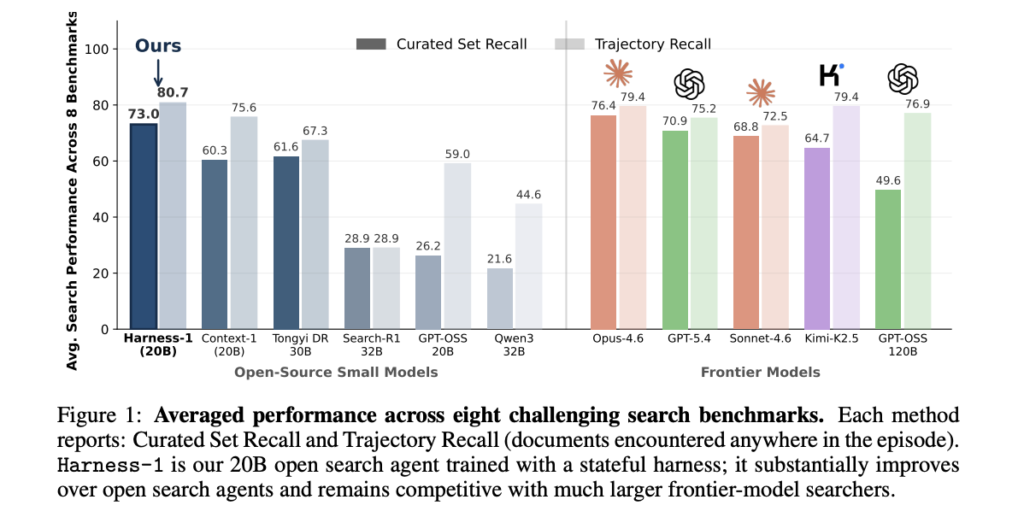
Meet Harness-1: A 20B Retrieval Subagent Trained With Reinforcement Learning Inside a Stateful Search Harness on gpt-oss-20b

Most search agents are trained as policies over a growing transcript. The model decides how to search. It must also remember what it saw, which evidence matters, and which claims it checked. A team of researchers from University of Illinois Urbana-Champaign, UC Berkeley, and Chroma argues this asks too much. Reinforcement learning ends up optimizing

Meet Harness-1: A 20B Retrieval Subagent Trained With Reinforcement Learning Inside a Stateful Search Harness on gpt-oss-20b Read More »

NVIDIA garak Tutorial: Build a Complete Defensive LLM Red-Teaming Workflow with Custom Probes and Detectors

In this tutorial, we analyze NVIDIA garak as a practical framework for defensive LLM red-teaming. We start by setting up Garak, then move through plugin discovery, dry runs, real-model scans, multi-probe evaluations, report analysis, custom probe creation, custom detector creation, and AVID export. Instead of running only a single scan, we use Garak end-to-end to

NVIDIA garak Tutorial: Build a Complete Defensive LLM Red-Teaming Workflow with Custom Probes and Detectors Read More »

Google’s New Colab CLI Lets Developers and AI Agents Run Python on Remote Colab GPUs and TPUs From the Terminal

This week, Google AI team released the Colab CLI. The tool connects your local terminal to remote Colab runtimes. It lets developers and AI agents run code on cloud GPUs and TPUs. You stay in your terminal the entire time. The CLI is open source under the Apache 2.0 license. What is Google Colab CLI

Google’s New Colab CLI Lets Developers and AI Agents Run Python on Remote Colab GPUs and TPUs From the Terminal Read More »

Moonshot AI Releases Kimi Code CLI: A Terminal AI Coding Agent Built in TypeScript for Next-Gen Agents

Moonshot AI has released Kimi Code CLI, an open-source coding agent that runs in the terminal. The tool reads and edits code, runs shell commands, searches files, and fetches web pages. It then chooses its next step based on the feedback it receives. The project is MIT-licensed and lives on GitHub.. Kimi Code CLI is

Moonshot AI Releases Kimi Code CLI: A Terminal AI Coding Agent Built in TypeScript for Next-Gen Agents Read More »

NVIDIA Releases Nemotron 3.5 ASR: A 600M-Parameter Cache-Aware Streaming Model Transcribing 40 Language-Locales in Real Time

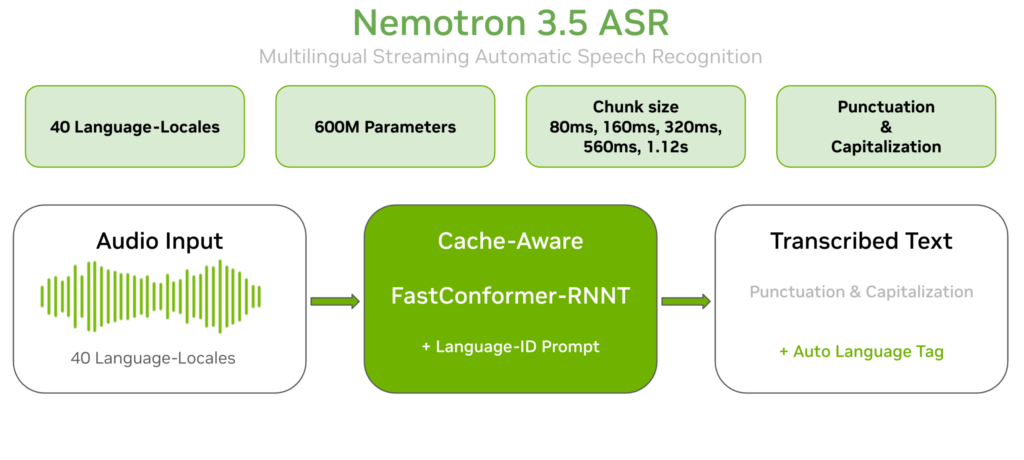
NVIDIA’s Nemotron Speech team has released Nemotron 3.5 ASR. It is a 600M-parameter streaming Automatic Speech Recognition (ASR) model. A single checkpoint transcribes 40 language-locales in real time. Punctuation and capitalization are built in natively. The model ships as open weights on Hugging Face. The license is OpenMDW-1.1. The architecture is a Cache-Aware FastConformer-RNNT. What

NVIDIA Releases Nemotron 3.5 ASR: A 600M-Parameter Cache-Aware Streaming Model Transcribing 40 Language-Locales in Real Time Read More »