Machine Learning

Auto Added by WPeMatico

NVIDIA Releases Nemotron-Labs-3-Puzzle-75B-A9B: A Compressed Hybrid MoE LLM Delivering 2.03x Server Throughput at Matched User Throughput

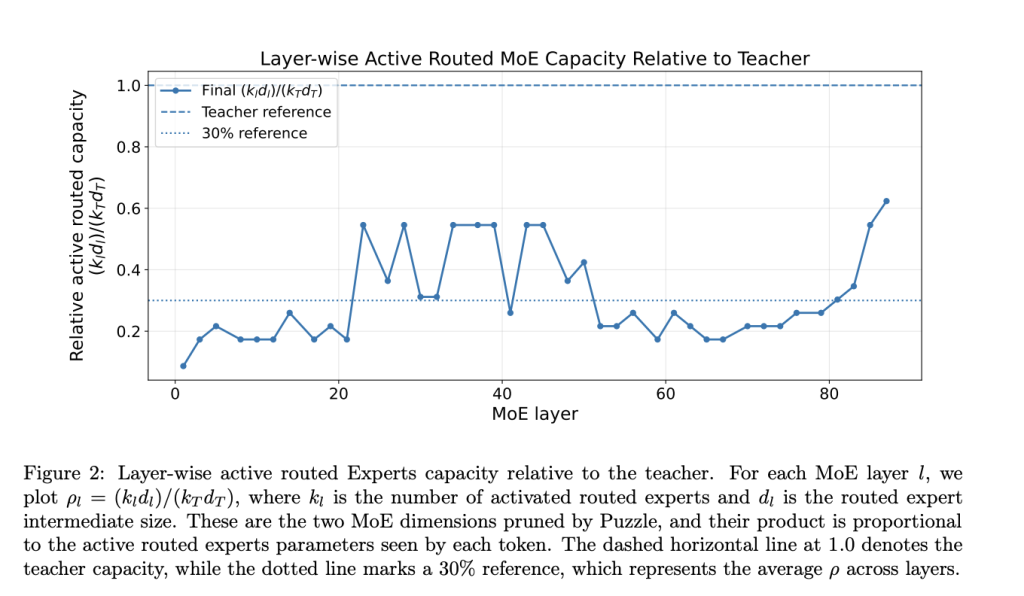
Large hybrid MoE models like Nemotron-3-Super are accurate but expensive to serve. Their active parameters, KV cache, and Mamba state cap how many users a node can hold at a given per-user token rate. NVIDIA AI team has released Nemotron-Labs-3-Puzzle-75B-A9B, a compressed variant of Nemotron-3-Super. The parent model has 120.7B total and 12.8B active parameters.
NVIDIA Releases Nemotron-Labs-3-Puzzle-75B-A9B: A Compressed Hybrid MoE LLM Delivering 2.03x Server Throughput at Matched User Throughput Read More »

Datalab Lift vs the Field: How a 9B Schema-First Extractor Compares with NuExtract3, LlamaExtract, Marker, and Docling

Datalab’s Lift is a focused document extraction tool with a specific promise: give it a PDF or image plus a JSON Schema, and it returns schema-shaped JSON directly. Instead of converting a document to Markdown first and then asking another model to extract fields, Lift reads rendered page images and attempts to emit the final

Datalab Lift vs the Field: How a 9B Schema-First Extractor Compares with NuExtract3, LlamaExtract, Marker, and Docling Read More »

Robbyant Releases LingBot-VLA 2.0: An Open-Source 6B Vision-Language-Action (VLA) Model for Cross-Embodiment Robot Manipulation

Ant Group’s Robbyant has released LingBot-VLA 2.0, a Vision-Language-Action (VLA) foundation model for robots. The release includes a technical report, an Apache-2.0 codebase, and a 6B checkpoint. The research team targets a well-known gap: VLA models often work in labs but stumble in deployment. LingBot-VLA 2.0 advances the prior version along three practical axes. These

Robbyant Releases LingBot-VLA 2.0: An Open-Source 6B Vision-Language-Action (VLA) Model for Cross-Embodiment Robot Manipulation Read More »

SpaceXAI Releases Grok 4.5, a Cursor-Trained Model for Coding, Agentic Tasks, and Knowledge Work at $2/M Input

SpaceXAI just released Grok 4.5. The company calls it its smartest model to date. It targets coding, agentic tasks, and knowledge work. SpaceXAI says Grok 4.5 was trained alongside Cursor, an AI coding editor. TL;DR Grok 4.5 targets coding, agentic tasks, and knowledge work, trained alongside Cursor. In SpaceXAI’s own chart, Fable (max) leads all

SpaceXAI Releases Grok 4.5, a Cursor-Trained Model for Coding, Agentic Tasks, and Knowledge Work at $2/M Input Read More »

Netflix AI Team Cuts Wide-Partition Read Latency from Seconds to Milliseconds by Splitting Cassandra Partitions Per ID

Netflix’s engineering team published a method for handling wide partitions in Apache Cassandra. The research work targets Netflix’s TimeSeries Abstraction, a platform for temporal event data. TL;DR Dynamic partitioning splits wide Cassandra partitions per TimeSeries ID, asynchronously and transparently, with no application changes. Detection runs on the read path via byte counting and a Kafka

Netflix AI Team Cuts Wide-Partition Read Latency from Seconds to Milliseconds by Splitting Cassandra Partitions Per ID Read More »

NVIDIA Releases Audex (Nemotron-Labs-Audex-30B-A3B): A Unified Audio-Text LLM That Preserves the Text Intelligence of Its Backbone

NVIDIA has released Audex (Nemotron-Labs-Audex-30B-A3B), a unified audio-text large language model. It understands and generates both audio and speech. It also keeps the text intelligence of its backbone. The checkpoints, along with a smaller Audex-2B, are released under a noncommercial license. Most multimodal models pay a text tax. When labs add audio or vision output,

NVIDIA Releases Audex (Nemotron-Labs-Audex-30B-A3B): A Unified Audio-Text LLM That Preserves the Text Intelligence of Its Backbone Read More »

Liquid AI Open-Sources Antidoom: A Final Token Preference Optimization (FTPO) Method that Reduces Doom Loops in Reasoning Models

Liquid AI has released Antidoom, an open-source method that targets a common failure mode in reasoning models. That failure mode is the doom loop. In a doom loop, a model emits a span. It then repeats that span again and again. The output continues until the context window is exhausted. Small reasoning models are more

Liquid AI Open-Sources Antidoom: A Final Token Preference Optimization (FTPO) Method that Reduces Doom Loops in Reasoning Models Read More »

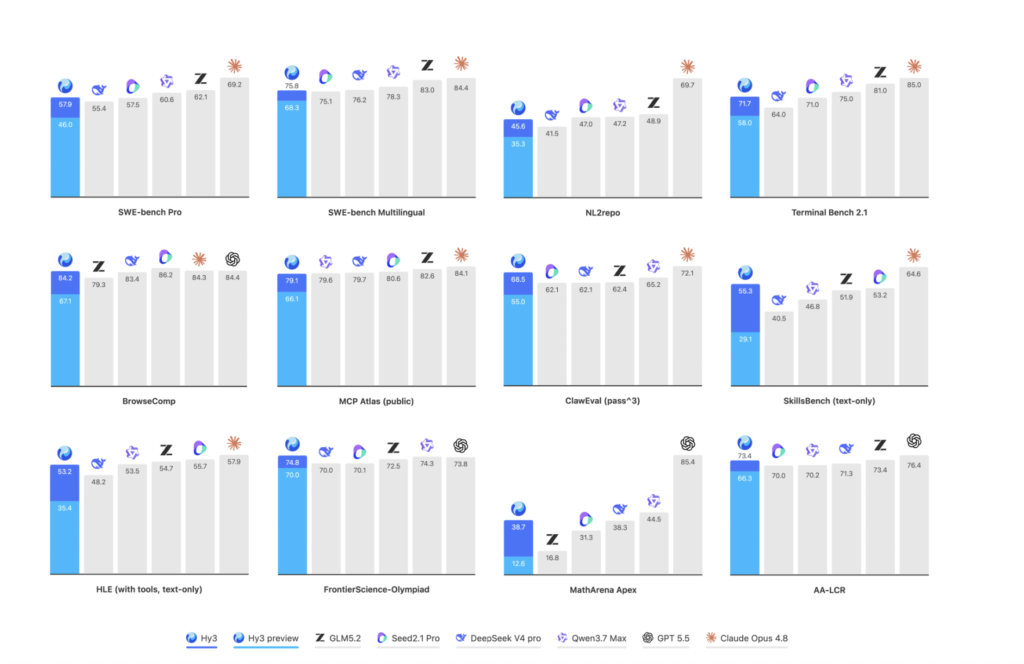
Tencent Releases Hy3: An Open 295B Mixture-of-Experts (MoE) Model with 21B Active Parameters and 256K Context

Tencent’s Hy team released Hy3. Hy3 is a 295B-parameter Mixture-of-Experts (MoE) model. It activates only 21B parameters per token. The weights ship under the Apache License 2.0. Hy3 is aimed at reasoning, agentic workflows, and long-context tasks. What is Hy3? Hy3’s architecture contains a sparse MoE with 192 experts and top-8 routing. Only 8 experts

Tencent Releases Hy3: An Open 295B Mixture-of-Experts (MoE) Model with 21B Active Parameters and 256K Context Read More »

OpenAI Releases GPT-Realtime-2.1 and GPT-Realtime-2.1-mini for Low-Latency Voice Agents in the API

OpenAI has released two new Realtime models in its API. They are named gpt-realtime-2.1 and gpt-realtime-2.1-mini. Both target low-latency voice and multimodal experiences. The mini model is the notable part of this release. It is a mini reasoning model for realtime voice. It ships at the same cost as the earlier gpt-realtime-mini. OpenAI also reduced

OpenAI Releases GPT-Realtime-2.1 and GPT-Realtime-2.1-mini for Low-Latency Voice Agents in the API Read More »

Building a Scaffold-Split Random Forest QSAR Co-Scientist for EGFR Inhibitor Discovery Using ChEMBL, RDKit, SHAP, and BRICS

In this tutorial, we build an end-to-end autonomous AI co-scientist workflow for next-generation EGFR inhibitor discovery, focusing on the C797S osimertinib-resistance mutation in non-small cell lung cancer. We start by resolving the biological target through ChEMBL and UniProt, then mine curated EGFR IC50 bioactivity records and convert them into a clean pIC50 modeling dataset. We

Building a Scaffold-Split Random Forest QSAR Co-Scientist for EGFR Inhibitor Discovery Using ChEMBL, RDKit, SHAP, and BRICS Read More »