Machine Learning

Auto Added by WPeMatico

When AI art has no author: Study finds generated images often can’t be traced to training data

When an artificial intelligence image generator produces a portrait, whose work went into it? The question sits at the center of lawsuits, licensing deals, and proposed regulations worldwide. Artists want credit. Companies want clarity. Policymakers want a way to assign responsibility.New work from a team of researchers at MIT’s Computer Science and Artificial Intelligence Laboratory

When AI art has no author: Study finds generated images often can’t be traced to training data Read More »

Meet SAM (Sovereign Agent Mesh): A Zero-Config, Zero-Trust P2P Network for AI Agents

google/sam is not Segment Anything. SAM here means Sovereign Agent Mesh, an Apache-2.0 networking project for autonomous AI agents. The problem it targets is concrete. Agents now run across cloud servers, on-prem datacenters, laptops, Raspberry Pis and Android devices. Letting them share tools usually means exposing internal scripts, LLM endpoints or private APIs to the

Meet SAM (Sovereign Agent Mesh): A Zero-Config, Zero-Trust P2P Network for AI Agents Read More »

Banner for the AI & Big Data Expo event series.

Samsung health AI models analyse wearable biosignal data

Samsung Research America’s Digital Health Team has presented two AI foundation models designed to learn from wearable biosignals. The work centres on data captured by smartwatches, including heart activity, sleep, and physical activity. The company discussed its Connected Care vision at the Health Forum during Galaxy Unpacked in July 2026. Samsung described a future of

Samsung health AI models analyse wearable biosignal data Read More »

Z.ai Ships GLM-5.3 Without Retraining the Base Model: Better at Complex Coding and Long-Horizon Tasks

Z.ai just released GLM-5.3. GLM-5.3 runs on the same 743B base model as GLM-5.2. Every reported gain comes from scaled post-training: more task environments, more environment types, longer training. The results land in two places. Coding jumps most on the longest-horizon benchmarks, with Terminal-Bench 3.0 moving from 4.6 to 28.3. Cybersecurity moved further than Z.ai

Z.ai Ships GLM-5.3 Without Retraining the Base Model: Better at Complex Coding and Long-Horizon Tasks Read More »

Meet Needle 2: An Open 45M-Parameter Tool-Calling Model That Ships as a 14MB Binary and Runs a Full Session in 28MB of RAM

Cactus Compute has released Needle 2, an open 45M-parameter model for tool calling, device use, and structured extraction. The entire model ships as a single 14MB binary that runs a full session in about 28MB of RAM. Weights are trained and deployed at CQ2-bit using Cactus Quants, and the model is sealed inside the company’s

Meet Needle 2: An Open 45M-Parameter Tool-Calling Model That Ships as a 14MB Binary and Runs a Full Session in 28MB of RAM Read More »

Google AI Just Released Gemini 3.7 Flash: A Coding and Agent Model at $0.75/1M Input Tokens

Google has released Gemini 3.7 Flash, the newest model in its Flash tier, three weeks after Gemini 3.6 Flash. The model card describes it as a refinement of 3.6 Flash with algorithmic improvements to the core reasoning foundation — not a new pretraining run. It accepts text, images, audio, and video across a 1M-token context

Google AI Just Released Gemini 3.7 Flash: A Coding and Agent Model at $0.75/1M Input Tokens Read More »

▶

Dyna Robotics Introduces Dyna-2: A World-Action Model Pre-Trained on 1 Million Hours of Human Video

Dyna Robotics has released Dyna-2, a world-action model for robot manipulation. It was pre-trained on more than one million hours of egocentric human video. That is roughly 170 years of continuous waking experience. Robot learning has been bottlenecked by action-labelled data, which teleoperation must deliberately produce. Dyna-2 tests whether ordinary human video can substitute. The

Dyna Robotics Introduces Dyna-2: A World-Action Model Pre-Trained on 1 Million Hours of Human Video Read More »

NVIDIA AI Releases Nemotron 3.5 Lightning: A 30B Open MoE with 3B Active Parameters, and NeMo Switchyard Model Router

NVIDIA introduced open technologies for building always-on AI agents from systems of specialized models. Two artifacts shipped together. Nemotron 3.5 Lightning is a lightweight, customizable open model built for high-volume agentic tasks, and NeMo Switchyard is an open source routing library that directs each step of an agent workflow to the most capable and efficient

NVIDIA AI Releases Nemotron 3.5 Lightning: A 30B Open MoE with 3B Active Parameters, and NeMo Switchyard Model Router Read More »

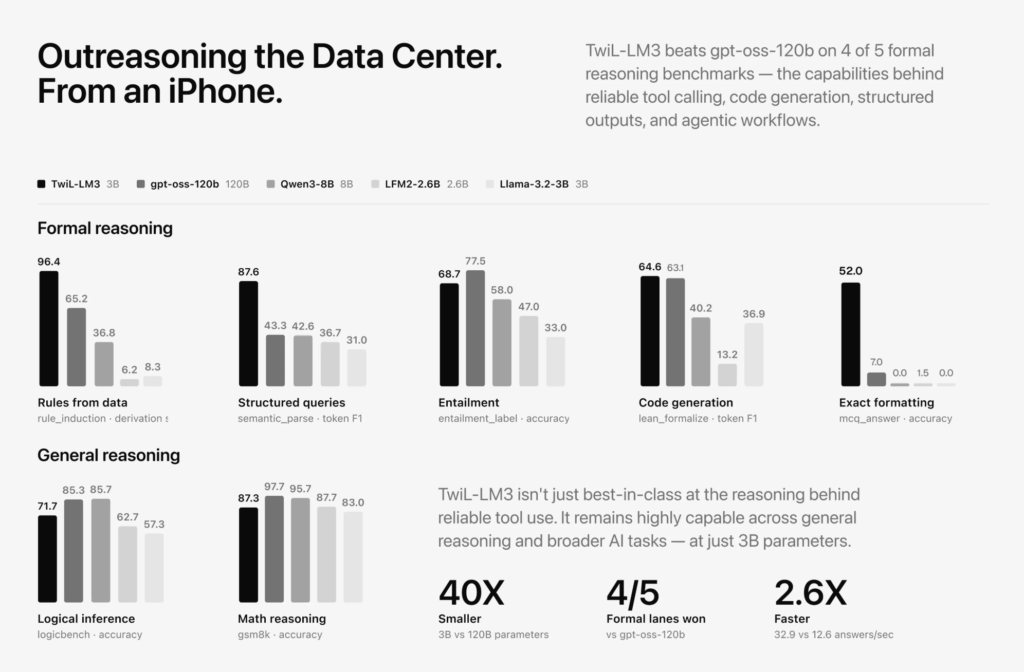
webAI Releases TwIL-LM: A 1.7B and 3B Formal-Logic Model Family for Autoformalization on Local Hardware

webAI has released TwIL-LM, a two-model family of formal-logic reasoners at 1.7B and 3B parameters. The 3B member, TwIL-LM3, is a merged fine-tune of SmolLM3-3B; the 1.7B member is a PEFT LoRA adapter for SmolLM2-1.7B-Instruct. Both target autoformalization: translating English into first-order logic and checking whether a conclusion follows from its premises. Both run locally,

webAI Releases TwIL-LM: A 1.7B and 3B Formal-Logic Model Family for Autoformalization on Local Hardware Read More »

Implementing a MiniMax-H3 Multimodal Video and Audio Generation Pipeline with ComfyUI APIs

In this tutorial, we implement an end-to-end MiniMax-H3 video generation workflow using ComfyUI as a headless inference backend. We configure the environment around GPU memory, disk capacity, model precision, resolution, duration, sampling strategy, and multiple generation modes, while dynamically selecting an appropriate weight profile based on the available hardware. We install and launch ComfyUI programmatically,

Implementing a MiniMax-H3 Multimodal Video and Audio Generation Pipeline with ComfyUI APIs Read More »