Machine Learning

Auto Added by WPeMatico

Meet ‘North Mini Code’: Cohere’s 30B Open-Weight Mixture-of-Experts Model With 3B Active Parameters for Agentic Coding

This week, Cohere AI team shipped its first developer-facing coding model named ‘North Mini Code‘. ‘North Mini Code’ is open-weight and focused at software engineers. It is a mixture-of-experts (MoE) model with 30B total parameters. Only 3B of those parameters activate per token. The release is positioned around “sovereign” AI. The idea is simple: run […]
Meet ‘North Mini Code’: Cohere’s 30B Open-Weight Mixture-of-Experts Model With 3B Active Parameters for Agentic Coding Read More »

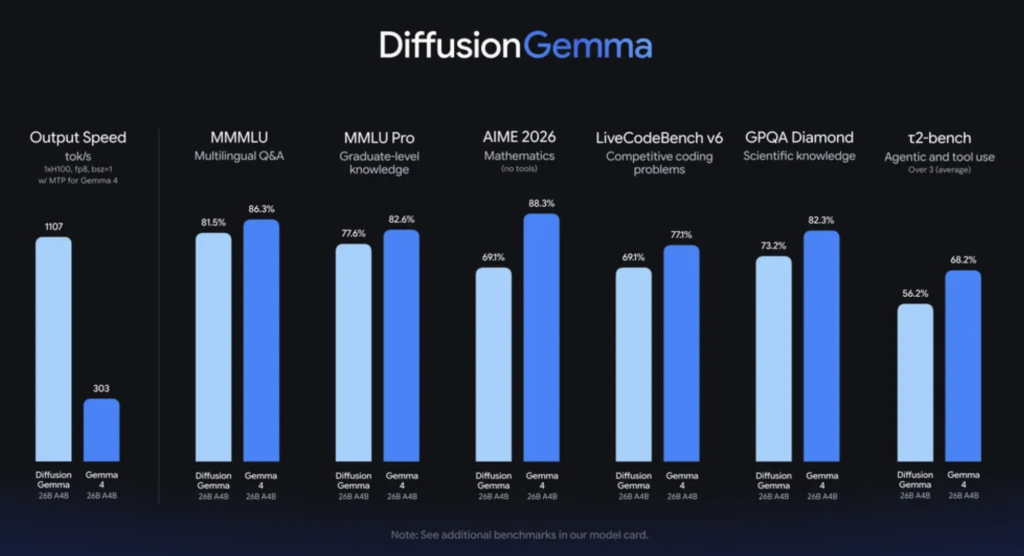
Google AI Releases DiffusionGemma, a 26B MoE Open Model Using Text Diffusion for Up to 4x Faster Generation

Google AI team including the Google DeepMind researchers have just released DiffusionGemma, an experimental open model for text generation. It uses text diffusion instead of standard autoregressive decoding. The model ships under a permissive Apache 2.0 license. Google positions it for devs and researchers exploring speed-critical, interactive local workflows. Examples include in-line editing, rapid iteration,

Google AI Releases DiffusionGemma, a 26B MoE Open Model Using Text Diffusion for Up to 4x Faster Generation Read More »

Anthropic Releases Claude Fable 5 and Claude Mythos 5: Same Underlying Model, Different Safeguards, New Mythos-Class Tier

Anthropic released two models on June 9, 2026: Claude Fable 5 and Claude Mythos 5. Both belong to a tier called “Mythos-class.” This tier sits above the Opus class in capability. Fable 5 is the version claimed to be made safe for general use. Mythos 5 is the same model with some safeguards lifted, kept

Anthropic Releases Claude Fable 5 and Claude Mythos 5: Same Underlying Model, Different Safeguards, New Mythos-Class Tier Read More »

Xiaomi MiMo and TileRT Push a 1-Trillion-Parameter Model Past 1000 Tokens Per Second on Commodity GPUs

Inference speed is becoming a competitive metric for large language models. Xiaomi’s MiMo team just released MiMo-V2.5-Pro-UltraSpeed, built in collaboration with the TileRT systems group. It decodes faster than 1000 tokens per second on a 1-trillion-parameter model. Xiaomi team describes this as a first at trillion-parameter scale. Demos show generation peaks near 1200 tokens per

Xiaomi MiMo and TileRT Push a 1-Trillion-Parameter Model Past 1000 Tokens Per Second on Commodity GPUs Read More »

Banner for AI & Big Data Expo by TechEx events.

Aviva deploys AI to stop £230M in sophisticated insurance fraud

Aviva has uncovered a record £230 million in insurance fraud claims and is using AI tools to counter the growing problem. The battleground has changed, and the culprits are also coming armed with a new generation of tools. We’re now in an environment where AI is being used not just to defend against fraud, but

Aviva deploys AI to stop £230M in sophisticated insurance fraud Read More »

The weather and climate science AI revolution isn’t revolutionary

It feels like there’s no escaping AI right now, whether you’re trying to type a sentence without being interrupted by a digital “assistant” or struggling to find a new refrigerator that doesn’t require a Wi-Fi connection for some reason. You’d be forgiven for wondering if we’re in the midst of a quantum leap in tech

The weather and climate science AI revolution isn’t revolutionary Read More »

Building Reflective Prompt Optimization with GEPA: Multi-Component Prompts, Structured Feedback, and Held-Out Validation

In this tutorial, we use GEPA as a reflective prompt-evolution framework to improve the way a language model solves arithmetic word problems. We begin with a weak seed prompt, create a small deterministic benchmark, define a structured evaluator, and pass actionable feedback to GEPA so it can understand why a candidate prompt fails. We also

Building Reflective Prompt Optimization with GEPA: Multi-Component Prompts, Structured Feedback, and Held-Out Validation Read More »

Google’s New Colab CLI Lets Developers and AI Agents Run Python on Remote Colab GPUs and TPUs From the Terminal

This week, Google AI team released the Colab CLI. The tool connects your local terminal to remote Colab runtimes. It lets developers and AI agents run code on cloud GPUs and TPUs. You stay in your terminal the entire time. The CLI is open source under the Apache 2.0 license. What is Google Colab CLI

Google’s New Colab CLI Lets Developers and AI Agents Run Python on Remote Colab GPUs and TPUs From the Terminal Read More »

NVIDIA AI Releases Dynamo Snapshot: A CRIU-Based Fast Startup System for AI Inference on Kubernetes

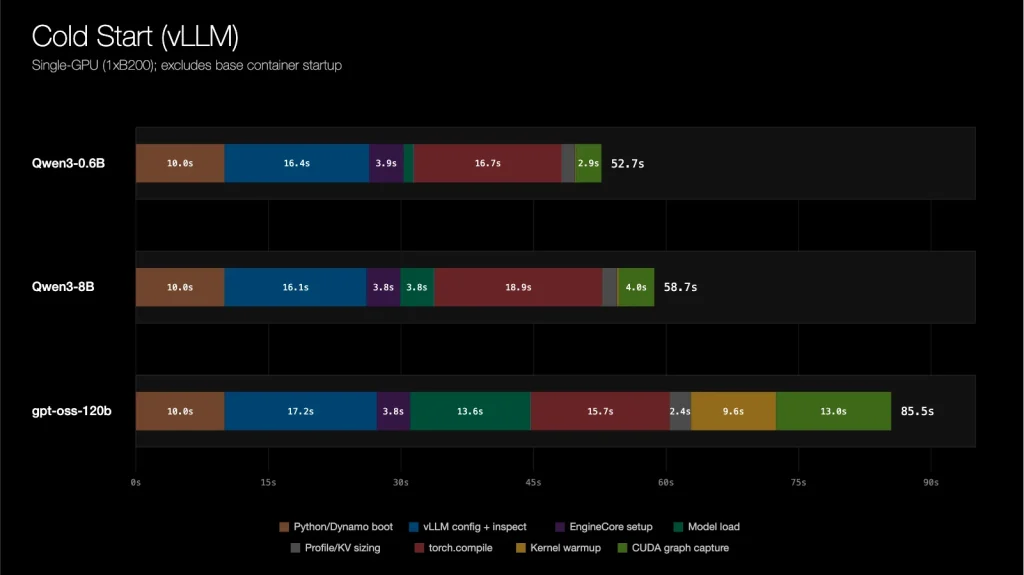
In production inference deployments, demand fluctuates over time, requiring inference replicas to scale elastically. Cold-starting inference workloads on Kubernetes can take several minutes. During that time, GPUs are allocated but idle, generating no tokens and serving no requests. ‘Cold start’ means the full sequence a model server must complete before serving any request: pulling the

NVIDIA AI Releases Dynamo Snapshot: A CRIU-Based Fast Startup System for AI Inference on Kubernetes Read More »

Building a Semantic Search Engine and Open-Status Classifier over the ResearchMath-14k Dataset

In this tutorial, we work with the amphora/ResearchMath-14k dataset, a collection of research-level mathematics problems mined from arXiv. We load the dataset, inspect its structure, and explore how the problems are distributed across mathematical fields and open-status categories. We then move beyond basic analysis by extracting field-specific keywords, generating semantic embeddings, visualizing the problem landscape,

Building a Semantic Search Engine and Open-Status Classifier over the ResearchMath-14k Dataset Read More »