Language Model

Auto Added by WPeMatico

Recursive Language Models (RLMs): From MIT’s Blueprint to Prime Intellect’s RLMEnv for Long Horizon LLM Agents

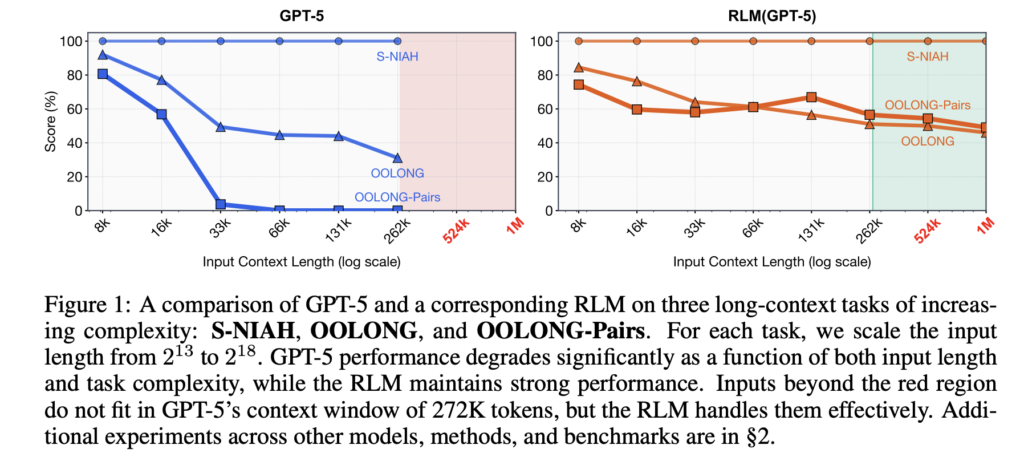
Recursive Language Models aim to break the usual trade off between context length, accuracy and cost in large language models. Instead of forcing a model to read a giant prompt in one pass, RLMs treat the prompt as an external environment and let the model decide how to inspect it with code, then recursively call […]

Recursive Language Models (RLMs): From MIT’s Blueprint to Prime Intellect’s RLMEnv for Long Horizon LLM Agents Read More »

Alibaba Tongyi Lab Releases MAI-UI: A Foundation GUI Agent Family that Surpasses Gemini 2.5 Pro, Seed1.8 and UI-Tars-2 on AndroidWorld

Alibaba Tongyi Lab have released MAI-UI—a family of foundation GUI agents. It natively integrates MCP tool use, agent user interaction, device–cloud collaboration, and online RL, establishing state-of-the-art results in general GUI grounding and mobile GUI navigation, surpassing Gemini-2.5-Pro, Seed1.8, and UI-Tars-2 on AndroidWorld. The system targets three specific gaps that early GUI agents often ignore,

Alibaba Tongyi Lab Releases MAI-UI: A Foundation GUI Agent Family that Surpasses Gemini 2.5 Pro, Seed1.8 and UI-Tars-2 on AndroidWorld Read More »

Meet LLMRouter: An Intelligent Routing System designed to Optimize LLM Inference by Dynamically Selecting the most Suitable Model for Each Query

LLMRouter is an open source routing library from the U Lab at the University of Illinois Urbana Champaign that treats model selection as a first class system problem. It sits between applications and a pool of LLMs and chooses a model for each query based on task complexity, quality targets, and cost, all exposed through

Meet LLMRouter: An Intelligent Routing System designed to Optimize LLM Inference by Dynamically Selecting the most Suitable Model for Each Query Read More »

From Gemma 3 270M to FunctionGemma, How Google AI Built a Compact Function Calling Specialist for Edge Workloads

Google has released FunctionGemma, a specialized version of the Gemma 3 270M model that is trained specifically for function calling and designed to run as an edge agent that maps natural language to executable API actions. But, What is FunctionGemma? FunctionGemma is a 270M parameter text only transformer based on Gemma 3 270M. It keeps

From Gemma 3 270M to FunctionGemma, How Google AI Built a Compact Function Calling Specialist for Edge Workloads Read More »

This AI Paper from Stanford and Harvard Explains Why Most ‘Agentic AI’ Systems Feel Impressive in Demos and then Completely Fall Apart in Real Use

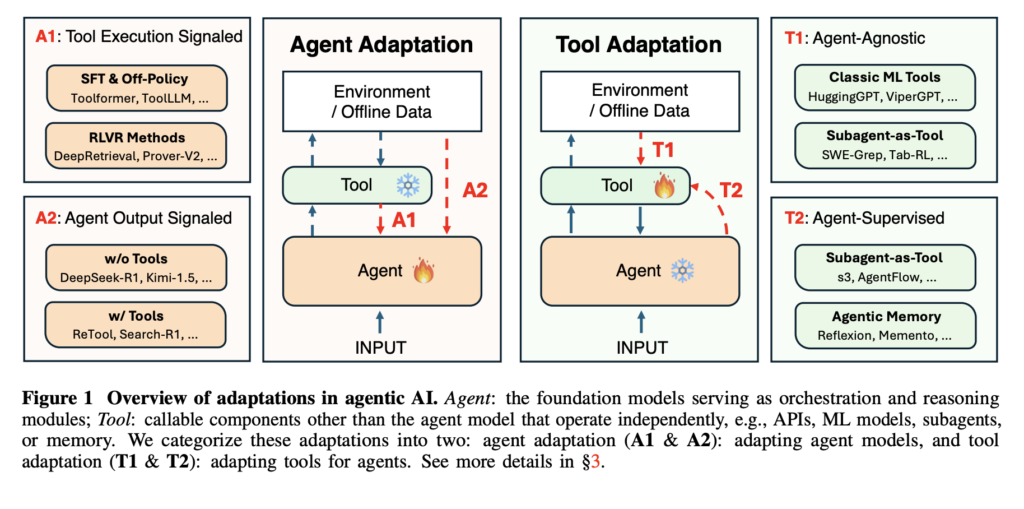
Agentic AI systems sit on top of large language models and connect to tools, memory, and external environments. They already support scientific discovery, software development, and clinical research, yet they still struggle with unreliable tool use, weak long horizon planning, and poor generalization. The latest research paper ‘Adaptation of Agentic AI‘ from Stanford, Harvard, UC

This AI Paper from Stanford and Harvard Explains Why Most ‘Agentic AI’ Systems Feel Impressive in Demos and then Completely Fall Apart in Real Use Read More »

Google Health AI Releases MedASR: a Conformer Based Medical Speech to Text Model for Clinical Dictation

Google Health AI team has released MedASR, an open weights medical speech to text model that targets clinical dictation and physician patient conversations and is designed to plug directly into modern AI workflows. What MedASR is and where it fits? MedASR is a speech to text model based on the Conformer architecture and is pre

Google Health AI Releases MedASR: a Conformer Based Medical Speech to Text Model for Clinical Dictation Read More »

Google DeepMind Researchers Release Gemma Scope 2 as a Full Stack Interpretability Suite for Gemma 3 Models

Google DeepMind Researchers introduce Gemma Scope 2, an open suite of interpretability tools that exposes how Gemma 3 language models process and represent information across all layers, from 270M to 27B parameters. Its core goal is simple, give AI safety and alignment teams a practical way to trace model behavior back to internal features instead

Google DeepMind Researchers Release Gemma Scope 2 as a Full Stack Interpretability Suite for Gemma 3 Models Read More »

Meta AI Open-Sourced Perception Encoder Audiovisual (PE-AV): The Audiovisual Encoder Powering SAM Audio And Large Scale Multimodal Retrieval

Meta researchers have introduced Perception Encoder Audiovisual, PEAV, as a new family of encoders for joint audio and video understanding. The model learns aligned audio, video, and text representations in a single embedding space using large scale contrastive training on about 100M audio video pairs with text captions. From Perception Encoder to PEAV Perception Encoder,

Meta AI Open-Sourced Perception Encoder Audiovisual (PE-AV): The Audiovisual Encoder Powering SAM Audio And Large Scale Multimodal Retrieval Read More »

Google Introduces A2UI (Agent-to-User Interface): An Open Sourc Protocol for Agent Driven Interfaces

Google has open sourced A2UI, an Agent to User Interface specification and set of libraries that lets agents describe rich native interfaces in a declarative JSON format while client applications render them with their own components. The project targets a clear problem, how to let remote agents present secure, interactive interfaces across trust boundaries without

Google Introduces A2UI (Agent-to-User Interface): An Open Sourc Protocol for Agent Driven Interfaces Read More »

Anthropic AI Releases Bloom: An Open-Source Agentic Framework for Automated Behavioral Evaluations of Frontier AI Models

Anthropic has released Bloom, an open source agentic framework that automates behavioral evaluations for frontier AI models. The system takes a researcher specified behavior and builds targeted evaluations that measure how often and how strongly that behavior appears in realistic scenarios. Why Bloom? Behavioral evaluations for safety and alignment are expensive to design and maintain.

Anthropic AI Releases Bloom: An Open-Source Agentic Framework for Automated Behavioral Evaluations of Frontier AI Models Read More »