AI Shorts

Auto Added by WPeMatico

Liquid AI Releases LFM2.5: A Compact AI Model Family For Real On Device Agents

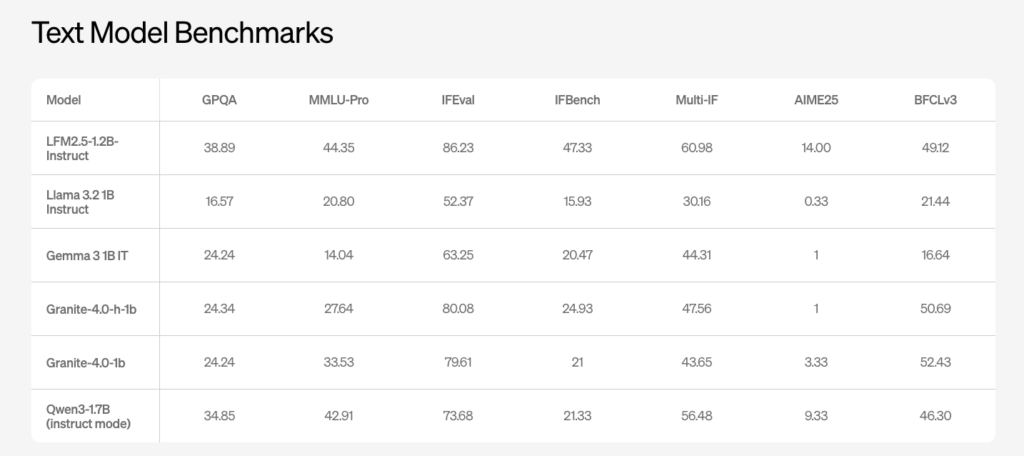
Liquid AI has introduced LFM2.5, a new generation of small foundation models built on the LFM2 architecture and focused at on device and edge deployments. The model family includes LFM2.5-1.2B-Base and LFM2.5-1.2B-Instruct and extends to Japanese, vision language, and audio language variants. It is released as open weights on Hugging Face and exposed through the […]

Liquid AI Releases LFM2.5: A Compact AI Model Family For Real On Device Agents Read More »

Tencent Researchers Release Tencent HY-MT1.5: A New Translation Models Featuring 1.8B and 7B Models Designed for Seamless on-Device and Cloud Deployment

Tencent Hunyuan researchers have released HY-MT1.5, a multilingual machine translation family that targets both mobile devices and cloud systems with the same training recipe and metrics. HY-MT1.5 consists of 2 translation models, HY-MT1.5-1.8B and HY-MT1.5-7B, supports mutual translation across 33 languages with 5 ethnic and dialect variations, and is available on GitHub and Hugging Face

Tencent Researchers Release Tencent HY-MT1.5: A New Translation Models Featuring 1.8B and 7B Models Designed for Seamless on-Device and Cloud Deployment Read More »

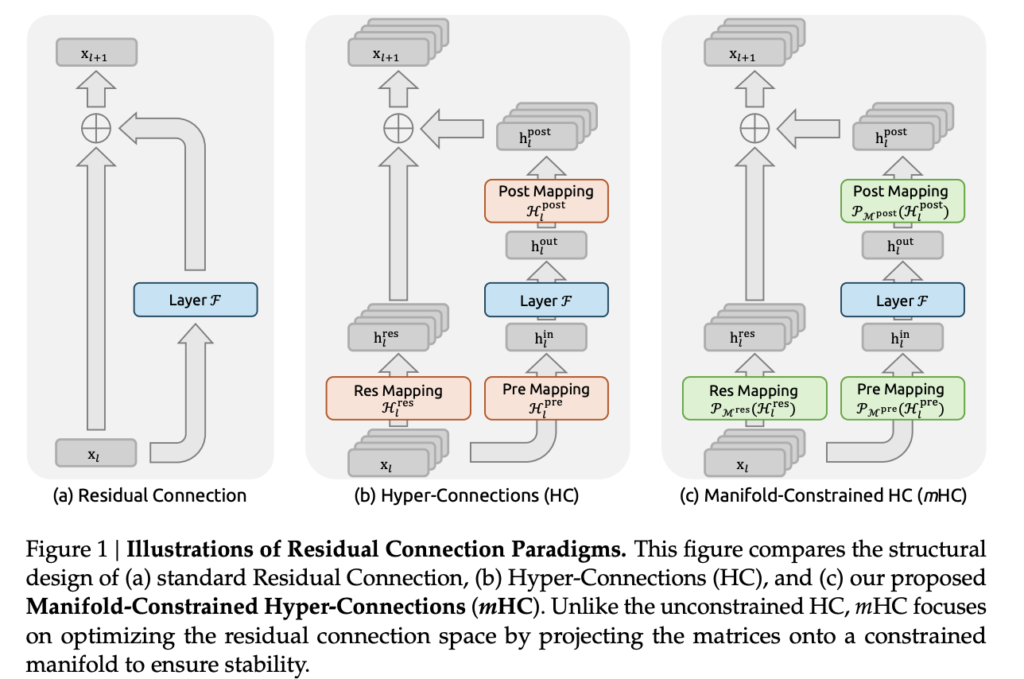
DeepSeek Researchers Apply a 1967 Matrix Normalization Algorithm to Fix Instability in Hyper Connections

DeepSeek researchers are trying to solve a precise issue in large language model training. Residual connections made very deep networks trainable, hyper connections widened that residual stream, and training then became unstable at scale. The new method mHC, Manifold Constrained Hyper Connections, keeps the richer topology of hyper connections but locks the mixing behavior on

DeepSeek Researchers Apply a 1967 Matrix Normalization Algorithm to Fix Instability in Hyper Connections Read More »

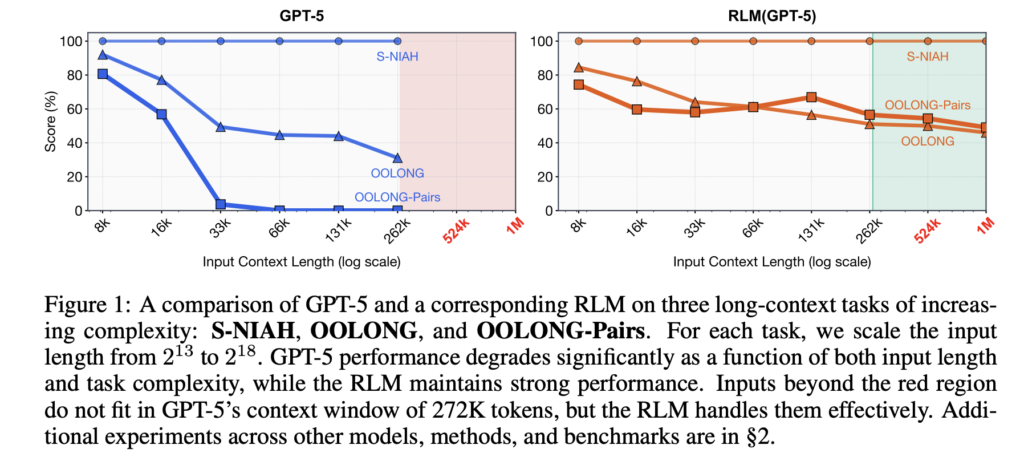
Recursive Language Models (RLMs): From MIT’s Blueprint to Prime Intellect’s RLMEnv for Long Horizon LLM Agents

Recursive Language Models aim to break the usual trade off between context length, accuracy and cost in large language models. Instead of forcing a model to read a giant prompt in one pass, RLMs treat the prompt as an external environment and let the model decide how to inspect it with code, then recursively call

Recursive Language Models (RLMs): From MIT’s Blueprint to Prime Intellect’s RLMEnv for Long Horizon LLM Agents Read More »

Tencent Released Tencent HY-Motion 1.0: A Billion-Parameter Text-to-Motion Model Built on the Diffusion Transformer (DiT) Architecture and Flow Matching

Tencent Hunyuan’s 3D Digital Human team has released HY-Motion 1.0, an open weight text-to-3D human motion generation family that scales Diffusion Transformer based Flow Matching to 1B parameters in the motion domain. The models turn natural language prompts plus an expected duration into 3D human motion clips on a unified SMPL-H skeleton and are available

Tencent Released Tencent HY-Motion 1.0: A Billion-Parameter Text-to-Motion Model Built on the Diffusion Transformer (DiT) Architecture and Flow Matching Read More »

Meet LLMRouter: An Intelligent Routing System designed to Optimize LLM Inference by Dynamically Selecting the most Suitable Model for Each Query

LLMRouter is an open source routing library from the U Lab at the University of Illinois Urbana Champaign that treats model selection as a first class system problem. It sits between applications and a pool of LLMs and chooses a model for each query based on task complexity, quality targets, and cost, all exposed through

Meet LLMRouter: An Intelligent Routing System designed to Optimize LLM Inference by Dynamically Selecting the most Suitable Model for Each Query Read More »

From Gemma 3 270M to FunctionGemma, How Google AI Built a Compact Function Calling Specialist for Edge Workloads

Google has released FunctionGemma, a specialized version of the Gemma 3 270M model that is trained specifically for function calling and designed to run as an edge agent that maps natural language to executable API actions. But, What is FunctionGemma? FunctionGemma is a 270M parameter text only transformer based on Gemma 3 270M. It keeps

From Gemma 3 270M to FunctionGemma, How Google AI Built a Compact Function Calling Specialist for Edge Workloads Read More »

⏳

A Coding Implementation on Building Self-Organizing Zettelkasten Knowledge Graphs and Sleep-Consolidation Mechanisms

In this tutorial, we dive into the cutting edge of Agentic AI by building a “Zettelkasten” memory system, a “living” architecture that organizes information much like the human brain. We move beyond standard retrieval methods to construct a dynamic knowledge graph where an agent autonomously decomposes inputs into atomic facts, links them semantically, and even

A Coding Implementation on Building Self-Organizing Zettelkasten Knowledge Graphs and Sleep-Consolidation Mechanisms Read More »

😊

MiniMax Releases M2.1: An Enhanced M2 Version with Features like Multi-Coding Language Support, API Integration, and Improved Tools for Structured Coding

Just months after releasing M2—a fast, low-cost model designed for agents and code—MiniMax has introduced an enhanced version: MiniMax M2.1. M2 already stood out for its efficiency, running at roughly 8% of the cost of Claude Sonnet while delivering significantly higher speed. More importantly, it introduced a different computational and reasoning pattern, particularly in how

MiniMax Releases M2.1: An Enhanced M2 Version with Features like Multi-Coding Language Support, API Integration, and Improved Tools for Structured Coding Read More »

This AI Paper from Stanford and Harvard Explains Why Most ‘Agentic AI’ Systems Feel Impressive in Demos and then Completely Fall Apart in Real Use

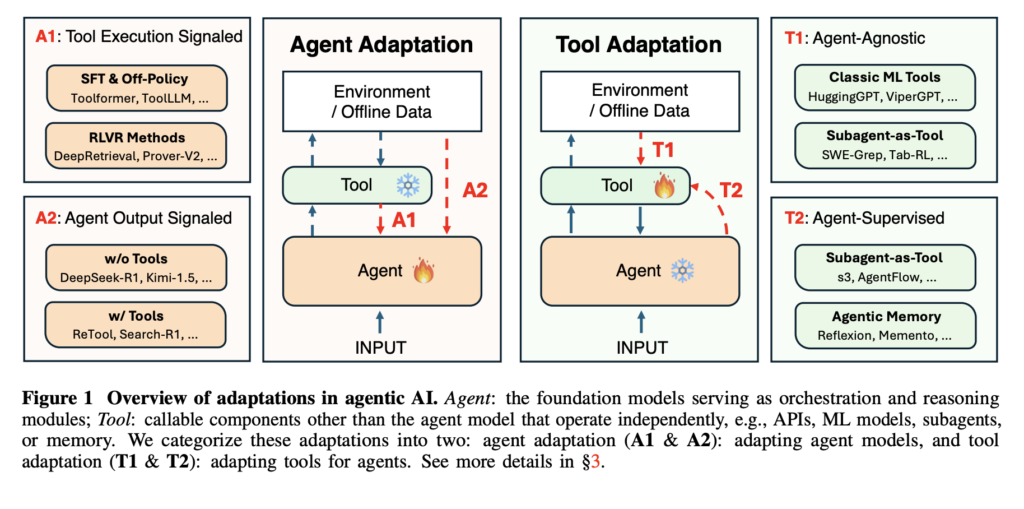
Agentic AI systems sit on top of large language models and connect to tools, memory, and external environments. They already support scientific discovery, software development, and clinical research, yet they still struggle with unreliable tool use, weak long horizon planning, and poor generalization. The latest research paper ‘Adaptation of Agentic AI‘ from Stanford, Harvard, UC

This AI Paper from Stanford and Harvard Explains Why Most ‘Agentic AI’ Systems Feel Impressive in Demos and then Completely Fall Apart in Real Use Read More »