
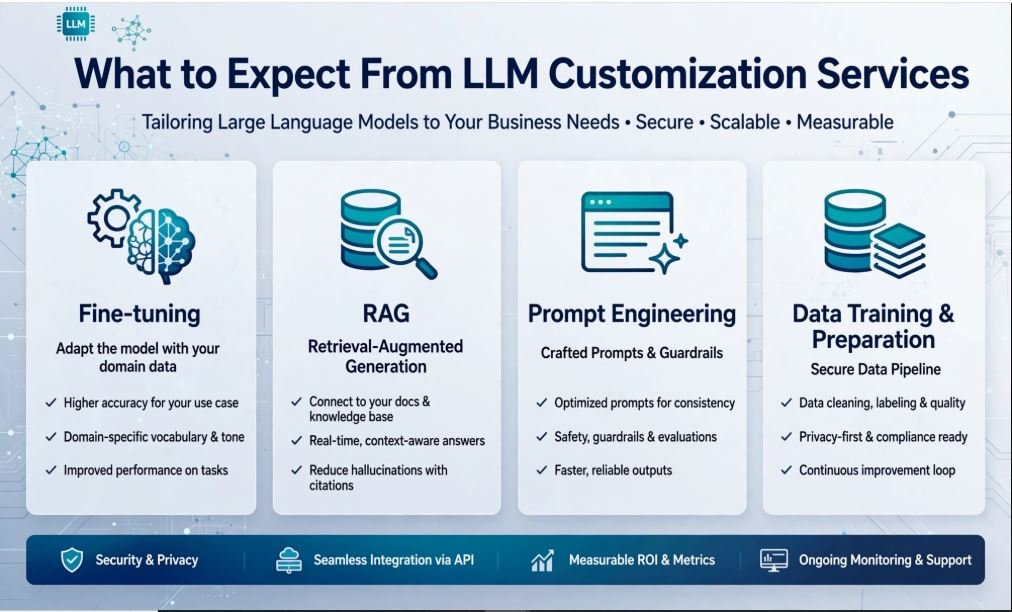
LLM Customization services help organizations adapt language-model applications to specific business tasks, knowledge sources, terminology, workflows, and security requirements. The work can include prompt design, retrieval-augmented generation, tool integration, fine-tuning, evaluation, deployment, and continuous optimization.
Customization should not begin with the assumption that a new model must be trained. In many cases, clearer instructions and access to approved internal information can deliver the required improvement with less cost and complexity.
A reliable provider should first identify the performance problem, establish a baseline, and recommend the simplest adaptation capable of meeting measurable requirements.
Business and Technical Discovery
The first stage is understanding what the organization wants the language-model application to accomplish.
A broad request to make an LLM “understand the company” does not provide enough direction. The provider needs a defined use case, such as classifying customer enquiries, extracting contract information, preparing reports, or answering questions from internal policies.
Discovery should examine:
intended users;current workflow;accepted inputs;required outputs;available knowledge sources;system integrations;response-time expectations;security restrictions;human approval points;consequences of an incorrect output.
The result should be a written scope explaining what the customized system will and will not do.
A provider should also determine whether an LLM is the right technology. Stable tasks with structured inputs and fixed rules may be handled more reliably through conventional automation.
Baseline Evaluation
Before customization begins, the team should test an appropriate general-purpose model on representative tasks. This creates a baseline and reveals the actual performance gaps.
The evaluation set should contain normal examples, difficult cases, incomplete inputs, conflicting information, and relevant exceptions.
Depending on the use case, evaluation may cover:
factual accuracy;classification performance;extraction accuracy;required tone and terminology;structured-output validity;correct source usage;task completion;response time;model cost;frequency of human correction.
Without a baseline, the organization cannot determine whether customization has improved the system.
The same evaluation set should be used to compare different models, prompts, retrieval configurations, and fine-tuned versions.
Prompt and Instruction Design
Prompt design is often the first customization method a provider should test.
System instructions can define the model’s role, objective, restrictions, available context, and expected output. They may require the system to use approved sources, follow a specific structure, or state when reliable information is unavailable.
Examples can demonstrate how the model should respond to common inputs. However, excessive instructions can create conflicts and increase processing costs.
Prompts should be treated as software components rather than informal text. They need version control, documentation, testing, and controlled deployment.
A provider should explain why each instruction exists and how prompt changes affect evaluation results.
Retrieval-Augmented Generation
Organizations commonly need an LLM to answer questions using current internal information. Retrieval-augmented generation, or RAG, allows the application to locate relevant content and provide it to the model at the time of the request.
This approach can support policies, manuals, product documentation, research materials, and other sources that change over time.
A provider may need to:
inventory available documents;identify authoritative versions;remove duplicated or outdated content;divide documents into useful sections;create embeddings and indexes;apply categories and metadata;enforce access permissions;configure result ranking;preserve source references.
Retrieval and answer generation should be evaluated separately. If the system selects an irrelevant document, the model may produce an incorrect answer even when it follows its instructions properly.
Users should receive source references when verification is important.
Tool and API Integration
Customized LLM applications can interact with business systems through controlled tools and APIs. They may retrieve customer records, create support tickets, search databases, schedule meetings, or update workflow systems.
Each integration should have a specific purpose and limited permissions.
The model can interpret what the user wants, but deterministic software should enforce authorization, validate parameters, and confirm that an action is safe.
Controls may include:
authenticated user identity;role-based access;confirmation of target records;required-field validation;transaction limits;employee approval;prevention of duplicate actions;complete audit logs;rollback procedures.
A provider should test tool failures and partial completion. If one action succeeds but the next fails, the system needs a method for identifying and correcting the incomplete workflow.
Fine-Tuning
Fine-tuning adapts a model using a prepared set of examples. It may improve performance when a task involves repeated patterns that prompting cannot handle consistently.
Potential use cases include:
specialized classification;structured extraction;organization-specific terminology;defined writing styles;consistent output formats;recurring text transformation.
Fine-tuning is usually not the best way to add frequently changing facts. Retrieval is easier to update when policies, prices, product information, or regulations change.
Training data must be accurate, representative, and legally usable. It should not contain sensitive information the model is not permitted to reproduce.
After training, the customized version should be tested against the original baseline. Fine-tuning should be retained only if it produces a meaningful improvement.
Model Selection and Routing
A customization provider may evaluate several models instead of assuming that one vendor is suitable for every task.
Models can differ in quality, context capacity, latency, cost, deployment options, structured-output performance, and data-handling arrangements.
A multi-model system may route routine work to a smaller model and complex requests to a more capable one. This can improve efficiency, but routing also adds architectural and testing requirements.
The selection process should use representative business tasks rather than relying exclusively on public benchmarks.
A provider should document why each model was selected, which data it may process, and what fallback is available if the primary service fails.
Security and Privacy
Customization may involve internal documents, proprietary processes, customer data, or employee information. Security must be included from the beginning.
The provider should clarify:
where data is processed;which external services receive it;whether inputs are retained;who can access logs and training data;how information is encrypted;how credentials are managed;how data is deleted;who owns the resulting configurations and models.
Access should follow the principle of least privilege. Users must not receive information through the LLM that they would be prohibited from viewing in the original system.
The application should also be tested against prompt injection and attempts to extract restricted instructions or data.
Evaluation and Quality Assurance
Testing should examine the complete system rather than isolated model responses.
A response may be well written but still fail because it uses an obsolete document, selects the wrong customer record, or returns an unsupported conclusion.
Evaluation should include:
common user requests;unusual and ambiguous cases;incomplete information;contradictory sources;unavailable integrations;malicious instructions;invalid output formats;unauthorized requests.
For high-impact use cases, qualified employees should review results before the system is permitted to act independently.
The provider should define acceptance thresholds and explain what happens when the system fails to meet them.
Deployment and Monitoring
A customized LLM application should usually be introduced through a controlled pilot.
The first version may operate in advisory or read-only mode. Employees can compare its outputs with real decisions before it receives permission to update systems or communicate externally.
After deployment, monitoring should cover:
task-completion rates;answer and retrieval quality;structured-output failures;tool errors;human escalations;response times;model usage;cost per successful task;user corrections and feedback.
Monitoring is necessary because business data, model behaviour, integrations, and user needs change over time.
Maintenance and Knowledge Transfer
The organization should understand how its customized system works and how it will be maintained.
Documentation should cover architecture, prompts, data sources, retrieval settings, models, integrations, permissions, evaluation methods, and known limitations.
The provider and client should agree on responsibility for updating documents, testing model changes, reviewing permissions, investigating failures, and monitoring costs.
Model and prompt updates should be evaluated before they reach production. A change that improves one task may reduce performance elsewhere.
Knowledge transfer reduces dependence on the original provider and helps internal teams make informed decisions about future development.
How to Evaluate a Customization Provider
Organizations comparing providers should ask:
How will you determine whether customization is necessary?How will baseline performance be measured?When do you recommend RAG instead of fine-tuning?How do you validate retrieved information?How do you protect sensitive data?How are tool permissions enforced?What happens when a model or integration fails?Which deliverables and documentation are included?Who owns the resulting code, prompts, data, and model artifacts?How will operating costs be monitored?
Clear answers indicate that the provider is considering the complete production system rather than only the model.
Conclusion
LLM customization services can help organizations create AI applications that follow business requirements, use current internal knowledge, and integrate safely with existing systems.
The most effective customization strategy is usually incremental. It begins with evaluation and prompt improvements, adds retrieval and tools where necessary, and uses fine-tuning only when evidence demonstrates a persistent performance gap.
By combining technical adaptation with security, testing, monitoring, and human oversight, organizations can build specialized LLM applications that provide reliable value beyond an initial demonstration.
The post What to Expect From LLM Customization Services appeared first on Big Data Analytics News.