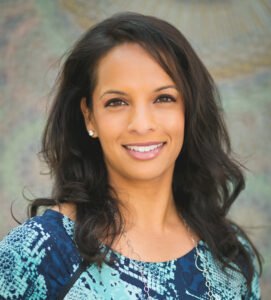
Sandhya Venkatachalam spent the first half of her career building technology companies. She led product at an early data center hardware company that was sold to Cisco, then became a product executive at Skype before its sale to Microsoft. Those roles brought her into data and machine learning years before AI became venture capital’s dominant theme.
She later became a general partner at Social Capital, where she led early institutional investments in AI chipmaker Groq, and later invested at Khosla Ventures. Now she’s founder and managing partner of Axiom Partners, a $52 million fund backing startups that use AI to do work in industries such as construction, industrials and insurance.
In an interview with Crunchbase News, Venkatachalam discusses why she looks beyond familiar founder profiles, what makes an AI company durable, and how an early investment in Groq shaped her approach.
This interview has been edited for clarity and brevity.

You invested at Khosla Ventures before starting Axiom. What did you take from that experience, and what did you want to do differently?
Venkatachalam: One thing I took was Vinod Khosla’s open view of where great founders can come from. Silicon Valley has gravitated toward a fairly narrow idea of who can build the next great AI company: Someone with a Stanford computer science or machine learning background, or experience at OpenAI. We’re looking for more nonobvious founders, particularly in nonobvious industries.
The other thing was how we think about risk. Instead of asking a company every conceivable diligence question, we focus on the risks that matter for its next set of milestones. Can this team do what it says it will do? And if it can, could the result be massive?
That means accepting that many bets won’t work out while aiming for the outliers. I think that’s what my investors are backing me to do: identify categories of the future, rather than participate in the categories everyone already recognizes.
At Axiom, the biggest difference is that we’ve built the firm around people who are actively working with AI. If you aren’t building, productizing, pricing or taking AI to market regularly, it’s very hard to keep up. Our team includes people doing exactly that in their other roles. They help keep our investment thinking current, and founders want to work with them because they’ve encountered many of the same challenges.
We also use AI throughout the firm. We’ve built what we call the Axiom Brain to help us make sense of market trends, identify interesting people and companies, and move faster on diligence and other work. For me, the value is the ability to act quickly.
You mentioned that some of those AI practitioners have other jobs. How does their role at Axiom work?
Venkatachalam: They have dedicated time to Axiom and work with us part time. They also receive carry in the fund. They’re partners in the work, rather than people whose names appear on an adviser list.
Their other jobs are central to the model. Some of the best angel investors are people who are still operating and building. I don’t need these people full time. In fact, they would be less valuable to Axiom if they left the work that keeps them close to the market.
Axiom says it invests in “AI for the real world.” What does that mean when you’re evaluating a startup?
Venkatachalam: Our view is that AI should benefit a much broader population than the early adopters who are already using it. We look at industries underserved by technology, where AI can produce an outcome rather than simply provide another software tool.
That may lead us to construction, industrials or insurance. Some of those companies involve hardware, sensors or robotics; others are entirely software-based. What connects them is that they’re doing work that matters to customers in real-world industries.
We generally don’t invest in products that look like conventional enterprise software tools. We want to see AI delivering a result.
You’ve described a shift from software people use to digital workers that perform jobs. Are customers actually paying for AI from labor budgets?
Venkatachalam: Yes, and that’s one of our investment criteria. Even when a portfolio company is at an alpha or design-partner stage, we do diligence to understand whether customers are willing to buy it that way. We’re often seeing contract values in the hundreds of thousands of dollars, rather than the much smaller contracts you might expect for a midmarket software tool.
We’ve seen that buying behavior play out across the majority of the portfolio companies we’ve invested in.
AI products are becoming faster to build and easier to imitate. What makes one durable enough to become a large company?
Venkatachalam: If you’re doing important work inside a customer’s business, and that work is worth a lot of money, you become difficult to replace. You’re handling what we call the last mile of the job.
In industrial settings, for example, delivering an outcome means integrating deeply with the systems customers use. You have to understand their data, train on it, learn the workflows that matter, and stand behind the result. That takes more than putting an interface on top of a model.
Those relationships and capabilities can become difficult for another startup to replicate. They also involve work that the large AI model companies may have little interest in doing themselves.
Before Axiom, you backed Groq when AI inference was far from an obvious investment category. What led you to it?
Venkatachalam: I came from both hardware and software. At one point, I became interested in why Google was building its own networking switches when it could buy them from existing suppliers. As I looked into that, I learned it was building its own chips, too.
That led me to Jonathan Ross, who had been involved in that work and had left to start Groq. I began learning why large technology companies were building chips to train models. Then Jonathan made the case that the much larger future market would be inference.
I’ll be honest: In 2016, I barely understood inference. But if you believed these models would spread, it made sense that people would build on top of them and need the infrastructure to support that. That insight drove my investment.
How did that experience shape what you look for now?
Venkatachalam: It taught me the value of being a little early and having some patience. You don’t have to be wildly contrarian, but you do have to see the opportunity before it becomes obvious to everyone else.
In a way, our thesis hasn’t changed. We’re still asking what will be built on top of AI infrastructure and models. We want to invest while the answer is emerging, before there’s a consensus.
What happens when one of those early bets doesn’t work out?
Venkatachalam: We plan for it. We have a $52 million fund and expect to make 35 investments. We fully expect about half of them to fail, whether that means a company shuts down or simply never reaches the growth trajectory we’re looking for.
The model depends on finding an exceptional outcome. We need one outstanding investment to return the fund. If you invest early enough and the company becomes very large, that can offset many bets that didn’t work.
That willingness to accept losses is part of making investments before an opportunity is obvious. It’s built into how we approach the fund.
Related Crunchbase query:
Illustration: Dom Guzman