
For ML engineers and data teams, the challenge is rarely about assigning labels. The concern is the amount and quality of data the model is trained on. Real-world data is usually incomplete, unstructured, and messy. Obtaining high-quality data becomes more time-consuming in sensitive fields like finance and healthcare. If they have to spend considerable time in preparing and cleaning data, it can be frustrating, slow, and error-prone, creating operational overhead.
This is where data annotation and labeling services can help. Not any data labeling solution, but from leading AI training data service providers like Cogito Tech, who have a team of trained annotators, domain experts, and follow a scalable approach to create AI-ready datasets. In this guide, we will explain data annotation solutions, challenges, costs, tools, quality and security considerations, and how to evaluate a data annotation service provider.
What is data annotation service?
Data annotation assigns meaningful labels to raw data so machine learning models can mark patterns and learn from examples. It depends on the task how labels may spot an anomaly, event, object, or associated features within the data. These labels can be bounding boxes, categories, timestamps, text spans, and more.
Cogito Tech team follows annotation process that gives machine learning systems the structured examples they need to learn a particular task.
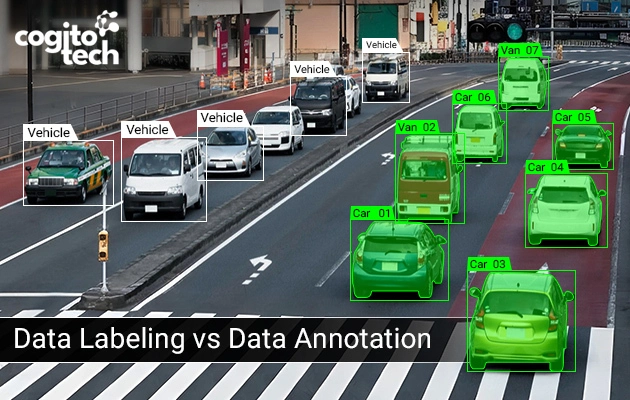
Data labeling vs. data annotation: are these different?
Labeling refers to allocating a class, category, or target value. Annotation can include more detailed information, such as object boundaries, entities, attributes, relationships, timestamps, or events.
For example, in a medical image, labeling could classify a scan as showing a lung nodule or no lung nodule, while annotation could identify the nodule, outline its exact boundaries, and add attributes such as its size or location.
A generalist annotator can handle labeling where it is required to spot a lung nodule. On the other hand, domain experts are required for more detailed tasks, where they have to outline the exact boundaries and add attributes such as its size or location.
In simple terms:
Labeling – Identifies what the data represents.
Annotation – Adds more specific information about the data.
Terminology can vary by team, tool, and vendor. At Cogito Tech, what matters most is defining the labeling or annotation requirements clearly for the machine learning task.
Why do ML teams need data annotation services?
Data annotation can become a significant time drain in an ML workflow. The challenge is not simply creating annotations; it is managing the work around them. An ML engineer may need to select and prepare raw data, divide it into annotation batches, explain tasks to annotators, track completed work, review samples, flag incorrect annotations, and send them back for correction. When this happens across thousands or millions of samples, annotation becomes an ongoing operational responsibility rather than a small part of the ML workflow.
The workload becomes even more demanding when teams retrain models. A model may fail to detect certain objects, struggle with specific text patterns, or perform poorly on edge cases. The team then needs to find relevant samples, annotate them, review the new data, update the dataset, and run another training cycle. Each model iteration can therefore create another round of annotation work.
This can pull ML engineers away from core activities such as model development, experimentation, and evaluation. Data annotation services can take on this operational workload by managing annotation teams, workflows, reviews, and rework, allowing ML teams to focus more on improving their models.
Data annotation challenges for ML engineers and data teams
Data annotation becomes difficult as datasets grow, and organizations struggle to maintain consistency, quality, and turnaround time. Let’s understand how Cogito Tech works around these challenges:-
Scaling Annotation
A small internal team may be able to label an initial dataset, but bigger projects can require larger volumes. Scaling requires more than hiring additional annotators; it also requires task allocation, escalation, and performance monitoring.
Inconsistent Labels
Different annotators can interpret the same guideline differently. This becomes particularly difficult when categories are similar, or the data contains ambiguous cases. For example, two annotators may classify the same customer message differently as “billing issue” or “payment failure” unless the labeling criteria are clearly defined. To maintain consistency, they need to reduce disagreement through training, multiple reviews, adjudication, and clear annotation guidelines.
Limited Domain Expertise
Some datasets (medical, financial, legal, scientific, and other specialized ones) require knowledge that general-purpose annotators may not have. For example, a medical imaging project may require radiologists to identify and validate abnormalities in CT or MRI scans. This makes it significant to hire a leading team of domain experts.
Difficult Edge Cases
Real-world datasets rarely contain only clear examples. There are several factors that may make annotation difficult, such as overlapping objects, poor-quality images, incomplete records, and rare events. For example, a video dataset may contain partially occluded pedestrians or unusual movements that cannot be reliably labeled using simple rules.
A robust service plan with a leading AI training data company helps define how these cases are flagged, reviewed, and resolved rather than forcing annotators to make unsupported assumptions.
Managing sensitive data
Healthcare, financial, proprietary, and personal data require controlled access and secure annotation environments. For example, clinical datasets may contain PHI that needs to be de-identified and handled within controlled access environments before annotation.
Maintaining quality at scale
Increasing annotation volume can make quality control more difficult. Projects may need gold-standard examples, double annotation, inter-annotator agreement measurement, sampling, expert review, adjudication, and ongoing error analysis. For example, a team may have multiple annotators label the same sample and review disagreements to identify gaps in the guidelines.
Data Security and Compliance
Datasets may contain personally identifiable information, protected health information, financial records, proprietary documents, or other sensitive material. Therefore, data annotation workflows need appropriate access controls, secure environments, auditability, and other security measures based on project requirements.
Engineering and Workflow Overhead
ML engineers can end up spending significant time preparing data, configuring annotation tools, managing labeling queues, checking outputs, resolving annotation issues, and coordinating external or internal teams.
A data annotation service provider can absorb much of this operational workload and also cope with changing requirements.
What are the types of data annotation?
Data annotation depends on the data modality, machine learning objective, and level of detail the model needs. A task may require one label per data point; healthcare, computer vision, robotics, and complex applications require detailed temporal, spatial, or contextual annotations. Data annotation services Cogito Tech offers:-
Image data annotation services
Image annotation services support computer vision models that need to identify objects, regions, attributes, or visual conditions. Projects may involve image classification, bounding boxes, semantic or instance segmentation, polygons, attribute labeling, and keypoint annotation according to the use case.
For example, a manufacturing project may require defect detection, while a healthcare project may require segmentation of anatomical structures or abnormalities.
Video annotation services
Video annotation adds a temporal dimension to visual annotation. Instead of annotating isolated frames, workflows may need to identify how people, objects, or events change over time. Video labeling services include frame-level classification, object tracking, action recognition, event detection, pose and keypoint annotation, temporal segmentation, and timestamp annotation.
For example, a robotics dataset may need to capture not only where an object appears in a frame but also how it moves, interacts with another object, or changes state over time.
Text Data Annotation Services
Text Annotation helps models understand the meaning, intent, and relationships within written language. The level of annotation depends on the application. A customer-support model may only need intent labels, while a clinical NLP system may require detailed entities, relationships, temporality, or other contextual information. Text annotation includes:-
Text classification
Named entity recognition
Sentiment analysis
Intent classification
Topic classification
Relation extraction
Content moderation
Question and answer labeling
Audio Data Annotation Services
Audio annotation provides information about speech, speakers, sounds, and events within an audio recording. The tasks include:-
Speech transcription
Speaker identification and diarization
Timestamping
Acoustic event labeling
Speech or emotion classification
Noise and sound-event labeling
Accent and dialect labeling
Sensor and Time-Series Data Annotation
Sensor data is different from static images or text because time and sequence matter. Labels may need to identify when an event starts, how long it lasts, or how a signal changes over time. Common tasks include:
Event labeling
Time-interval labeling
State classification
Anomaly labeling
Change-point annotation
Multimodal Data Annotation Services
Some AI systems work with several types of data at once, such as video, audio, text, images, and sensor streams. Multimodal annotation helps preserve the relationships between these sources. For example, a healthcare AI system may combine video, audio, clinical text, and sensor data to understand an event in its full context. A robotics system may combine RGB-D video, LiDAR, IMU, force-torque, and other sensor data to understand an environment and an object’s movement.
Data annotation methods used by service providers
Organizations opt for different annotation approaches according to their data volume, budget, and timeline requirements. The following methods have their own specifications as per the project needs. Let’s check each of them:-
1. Manual annotation
Manual annotation involves human annotators reviewing and tagging data points individually. This approach ensures the highest accuracy for complex tasks requiring contextual understanding, domain expertise, or nuanced judgment calls. Medical imaging projects often rely on manual annotation by radiologists who can recognize subtle pathological features that automated systems might miss. Manual annotation is considered time-intensive and expensive, but it is still the best method to establish ground truth datasets.
2. Programmatic annotation
Programmatic annotation uses scripts, rules, or algorithms to assign labels based on predefined criteria. It works well for objective tasks, such as categorizing products by keywords or flagging transactions that meet specific thresholds. It scales but is less effective when annotation requires subjective judgment or complex context.
3. Semi-supervised and active learning
A semi-supervised approach combines a smaller set of labeled data with larger amounts of unlabeled data. Active learning takes this forward by tracking the most useful or uncertain examples for human labeling.
This reduces manual effort by focusing annotators on the data that provides the most value. Human reviewers can also correct model predictions and feed those corrections back into the workflow.
4. Crowdsourced annotation
Crowdsourced annotation distributes annotation tasks among a large pool of workers. It can help process high volumes of relatively straightforward data. For reliable results, projects need clear instructions, worker qualification, multiple reviews, and quality checks. Crowdsourcing is generally less suitable for sensitive data or tasks requiring specialized domain expertise.
How is data annotation quality measured?
Quality measures should be defined before large-scale annotation begins. The right approach depends on risk level, modality, task, and taxonomy.
Inter-Annotator Agreement
Inter-annotator agreement measures how different annotators label the same data. The appropriate metric depends on the task and label structure.
Gold-Standard Data
To ensure validated labels, annotator performance should be regularly monitored by identifying quality issues during production.
Adjudication
An expert or designated reviewer needs to resolve disagreements and establish the final label when required, particularly for complex or domain-specific cases.
Sampling and Audits
Random or targeted samples have to be reviewed to identify systematic errors that may not be visible through individual annotation checks.
Error Analysis
Teams can analyze recurring mistakes and update guidelines, training, or taxonomy definitions accordingly.
Data security and compliance in data annotation services
Depending on the dataset and jurisdiction, organizations need to assess access controls, encryption, secure annotation environments, PII and PHI handling, de-identification, workforce access, audit trails, retention and deletion policies, geographic restrictions, secure data transfer, and applicable compliance controls.
GDPR, HIPAA, SOC 2, and ISO 27001 may apply as per the organization, data type, and project. For healthcare data, for example, organizations may need contractual safeguards such as a Business Associate Agreement (BAA) when HIPAA applies. Data residency may also matter when contractual or regulatory requirements restrict where data can be stored or processed.
As an AI training data service provider, Cogito Tech team is able to explain how sensitive data moves through its labeling environment, who can access it, where it is stored, how long it is retained, and how access and activity are monitored.
Data annotation tools and platforms
Annotation tools provide the working environment in which annotation teams create, review, manage, and export annotations. A strong tool does not automatically create a high-quality dataset. The workforce, guidelines, QA process, and project management around the platform remain equally important. When evaluating a tool, Cogito Tech looks beyond the annotation interface. Supported data types, annotation capabilities, automation and pre-labeling, review and adjudication, dataset management, security controls, export formats, and collaboration capabilities can all affect how well the platform fits the project.
Depending on the project, we select platforms such as CVAT, Labelbox, V7, Datasaur, 3D Slicer, RedBrick AI, and other modality-specific annotation platforms for our clients.
Data annotation pricing: what determines the investment?
There is no single standard price for data annotation services because project complexity varies significantly. Cost may differ due to:-
Annotation complexity
Volume and modality
The number of labels and attributes
Quality and security assurance requirements
Expert reviews, tooling, and turnaround time
Ongoing maintenance and relabeling
Pricing Models Explained
Data annotation providers use different pricing models based on annotation type, dataset volume, expertise required, task complexity, and quality requirements. Common approaches include per-unit, subscription, hourly, and custom project- or SLA-based pricing.
1. Per-Unit Pricing
Description
Per-unit pricing charges based on the amount of data annotated. A unit can be an image, video frame, audio minute, text document, entity, object, or other defined annotation task.
How it works
You pay a predetermined rate for each annotation unit.
For example, if video annotation costs $0.05 per frame and a project requires annotation of 20,000 frames, the base annotation cost would be $1,000.
The final cost may vary depending on what needs to be annotated within each frame, such as simple object identification, detailed segmentation, or tracking objects across consecutive frames.
Ideal for
Projects with clearly defined annotation units.
Teams with large datasets.
Projects where the scope can be measured by images, frames, minutes, documents, or other units.
2. Hourly Pricing
Description
Hourly pricing charges for the time spent by annotators, reviewers, subject-matter experts, or other project resources.
How it works
The provider charges an agreed hourly rate based on the resources involved.
For example, if an annotation specialist charges $40 per hour and spends 75 hours on a project, the annotation cost would be $3,000.
Rates can differ depending on the level of expertise and whether the work involves standard annotation, quality review, or specialized expert validation.
Ideal for
Projects where the scope is difficult to estimate upfront.
Complex or specialized annotation tasks.
Expert review, adjudication, and annotation quality assessment.
3. Subscription or Retainer Pricing
Description
Subscription or retainer pricing involves a recurring payment for ongoing annotation capacity or a defined volume of annotation work over a set period.
How it works
The client pays a recurring monthly or quarterly fee.
The agreement may include a defined annotation volume, dedicated team capacity, or specific service hours.
Additional work beyond the agreed scope may be charged separately.
Ideal for
Teams with ongoing annotation requirements.
Recurring dataset updates and model iteration.
Organizations that need consistent annotation capacity rather than a one-time project.
4. Custom Project or SLA-Based Pricing
Description
Custom pricing is negotiated around the specific requirements of an annotation project. The pricing can account for data volume, annotation complexity, turnaround time, quality requirements, specialist expertise, security controls, and service-level commitments.
How it works
The provider assesses the dataset, annotation taxonomy, workflow, expected volume, and quality requirements.
Pricing is then set based on the agreed scope and service levels.
The agreement may include defined turnaround times, quality targets, review processes, reporting, and escalation procedures.
Ideal for
Large enterprise annotation projects.
Specialized or domain-specific datasets.
Projects involving sensitive data or additional security requirements.
High-volume workflows with strict turnaround and quality expectations.
Questions to ask a data annotation service provider
Before selecting a provider, ask questions such as:
How do you measure annotation quality?
What is your QA process?
How do you handle ambiguous data?
Do you have domain and subject-matter experts on your team?
How do you measure inter-annotator agreement?
Which annotation tools and platforms do you support?
Can you integrate with our existing ML workflow?
How do you handle sensitive or regulated data?
Can you scale from a pilot to production?
How is pricing calculated?
What happens when the taxonomy changes?
How do you manage dataset versions?
Can you provide a pilot or sample project?
The answers can reveal how mature the provider’s operational and quality processes are. Explore our blog with a detailed list of top data labeling service providers to find the best fit.
Conclusion
Thus, data annotation services can provide organizations with the best people, processes, technology, and operational capabilities needed to manage their journey to build the best ML models. This happens only with the guidance of a leading data annotation service company with domain expertise, quality assurance, strong tooling, and efficient workflows to process large volumes of data. The best service provider, such as Cogito Tech, demonstrates how it maintains quality, handles difficult cases, protects data, adapts to changing requirements, and integrates with the broader ML workflow.
The post Data Annotation Services: Complete Guide to Providers, Costs, Tools, and Best Practices appeared first on Cogitotech.