
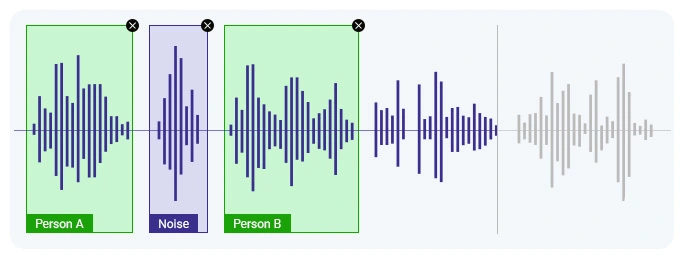
Behind these rapid innovations lies a challenge: converting raw audio into structured, high-quality data that AI systems can reliably understand and learn from. In this blog, we will explore challenges, techniques, and best practices of audio data collection and annotation:-
What Is Audio Data?
Audio data is a digital representation of sound, created by converting analog sound waves (human speech, music, environmental noise, or machine sounds) into numerical signals that computers can store, process, and analyze. This conversion is achieved through sampling, in which sound is captured at regular intervals and converted to a digital format. The common audio file formats are:-
FLAC (Free Lossless Audio Codec): A lossless compression format that helps reduce storage requirements without sacrificing audio fidelity.
MP3 (MPEG Audio Layer III): A compressed format that reduces file size while holding acceptable audio quality for everyday use.
WAV (Waveform Audio File Format): An uncompressed format that preserves high audio quality. It makes the audio useful for AI training, editing, and professional audio processing.
Bottlenecks of Audio Data Collection
Building quality audio introduces multiple challenges around costs, diversity, ethical/legal concerns, and more:
1. Language Diversity Remains One of Audio AI’s Biggest Challenges
Human speech is extraordinarily diverse. Most speech AI systems are trained on a relatively small subset of languages and dialects, even though more than 7,000 languages are spoken worldwide. Several factors can impact model performance, including pronunciation variations, regional accents,, and cultural context.
Recent advances have dramatically expanded multilingual speech recognition. Google’s Universal Speech Model (USM) was trained on data spanning more than 300 languages and supports speech recognition across 100+, while Meta’s multilingual speech initiatives have expanded speech recognition support to beyond 1,000 languages.
Despite this progress, it is hard to collect audio data as many languages lack large-scale annotated speech datasets. Even widely spoken languages often suffer due to insufficient coverage of regional accents, age groups, and speaking styles. As a result, speech models that perform well in controlled environments may degrade significantly when deployed across diverse populations and geographies. AI leaders outsource to leading speech annotation companies for sourcing, collecting, and labeling audio data for speech recognition.
2. Audio Data Collection is Inherently Time-Intensive
Unlike static images, speech data requires more time and effort. Multiple factors, such as speaker age, gender, dialect, speaking rate, accents, emotional state, and recording conditions, impact data quality. Let’s check the scale of modern speech data collection to understand this challenge:-
Mozilla’s Common Voice project required contributions from more than 50,000 speakers to accumulate approximately 2,500 hours of multilingual speech data, demonstrating the effort needed to achieve linguistic diversity and broad demographic coverage. Even relatively focused voice biometric projects can demand substantial timelines.
A speaker-recognition dataset including 150 participants and 3,000 voice samples required 2 months of collection, despite targeting a single regional demographic and yielding only 6 hours of final speech data.
3. Privacy Concerns and Regulatory Barriers
Concerns around surveillance, privacy, and data misuse emerged as biometric authentication expands beyond fingerprints and facial recognition to include voice-based verification. Biometric identifiers are permanent, unlike passwords, and cannot be changed if compromised, making users increasingly wary about sharing such information.
Recent research from the Identity Theft Resource Center (ITRC) found that 87% of respondents were asked to provide a biometric identifier, and 63% have serious concerns about sharing biometric data. For organizations collecting voice and other biometric data, regulatory compliance presents an additional challenge. Biometric data used for the purpose of identification is classified as a special category of personal data under the European Union’s General Data Protection Regulation (GDPR) and is subject to stringent processing requirements. Serious breaches may be subject to a fine of up to €20 million or 4% of the company’s global annual turnover, whichever is higher. These data privacy expectations and regulatory obligations often make participant recruitment, consent management, and large-scale voice data collection services much more complicated than traditional data acquisition initiatives.
4. Significant Storage and Infrastructure Demands
Storage requirements scale rapidly in speech AI projects. According to IBM’s Speech-to-Text documentation, a standard 16 kHz, 16-bit mono WAV recording consumes approximately 1.92 MB, while higher-fidelity recordings and multi-channel audio can require substantially more storage. When datasets expand to tens or hundreds of thousands of hours, as seen in modern speech foundation models, the costs associated with storage, transfer, processing, and management become a major infrastructure challenge.
Audio Data Collection Challenges Are Only Part of the Problem
While language diversity, privacy regulations, and infrastructure costs make speech data collection difficult, there are many other challenges to address. Modern AI systems require much more than speech recordings. They must understand context, intent, emotion, behavior, and interaction. As a result, organizations are shifting their focus from collecting audio to extracting intelligence from it. This transition is fundamentally changing how audio datasets are designed, annotated, and managed.
Why is Audio Data Collection a Human Behavior Problem?
Human speech is inherently dynamic. A person’s voice may change based on emotional state, health conditions, fatigue, social context, the quality of the recording device, and surrounding environmental noise.
Now multiply those variations across:
Languages
Dialects
Regional accents
Age groups
Occupations
Socioeconomic backgrounds
This complexity explains why many speech models perform well in controlled testing environments but struggle when deployed in real-world settings.
The problem is often not the dataset size. It is dataset diversity.
The Speech AI Industry has solved speech recognition; it is yet to solve Audio Intelligence
Many organizations assume audio AI begins and ends with Automatic Speech Recognition (ASR). They need to update this assumption as modern AI systems must understand far more than words. When a customer contacts a support center, a voice agent must identify:
What is being said
Who is speaking
Why are they calling
Whether escalation is required
Whether they are frustrated
Whether they are likely to churn
Whether the conversation violates policy
The same audio stream now serves multiple AI models simultaneously. A healthcare assistant may analyze speech patterns for neurological disorders. A robotics platform may use voice commands to coordinate actions. An autonomous system may combine audio, vision, and sensor streams to improve situational awareness. In all these cases, speech recognition becomes merely the first layer of a much larger intelligence stack.
The Importance of Audio Data Annotation for Model Performance
Gathering audio is a tentative first step. Raw recordings are meaningless until they are structured and made machine-readable. Audio data annotation services supply the contextual cues that enable AI systems to understand not just what was said, but also who said it, how it was said, and what was happening in their surrounding environment.
Transcription and audio annotation are related, but they play different roles in the AI data pipeline. Before diving into the different types of audio annotation, it’s worth understanding how the two differ.
Audio Data Transcription Vs Audio Data Annotation
Audio Transcription
Audio Annotation
Converts spoken content from an audio recording into written text.
Enriches audio recordings with labels, tags, and metadata that help AI systems understand and interpret sounds.
Emphasizes capturing spoken words through speech-to-text conversion.
Focuses on identifying and audio data labeling elements such as speakers, emotions, intents, sound events, accents, and acoustic conditions.
Output is a text transcript that represents the spoken conversation or narration.
Output is a structured dataset containing annotations, timestamps, classifications, and contextual labels.
Primarily used for subtitles, meeting notes, customer call records, legal documentation, and content accessibility.
Primarily used for training and improving speech recognition, conversational AI, voice assistants, sentiment analysis, and sound detection models.
Useful for human readability and searchability of audio content.
Essential for machine learning models that need contextual understanding and decision-making capabilities.
Types of Audio Data Annotation
Speech TranscriptionConverts spoken language into written text, forming the foundation of speech recognition systems, voice assistants, and conversational AI.
Sound Event AnnotationLabels environmental sounds such as alarms, footsteps, traffic noise, machinery sounds, and animal vocalizations.
Speaker Identification and DiarizationDistinguishes between multiple speakers and determines when each person is speaking.
Emotion and Sentiment AnnotationCaptures emotional states such as happiness, frustration, anger, excitement, or neutrality.
Phonetic and Pronunciation AnnotationSpot pronunciation patterns, variations in accent, and linguistic nuances.
Intent and Entity AnnotationHelps AI understand user objectives and retrieve meaningful information from conversations.
The Rise of Multimodal AI Is Redefining Audio Collection Requirements
Traditional speech datasets were primarily designed for automatic speech recognition (ASR), which converts spoken language into text. In these systems, audio was often collected and processed as a standalone modality. AI systems have evolved to include large multimodal models and embodied AI applications that understand the world through multiple streams of information simultaneously, much like humans do. Rather than relying solely on speech, these systems combine:
Audio
Video
Text
Environmental signals
This shift is redefining how audio data is collected, annotated, and used for training AI models. For example, a collaborative robot is operating in a warehouse. If a worker says, “Place that box over there,” the spoken command alone may not provide enough information for the robot to act correctly. The system must also determine:
Who issued the command
Which object is the speaker referring to
Where the speaker is located
What gestures or body movements accompany the instruction
Whether nearby obstacles or safety risks are present
To understand the entire context, the AI must process synchronized audio, video, and sensor data instead of isolated speech recordings.
Why Human-in-the-Loop Remains Critical?
Many organizations assume that large language models will eliminate the need for human annotation.
The opposite is happening.
As models become more capable, evaluation requirements become more sophisticated.
As speech AI systems become more advanced, human expertise persists, essential for ensuring accuracy, reliability, and trust. While AI can automate many tasks, it frequently struggles with ambiguity, cultural nuances, and context-dependent decisions. Human reviewers play a key role in:
Accent and dialect validation boosts performance for different speakers.
Intent verification to make sure the AI understands user requests accurately.
Emotion labeling helps in accurate capturing of sentiment and behavioural cues.
Safety & compliance assessment to find harmful, sensitive, or policy-violating content.
Reinforcement Learning from Human Feedback (RLHF) to improve model behavior and align outputs with human expectations.
This is particularly important for voice agents, healthcare AI, financial systems, and agentic AI applications where errors carry significant consequences.
The future is not humans versus automation. It is human-guided automation.
Building Scalable Audio Data Pipelines
AI leaders are putting in place specific strategies to deal with audio data issues at scale.
1. Supporting multiple audio sourcesData collection with consent and global contributor networks and programs help increase dataset diversity.
2.Upgrading Synthetic DataSynthetic speech can complement real-life data and improve coverage for underrepresented scenarios.
3. Privacy First Data CollectionConsent management, anonymization, governance frameworks and data minimization practices help ensure compliance and trust.
Audio Data Quality is Becoming an Enterprise Capability
Traditionally, organizations treated audio annotation as a project.
Today, leading AI companies increasingly view audio quality as infrastructure.
Building reliable AI systems requires continuous processes for:
Collection
Validation
Monitoring
Retraining
Drift detection
Dataset governance
The organizations that gain sustainable competitive advantage are not necessarily training larger models.
They are building better data systems.
Conclusion
Between humans and AI, voice is rapidly becoming the primary interface. As AI systems evolve from speech recognition tools into multimodal and dialog-based agents, the quality of audio data will increasingly determine model effectiveness. Organizations that invest in diversified data collection, expert annotation, and scalable data infrastructure will be more likely to build AI systems that understand not only language but also intent, behavior, and context.
The post Audio Data Collection and Annotation: Challenges, Techniques, and Best Practices appeared first on Cogitotech.