
Introduction
As large language models move from proof-of-concept into production systems that touch real users, real money, and real decisions, the industry has been crying out for structured, actionable guidance on how to test them responsibly. IMDA’s Starter Kit for Testing LLM-Based Applications is a meaningful answer to that call. It arrives at exactly the right moment when enterprises are racing to deploy AI but lack standardized safety guardrails.
This post breaks down what the kit gets right, where it can grow further, and how practitioners can use it as a springboard for building truly robust AI testing pipelines.
What the Kit Gets Right
1. Naming the Right Risks
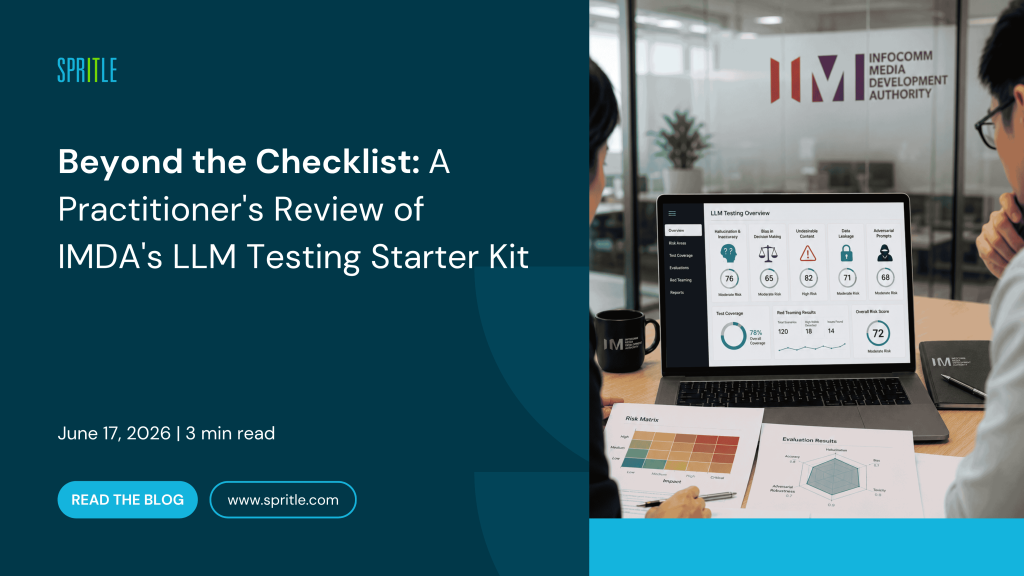
The five risk categories represent a clear-eyed reading of the most common failure modes seen in production LLM deployments today. Rather than burying practitioners in abstract threat taxonomies, these categories map directly to incidents that have actually caused reputational and operational damage in real organizations:
Hallucination
Bias
Undesirable Content
Data Leakage
Adversarial Prompts
Naming risks in plain language lowers the barrier for non-ML teams (legal, compliance, product) to engage meaningfully in AI safety conversations which is where governance work gets done in practice.
2. Voluntary-but-Codified Positioning
Positioning the kit as ‘voluntary-but-codified’ is strategically sound rigid mandates often produce checkbox compliance rather than genuine safety culture.
By making the kit a recommended baseline rather than a hard regulation, IMDA creates space for organizations to adapt the framework to their context while still having a credible reference standard for audits, vendor evaluations, or board-level AI governance reviews.
For fintech, health tech, and other regulated industries, this makes the kit immediately actionable as an artifact for vendor due diligence.
3. The CREX Case Study
Including a real-world case study (CREX) ground the framework in lived experience rather than theoretical ideals. Key takeaways from the CREX case study:
Trust, reliability, and governance cannot be treated as afterthoughts once AI moves into production.
Hard-won lessons from retrofitting safety into deployed systems are encoded throughout the framework.
This evidence makes the kit far more persuasive to engineering leaders who need to justify investment in testing infrastructure.
4. Organizational Responsiveness as a First-Class Concern
The emphasis on organizational responsiveness not just tooling is one of the most sophisticated insights in the kit.
Many testing frameworks focus exclusively on what to measure, ignoring the organizational muscle needed to act on findings.
The requirement to ‘coordinate faster’ and ‘reduce execution friction’ as threat velocity increases reflects a mature understanding that AI safety is an operational discipline, not just a technical one.
Improvement Suggestions
1. Severity Scoring and Prioritization Guidance
The current five-category taxonomy is excellent for awareness, but practitioners quickly face a prioritization problem: all five risk areas cannot receive equal investment simultaneously.
A lightweight risk severity matrix helping teams decide whether hallucination is more dangerous than data leakage in a given context would make the kit significantly more actionable.
Even a simple 2×2 (likelihood × impact) framework per risk category would help teams triage effectively.
2. Metric Definitions and Thresholds
The kit identifies what to test but is light on how to measure it and what constitutes passing.
Publishing reference metric definitions even as optional starting points would accelerate adoption, especially for teams without dedicated ML safety researchers.
Questions like ‘what hallucination rate is acceptable for a medical advice bot?’ need an anchor reference thresholds would provide that.
3. Tool-Specific Implementation Guides
The kit is appropriately tool-agnostic at the framework level, but practitioners need a bridge between principle and practice.
A companion section mapping each risk category to specific open-source or commercial tools such as DeepEval, Giskard, PromptFoo, LangSmith, or Ragas would dramatically reduce the ‘now what?’ problem teams face after reading the framework.
4. LLM-in-the-Loop Evaluation
Testing LLMs using human evaluators alone is slow and expensive.
The kit would benefit from guidance on LLM-as-a-judge patterns using a separate model to evaluate outputs at scale.
Known failure modes such as position bias and self-preference bias in same-family models should also be documented, as LLM-as-a-judge is now a standard technique in the field.
5. Continuous / Online Evaluation
The kit frames testing largely as a pre-deployment activity, but in production, LLM behavior drifts model updates from providers, shifting user input distributions, and prompt injection attempts evolve continuously.
A section on continuous evaluation is needed, covering: monitoring real traffic, triggering re-evaluation on model version bumps, and integrating safety checks into CI/CD pipelines.
This would complete the full evaluation lifecycle picture from pre-deployment testing through ongoing production monitoring.
6. Sector-Specific Annexes
The current framing is enterprise-generic, but regulated sectors financial services, healthcare, and public sector each have distinct threat models that warrant tailored guidance.
A sector-specific annex (even one page per sector) listing the top risks and recommended minimum test coverage would dramatically improve adoption in exactly the high-stakes contexts where this kit matters most.
7. Community Contribution and Living Document Cadence
The AI safety landscape moves fast publishing the kit as a static document risks it becoming dated within 12–18 months.
A public GitHub repository with a community contribution model would keep the material current and build a practitioner community around it.
A versioned release cadence (even annually) would significantly amplify IMDA’s impact over time.
Putting It Into Practice Today
For teams that want to adopt the kit’s spirit right now, the table below offers a minimal starting checklist mapped to each risk category:
Start with the risk categories most relevant to your deployment context not all five need equal investment from day one.
Closing Thoughts
IMDA’s Starter Kit represents exactly the kind of institutionally credible, practically grounded guidance the industry needs to move AI governance from aspiration to action. Its strengths — clear risk taxonomy, organizational focus, and real-world grounding — make it a genuine contribution to the field.
The organizations that will win in the AI era will not just be those that deploy fastest — they will be those that deploy most trustworthily.
The suggested improvements are not criticisms but invitations: this is a foundation worth building on. The organizations that will win in the AI era will not just be those that deploy fastest — they will be those that deploy most trustworthily. This kit is a meaningful step toward making that easier.
The post Beyond the Checklist: A Practitioner’s Review of IMDA’s LLM Testing Starter Kit appeared first on Spritle software.