
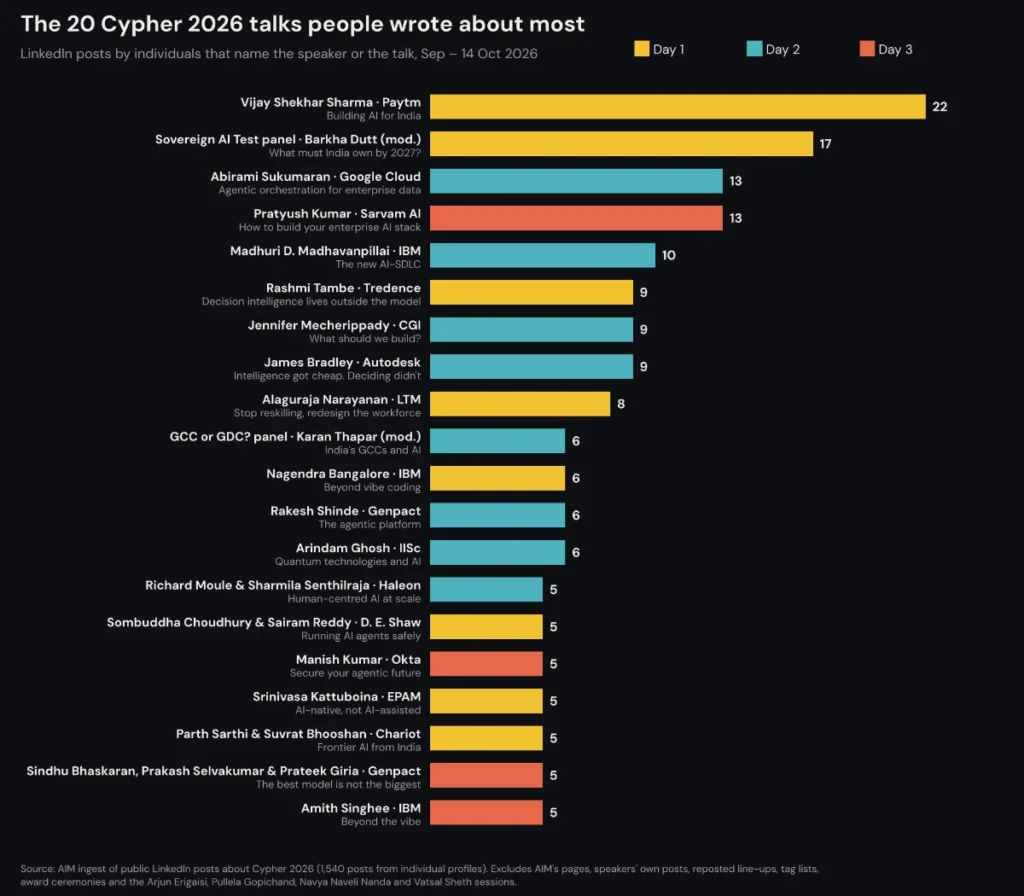
Ten days after Cypher 2026 wrapped up at KTPO, one useful way to review the programme is to look at what attendees chose to write about themselves. We collected every public LinkedIn post about the event and retained the 1,540 written by individuals. AIM’s own pages, company pages and posts by speakers about their own sessions were left out. We then counted how many of those posts explicitly named a speaker or a talk in the author’s own words. Reposted line-ups and long tag lists at the foot of a post did not count.
The result measures recall: which ideas people carried out of the hall and considered worth putting their names to.
We also set aside four sessions that would have dominated on star power alone. Arjun Erigaisi (22 posts), Pullela Gopichand (19), Navya Naveli Nanda (14) and Vatsal Sheth (7) drew attendees who wanted a photograph as much as an argument. The award ceremonies are excluded too. What remains is a ranking of the arguments that travelled.
India Should Build, and the Room Agreed
Paytm CEO Vijay Shekhar Sharma’s Day 1 keynote, Building AI for India, was named in 22 posts, five more than anything else on the list. The line attendees repeated most was his: “We should be the LLM capital of the world.” Several picked up the money behind it. He said he would write personal cheques of ₹1–2 crore to Indians building their own models, and put the cost of building one at under $100 million. One attendee called it “the goosebumps session”. Another distilled the message into a question: why is India always the use-case capital?
In second place was the session that put this ambition to the test. The Sovereign AI Test, moderated by journalist Barkha Dutt, asked what India must own by 2027 and what it can rent, and was named in 17 posts. The four panellists left four distinct takeaways. Srinivas Chamarthy of Diligent put cybersecurity inside the sovereignty conversation. Saurabh Jha of Tech Mahindra argued for Indian-language models and compute choices. Sriram Raghavan of IBM defined sovereignty as control and freedom of choice. RaviKiran S Avvaru of Sundaram Clayton wanted domain expertise to lead AI decisions. More than one attendee remembered that it opened on Bengaluru traffic, used as an example of a problem that is really about infrastructure.
Pratyush Kumar of Sarvam AI closed the trilogy on Day 3 and tied for third with 13 posts. The example people quoted was among the most concrete of the event. Sarvam built a four-billion-parameter OCR model to digitise Odisha’s land records. Starting at close to 30% accuracy on documents that defeat off-the-shelf OCR systems, it improved as government staff corrected its outputs and those corrections fed back into training.
Kumar’s framing of the global AI race also resonated. The US has capital to risk, China has a government that can streamline efforts, and India has a population that should adopt AI and deliver it to the world.
The Enterprise Track Had One Idea, Expressed in Several Ways
Abirami Sukumaran of Google Cloud shared third place with 13 posts for a session on agentic orchestration over enterprise data. Attendees took away agent memory, breaking down data silos and bringing AI closer to where the data lives, and several noted the hands-on detail she went into afterwards. Behind her sits a cluster of talks that attendees kept connecting to one another. Madhuri D Madhavanpillai of IBM (10 posts) described an AI-SDLC built to “modernise everything that can be improved while preserving everything the customer must continue to trust”. Rashmi Tambe of Tredence (9) argued that decision intelligence lives outside the model. Jennifer Mecherippady of CGI (9) asked what we should build once AI can build almost anything. James Bradley of Autodesk (9) gave the cluster its sharpest title: Intelligence Got Cheap. Deciding Didn’t.
Attendees wrote these up as one argument. One summarised Tambe as “the model is a commodity; the context you feed it is the moat”. Another compressed Mecherippady into three lines: model capability is rented, context is accumulated, decision authority is owned. A third grouped Rakesh Shinde of Genpact, Mecherippady, Madhavanpillai and Bradley under a single sentence: AI is constrained by our ability to apply intelligence safely and consistently at scale.
Where It Happened
Fourteen of the 20 talks were on the main stage in Hall 1, and seven came from a single run there on Day 2, between Shinde’s 10:00 opener and the 13:00 ‘GCC or GDC?’ panel moderated by journalist Karan Thapar. That morning held Shinde, Mecherippady, Madhavanpillai, Sukumaran, Haleon’s Richard Moule and Sharmila Senthilraja on human-centred AI, Bradley, and the GCC panel. Days 1 and 2 placed eight talks each in the top 20, and Day 3 placed four.
The halls away from the main stage still produced talks that attendees sought out. Arindam Ghosh of IISc drew six posts from Hall 3 with a session on quantum technologies and AI; the number people repeated was roughly 1,000 logical qubits to break RSA, with a window of 2030 to 2035. From Hall 2, Alaguraja Narayanan of LTM (8 posts) argued for redesigning work around AI fluency in place of reskilling, and DE Shaw’s Sombuddha Choudhury and Sairam Reddy Kanikireddy (5) made the case that production agents need identities, secure execution and credential controls.
What The List Tells the Next Edition
Three things stand out. Specific stories travel further than frameworks: people quoted the Odisha land records, the ₹1–2 crore cheque, and the 1,000-qubit threshold almost word for word, while broader talks were remembered only by title and name. Titles do work: Intelligence Got Cheap. Deciding Didn’t and The Sovereign AI Test were reproduced in full by people who had no reason to promote them. And the main stage’s Day 2 morning shows the value of programming a coherent sequence, because attendees who sat through it wrote it up as a single narrative.
The full top 20 is in the chart above. Ruchika Panesar of NatWest Group, Kunal Das of Cast AI, Karthik Ragunathan of Tredence, Abhishek Upperwal of Soket AI Labs, Saurabh Jha’s Unsettled keynote and Ambarish Kenghe of Angel One each finished one post short, with four.